

This is the second of two articles on the Otter Trail Challenge. Part one deals with how a wobbly road runner so to the start line. Part two deals with the race itself.
The Otter Trail is South Africa’s most famous hiking trail and the Garden Route National Park, where it is located, is the third biggest public tourist attraction in South Africa in terms of number of visitors (after the Kruger National Park and Table Mountain). The Otter Trail is within an exclusive area of the national park and entrance into the park is throttled at just 12 people per day who are allowed to start the hike which is completed over 5 days and 4 nights.

Once a year they get rid of the hikers and allow 300 people to run the trail in a day on the Thursday for the more recreational Challenge and another 300 on the Saturday for the much more competitive Race. I was one of the fortunate few who got an entry for the Thursday Challenge trail run (courtesy of title sponsors EasyEquities) which must be completed in under 11 hours over incredibly technical terrain to earn a finish.
I had left my accommodation booking late and therefore stayed in Plettenberg Bay which is about 40 minutes away from the race village in Nature’s Valley which also marks the finish line. There is an EasyTransfers shuttle service, also sponsored by EasyEquities, which makes getting around a breeze and keeps the race venue traffic free. They also provide transport from the finish to the start on race morning.
A 4:45am departure with a and a 40 minute drive to get there meant a very early wake up. It had rained quite heavily overnight and there was still plenty of drizzle which occasionally escalated to proper rain on the drive through to Storms River Mouth. I made sure that I finished my standard pre-marathon breakfast of peanut butter sandwiches on the drive through so that they did not get soggy once outdoors.
However, this precaution was unnecessary. Perfectly on cue, as we pulled into the parking lot, the clouds cleared and we got a spectacular sunrise over the Indian Ocean. Runners get a complimentary coffee from Vida who had kindly moved their mobile kiosk from the race village to the start for us and I grabbed a cappuccino and joined the toilet queue to ensure that I did not leave anything more than footprints on the trails.
The 24 fastest men and 16 fastest women from the previous day’s 4.5km Prologue time trial set off at 6am in a special “Abangeni” grouping to much fanfare from their fellow runners and entourage of supporters. You need to make sure you soak up and store up all the clapping and encouragement at the start as there is no supporter access whatsoever along the route.

The Abangeni group got a 5 minute head start from the masses, after which 10 runners are released onto the trail every 30 seconds like clockwork. This ensures that there is not too much congestion over the early stages of the race. My relaxed Prologue escapade placed me toward the back of the field in V batch with a 6:15:30 start.
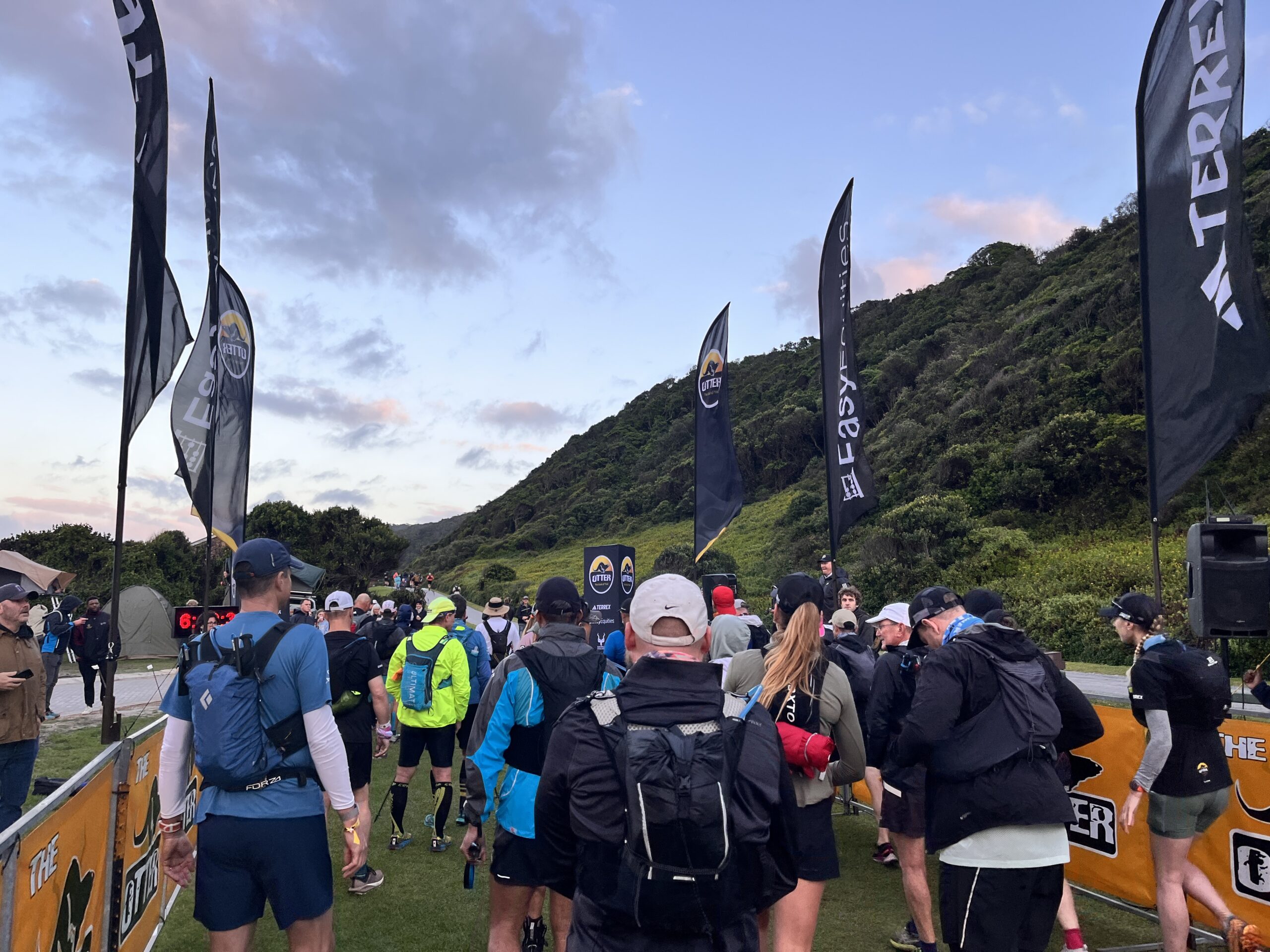
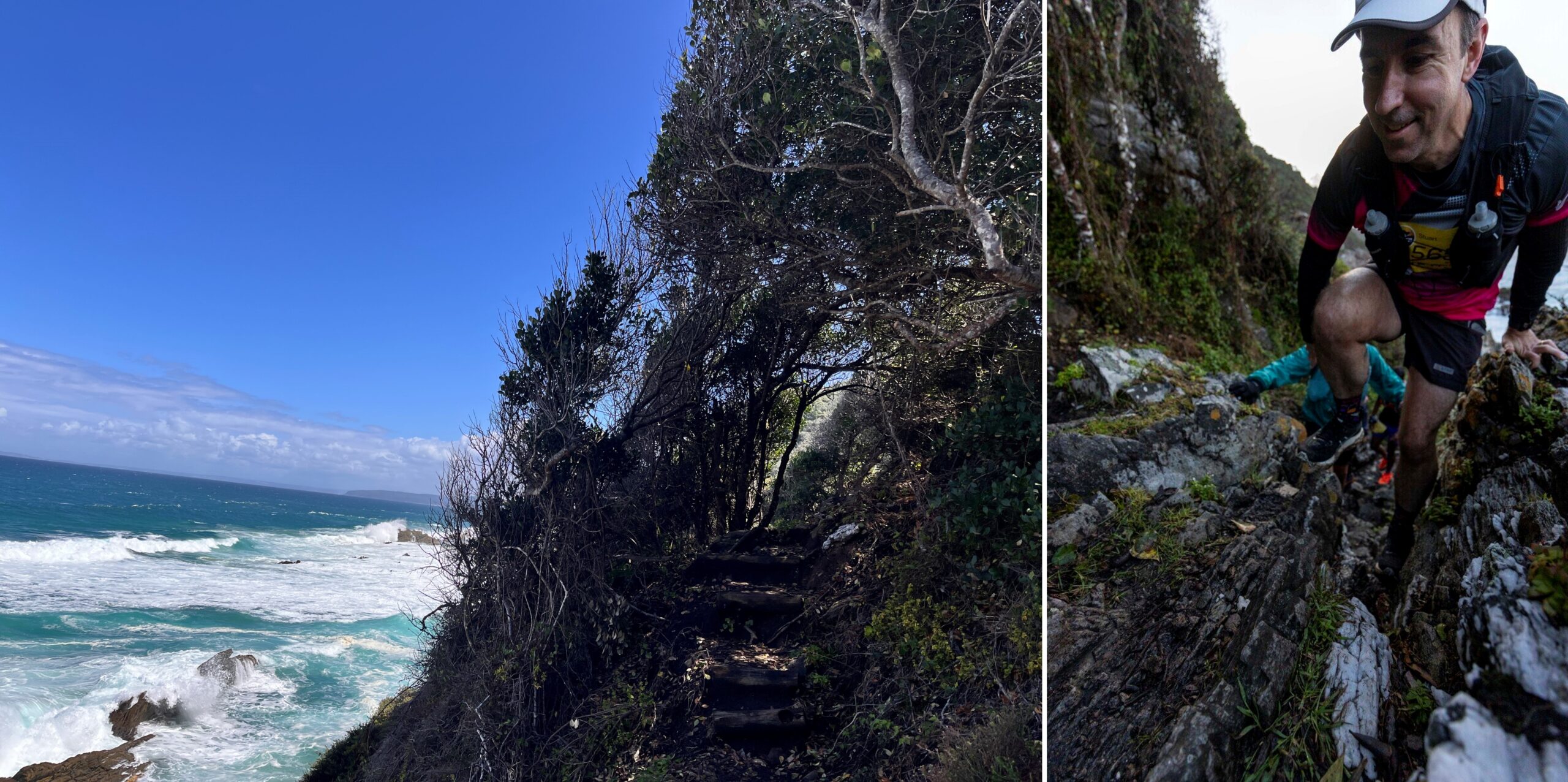
The start is on tar and I wondered how long it would be until the technical trail started. I did not have to wait long. Before the first drop of sweat had formed we were onto rocky boulder hopping terrain with the waves from an angry ocean crashing alongside us.

I was always going to walk this section and was reassured that this was the correct decision as I tried not to slip on the fresh trail of blood from someone in front who had flown too fast and Icarussed onto the rocks.

My race plan was very simple, run what is runnable and walk everything else. One of the questions my fellow road runners might ask is just how different is trail to road running? To answer this question one must consider that there is offroad trail running and technical trail running, the latter of which more broadly translates into hiking with short sporadic bursts of light jogging (unless you are blessed with mountain goat skills far exceeding my own).

In my early days of running I did the three Mont Aux Sources and a Rhodes trail race. These seemed to be a rite of passage for all road runners to tick off and add to their running CVs. They are both 50kms, mostly runnable and no one raises their eyebrows if you decide to tackle them in normal running shoes. I also don’t remember them being particularly difficult to complete. The Otter is a completely different prospect.
Nearly everything is technical, there is nowhere along the route where you can knock off any easy kilometres and when you tell people that you are wearing road shoes that look at you like you are a special kind stupid rather than brave. For a flat footed road runner with stability issues like myself, on this terrain there really is just one choice: walk or die. As I have survived to write this article you can decipher that I made the sensible choice and picked the former. Of course you try to walk (or hike) as fast as possible – and anything runnable you need to run, no matter how slowly or short the runnable section, if you want to make the cutoff.
Trail runners profess to love getting into nature and being away from technology and traffic. Ironically, the best way I can explain running (used in the loosest possible connotation of the word) the Otter is that it’s like being stuck in bumper to bumper traffic. You crawl along for many painful minutes at a time and then suddenly space opens up in front of you and you can turn on the gas – only to slam on the brakes again a short while later and resume the laborious crawl.
Another metaphor to aptly describe how to ‘run’ the Otter is my wife’s TV watching habits. In the evening, she will watch her shows until I am ‘ready’. As soon as I am ready and present myself in the lounge, she pauses her show and looks at me expectantly. I almost always then remember that I need to do or get something (usually a beer). “I’ll just be 10 seconds” I say and duly return (usually with a fresh beer) in 10 seconds or less as promised. During that time she unpauses her show and gets in 10 seconds of viewing time.
In the past I have always thought, “Were those 10 seconds really worth it?” (I’ve been married long enough to know not to say that out loud). However, now I get her point. The Otter is like trying to watch an entire Netflix series on super slo-mo with 10 seconds of regular speed viewing thrown in every few minutes. Pause, play, pause, play, pause, play… and repeat ad infinitum. Without those 10 seconds of regular speed viewing every time your husband remembers he needs another beer and you will never get to the end of the show.
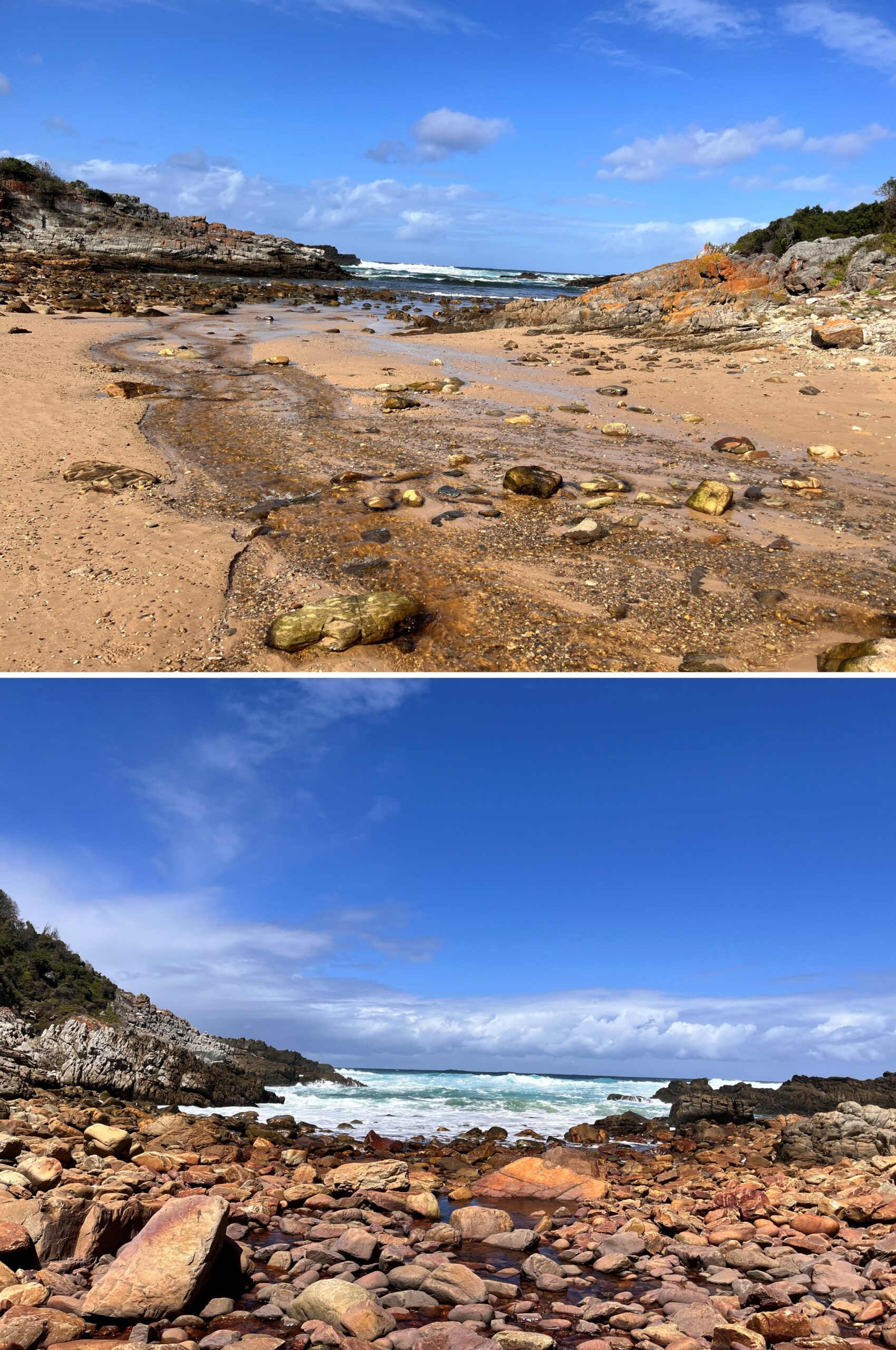
Whilst on the subject of Netflix, the Otter does provide some mesmerising streaming services. There are 11 official rivers to cross, most of which are of the charming babbling brook type and provide the opportunity to refill your water bottles between the taps at the Otter Trail’s overnight huts.

The severity of the major river crossings is heavily dependent on the tides and recent rainfall. Low tide and you might escape with a light ankle tap but face a torrent at high tide. The most fearsome of the crossings is the Bloukrans but we’ll get to that later. Crossing the Elandsbos at around 16km was the first time where it was mandatory to get your feet wet. As you can see from the video clip below, there are different approaches ranging from extreme caution to puppy dog-like reckless abandon when it comes to crossing the river.
Before your shoes have had a chance to dry you emerge from another heinous downhill through the forest to the serene sight of the Lottering River just before halfway. You need to be self-supported for the entirety of the race except for the marvellously stocked Munchie Point on the far side of the river.

This was a true fridge over troubled waters and I relished the chance to replenish my supplies. I must have spent a good 15 minutes loitering along the Lottering River and gorging myself on the food and snacks. The fact that another steep hill was to follow assisted in my procrastination.
If you want to prime yourself for the Otter you should know that there are 11 major climbs to go with the 11 river crossings. I generally “remember” to stop and take a video when I am hyperventilating and need to drop my heart rate below 200 (which happened on several occasions). In road running the bravado statement is, “I’ve never come across a hill that I cannot walk”. The trail equivalent is, “I’ve never come across a hill that I cannot clamber.” There were a couple of cliff climb ascents where I quite literally went feral, entered into four wheel drive mode and clambered upwards with all limbs touching the ground in an effort to get up the next step.
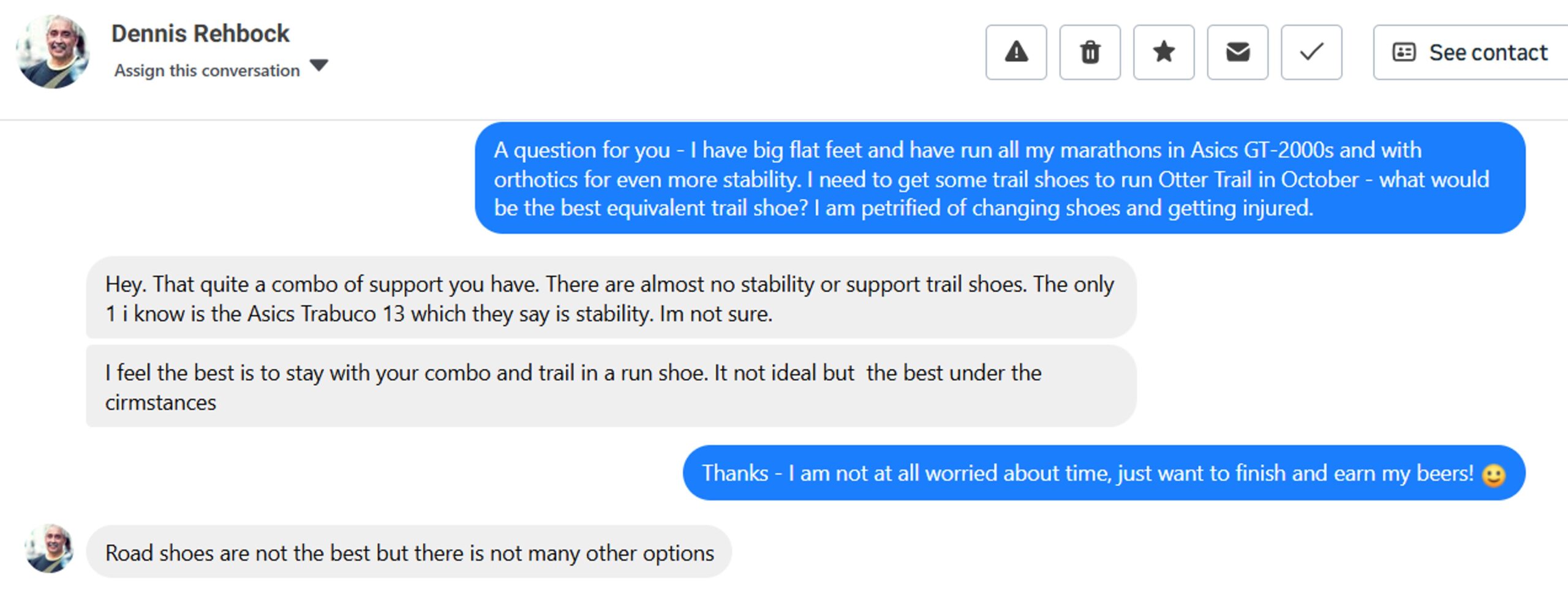
I was obviously not assisted in my travails with my choice of footwear. In my defence, my Asics GT-2000s have successfully got me through 286 marathons (5 of which could be classified as “trail”). I have the kind of feet that an orthopod looks at and says, “You shouldn’t be running” whilst gleefully thinking, “Your future surgeries will pay for my next sportscar!” My feet are big (US size 12 on a small frame) and completely flat. I am genetically engineered to be a barefoot waterskier. A giant 700g piece of rump steak is about the same size and has higher arches. I run in stability shoes with orthotics. Anything less and I get compartment syndrome from rolling.

In my defence, I did consult with world renowned podiatrist Dennis Rehbock whose expert advice was to stick with my road shoes (proof provided below). I also mitigated the risk as much as possible by wearing a brand new pair of shoes so that I would have maximum tread.
However, wearing road shoes at the Otter did leave me feeling like I’d brought a knife to a gunfight. As a very occasional trail runner, I was already dealing with severe imposter syndrome over one of the most technical long distance trail events in the country. Therefore, I was quite relieved to sink into gelatinous sludge on several occasions and emerge with a thick, muddy mask to hide my road shoes.

My shoes did not stay muddy for long with the frequent river crossings and the mighty Bloukrans gave them a deep cleanse with about 11km to go. The Bloukrans is met towards the end of day four on the hike and is described as being, “the heart of the Otter experience”. It is also famous for having the highest commercial bungee jump that one can do from a bridge a short distance upriver.
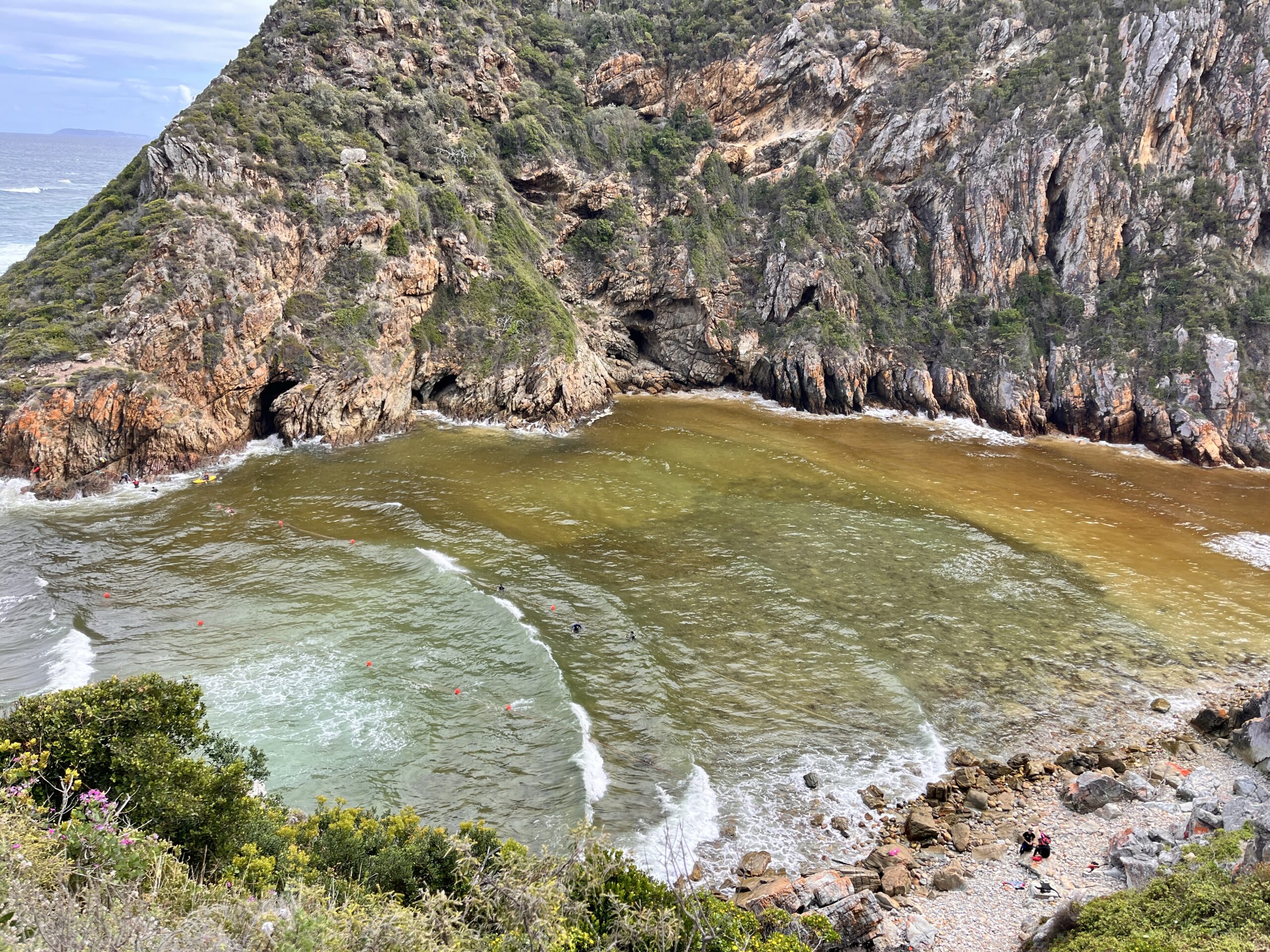
When the hikers start their trek, they are given a tidal chart by a ranger with the recommended Bloukrans crossing time window highlighted. This is a narrow period, at most 60 minutes either side of low tide, when the river is at its most docile. A stern sign overlooking the river warns, “Under no circumstances should you attempt to cross the river more than 1 hour before or 1 hour after low tide”.

Of course my slovenly pace was perfectly timed to arrive in the perfect storm window of 30 minutes to high tide. At the bottom of the gorge, I took my time to double Ziplock-bag my phone and pack away my sunglasses and cap so that they did not get swept away. There is a rope to hold onto and some lifesavers and paddleskiers to catch anyone who got swept away. The first few steps were rocky and slippery but it was soon deep enough that I could no longer touch the bottom.
As for my bottom, it was parallel to the riverbed, such was the strength of the current. This was fortunate because, had I been able to stand, there is no doubt I would have been on the receiving end of a saltwater enema. As it was, there was a relentless barrage of 1.2m waves crashing over my head resulting in me taking in a fair amount of saltwater through various other orifices.
Bedraggled but alive, I gratefully received the helping hand of the volunteer on the other side to get back onto solid ground. If you want the full Otter experience, I would highly recommend timing your run for a high tide Bloukrans crossing. Anything less and you are cheating yourself.
I am not sure whether it was fatigue or the sudden intake of large amounts of seawater but what followed were two major failures of logic.
The Otter Trail Challenge flips directions every year (and is known as the Retto when done in reverse). This year was the classic Otter direction from Storms River Mouth to Nature’s Valley. Consensus is that this is the tougher routing and means that you get going with a very rocky start but have a much easier finish. The course record times agree with this opinion, the Retto time (Bartlomiej Przedwojewski 3:40:48) being about 20 minutes faster than the Otter time (Marc Lauenstein 3:59:29).
I was certain that I had read that the route flattened out and is a lot more runnable after crossing the Bloukrans. The minutes turned into hours as I expectantly kept looking for something runnable as we alternated between climbing sheer cliff faces and tentatively treading on pebbles which provide the equivalent effect of running on Lego and marbles at the same time.

My second failure of logic was that my math stopped mathing. When I’d chatted to race organiser and CEO of Faces, Clark Gardener, after the final race briefing he joked, “Just don’t get caught in my cutoffs.” The Challenge cutoffs are very generous (and you would be incredibly unlikely to finish under 11 hours if you did miss one) but I replied that I’d “already written more about cutoffs in one lifetime that anyone should have – and plan to stay well clear of them.”
Somehow, I managed to calculate that I had one hour less to finish than I actually had left and the longer the pedantically slow, unrunnable terrain unfolded in front of me, the more concerned I became that I was heading for a dreaded DNF. Fortunately, my brain rebooted and I realised that I had an extra hour and therefore plenty of time to appreciate the views and stop and smell the fynbos.
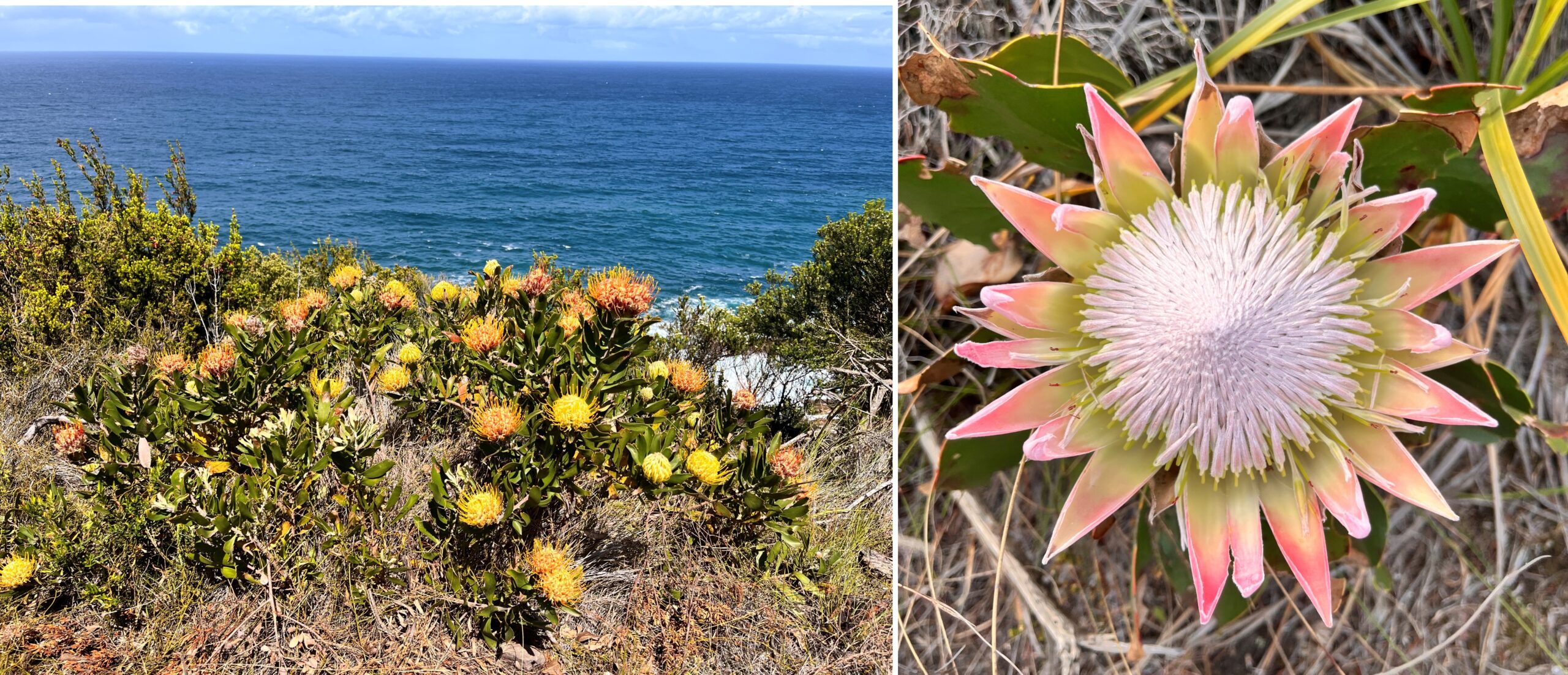
The fynbos are fantastic but the truly lucky get to see an actual otter on the Otter Trail. I have not heard of anyone on the Challenge or Race seeing one ‘in competition’ but there were plenty around and the evidence is below from the day before and morning of the Challenge (both clips supplied).
Also elusive is the Knysna Loerie (now called a Turaco but hey, I’m old school) which is incredibly difficult to spot unless it exposes its red wing tips in flight. Sightings of dolphins and whales are much more common but we had an angry ocean with rough seas which makes large sea animals much harder to see. I did get to startle a blue duiker as I came around a corner on one of my sporadic forays into running.
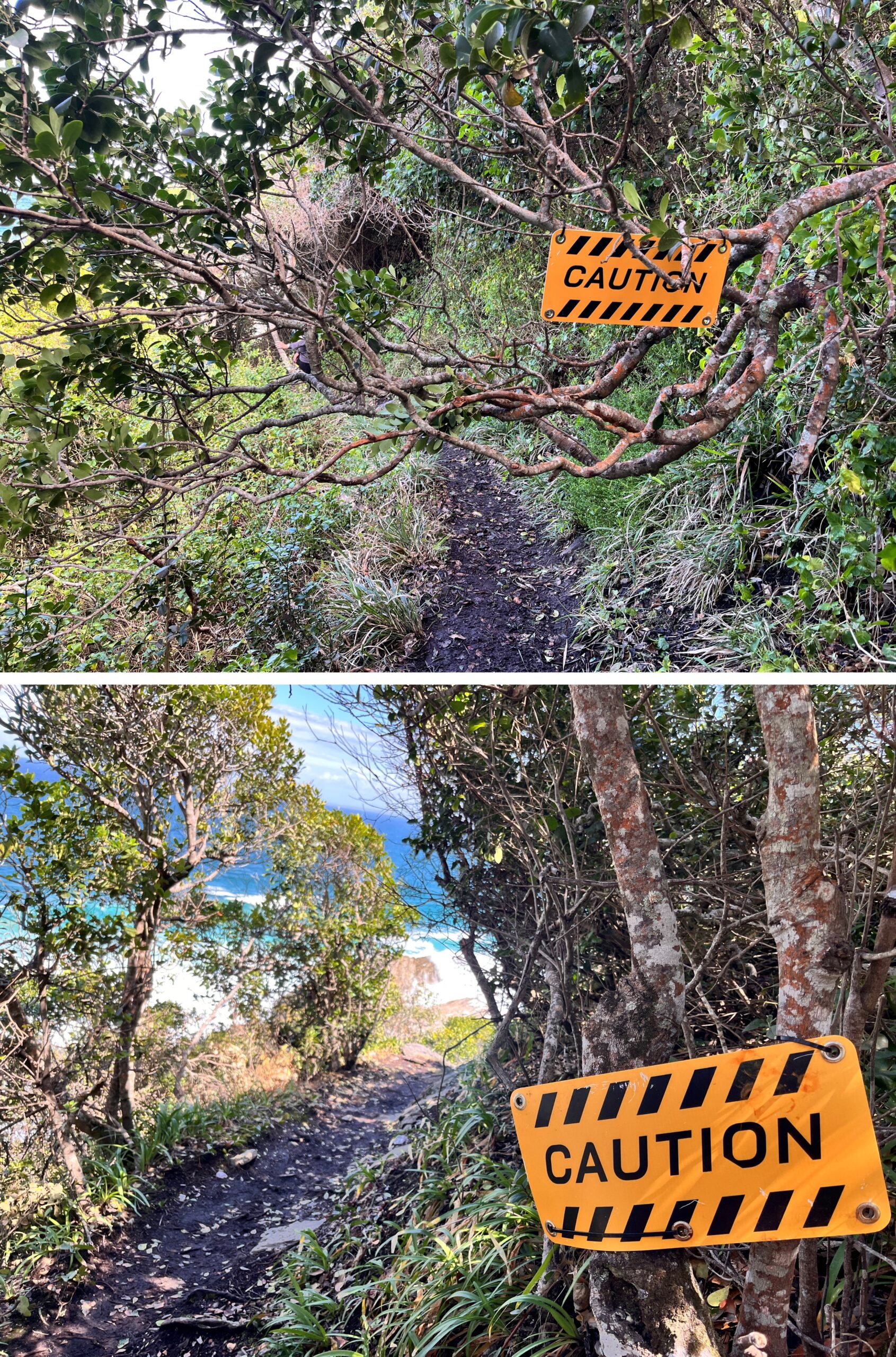
Whilst the odds were stacked against me, in my favour was that the route markings were impeccable. I can get lost on out-and-back routes (and recently did in Hillcrest) but Pierre Jordaan and his safety team did such a fantastic job with the yellow ribbon route markings that I did not stray from the road less travelled once. On the other hand, these “Caution” signs below were redundant for me as I was taking baby steps the whole way.
I had made a bit of a rookie mistake not filling up my water bottles in the streams before Bloukrans as they seemed to disappear from the route when I needed them most. I was therefore very thankful to arrive at Andre hut and took my time to rehydrate and socialise with the other weary travellers who were doing the same. My watch was also about to die so I switched over to using Strava on my phone.
The race bibs have the route profile and distances between the huts and landmarks. According to this, there was exactly 8.8km left to get back to the race village in Nature’s Valley. Leaving Andre hut meant tackling the last of the 11 significant climbs. As you can hear from the video below, it was tough going.
However, nobody talks about the insignificant climbs of which there were plenty done and plenty still to come. In trail lingo, the race has over 2,400 metres of ‘vert’. To put things in perspective, this is 800m more than Sani Stagger and 400m more than the Comrades Up run over what is a standard marathon distance give or take a few hundred metres (I ended up with 42.8km).
There was some reasonably runnable track at the top of the last summit, broken with some tolerably walkable uphills. I was counting down the kilometres when suddenly the breathtaking view of Nature’s Valley Beach appeared.
You can hear the excitement in my voice in the video above knowing that, whilst the end was not quite in sight, it was very near. However, a nasty surprise was in store at the bottom – soft sea sand which is the mortal enemy of tired legs and aching ankles. What I thought and hoped was going to be 2 kilometres home turned into 2.8 kilometres but, once off the beach, I finally found the first easily runnable section of the route and trotted home.

There is one final piece of spectacularness left in the race. After a quick wade through the lagoon you launch yourself onto a temporary constructed bridge which is bouncy underfoot and every finisher is warmly (and loudly) welcomed home by Robert Le Brun to finish under the yellow and black Otter Trail hexagon. Carel Nolte from EasyEquities was on hand to place the impressive medal (also a hexagon) around my neck.

Before tucking into the buffet lunch and complimentary Jack Black beer, you need to pass a compulsory gear check to ensure that you’ve not violated safety protocols. As a complete novice, I had also done the voluntary check the previous evening. With that last hurdle negotiated I was an Otter finisher.

There was still a lamb spit dinner at 6pm and final awards presentation at 7pm to look forward to. The lagoon wade means that you finish with wet pants and feet and I realised I had made another rookie mistake. Evenings can get really cold and, in my post-race tog bag, I had not packed underpants, socks or a spare pair of shoes. The underpants I can live without but my feet were frikken freezing until I eventually got home and showered around 9pm. Whilst I might have finished the day with cold feet, everything else was fantastic. It was an absolutely amazing experience from start to finish.
They say you should not meet your heroes and when it comes to bucket list races sometimes it’s best not to run them. The most disappointing marathon I’ve ever run was London, which had some great parts but the overall expectation to actual experience differential was a massive disappointment for me. Having wanted to hike the Otter since I was a kid and wanting to attempt the run ‘one day when I am big’, I am pleased to say that it truly lived up to expectations.
In preparation for a race report article, I ask all race organisers a set of standard questions. I got a wonderful set of answers from Clark Gardner but I’ve chosen not to use any of them except for his reply to my last question. This was my stock-standard catch all, “Is there anything else you’d like to add?”
Gardner’s reply was a simple, “No – it’s all there in the trails which you experienced.” There is a fine line between confidence and arrogance but when you’ve got the Otter on your books, the remark falls firmly into the confidence camp.
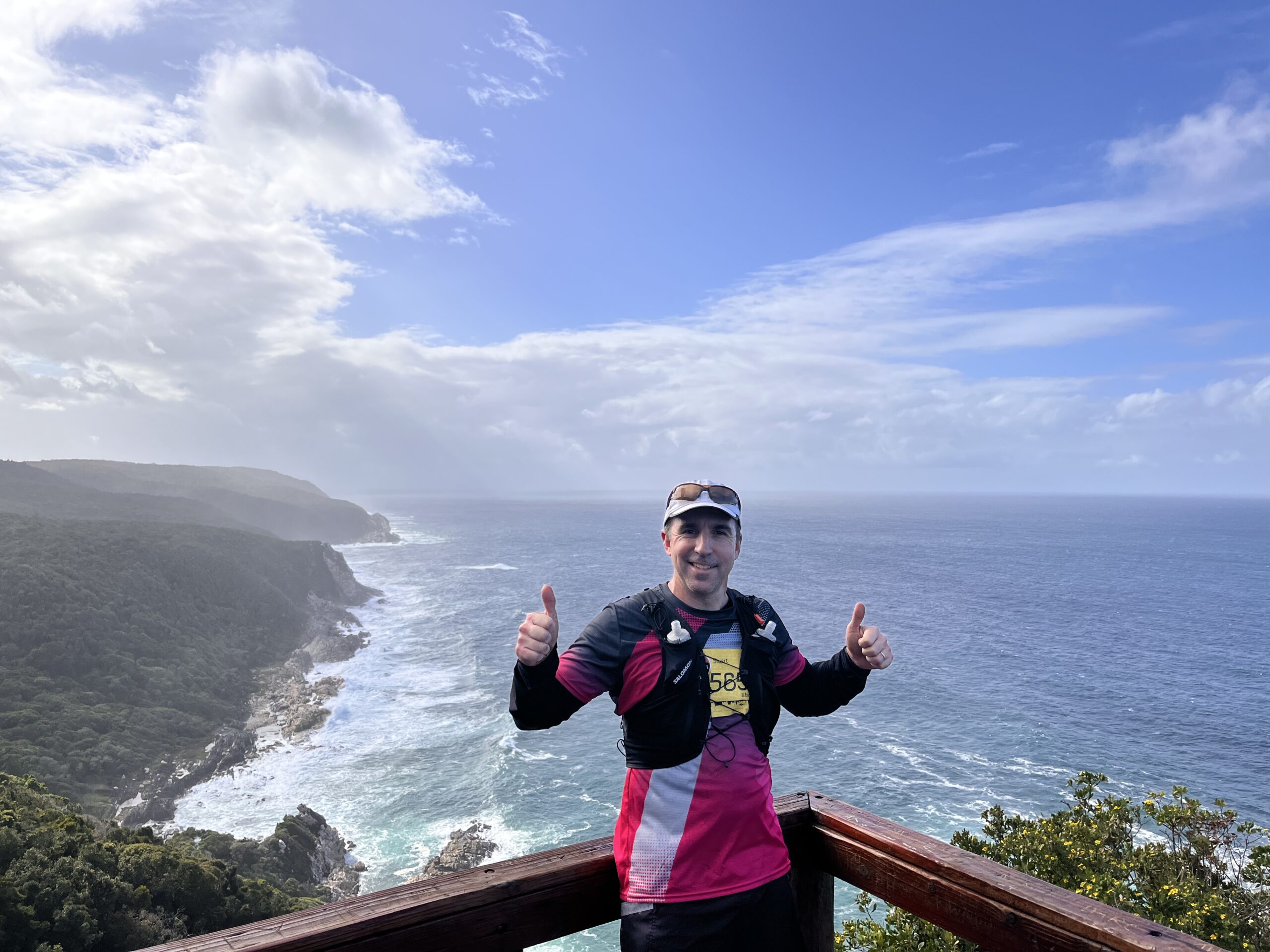
Just 12 people a day get to hike the route and 600 a year attempt to run it. Make sure you are one of them. The Otter needs to be experienced. Photographs, videos and race reports are but a teaser for the real thing. Out on the trail itself, you cannot but marvel at the beauty, appreciate the tranquility and revere the toughness of the Otter.
READ MORE: The Otter Trail Challenge Part One (A Long Prologue)
Want some more? Here’s the official 2025 race video: https://www.youtube.com/watch?v=-w9hzrYsz2Q
I am a self-supported runner but RaceSpace kindly offered to cover my travel costs for this race. Follow the links below or use the QR code to install the app to get access to every running event (road and trail) plus other endurance sports.
Support this site and my marathon travels by downloading the RaceSpace app (100% free) on Apple, Android or by using the QR Code below.

“RaceSpace is South Africa’s first app-based race calendar, bringing thousands of event listings to your fingertips. Use an integrated search function to filter races according to discipline, distance, location and format to #FindYourRace. From running, cycling and swimming to triathlon, OCR, adventure racing and more, RaceSpace makes selecting your next event easier than ever!”


You are very lucky to have been able to run this trail. Lovely account of your experience, and a great read.
Definately not for the unfit, or anyone who is not strong minded.
Did you know how tough it was when you entered?
How many DNFs were there, and how were they removed from the trail if they were too exhausted to continue?