

This is part of a series of statistics articles on Comrades 2025. Other articles published: entry stats, shoe stats, qualification marathon stats. Other articles to come: elite women, elite men and full field statistics.
All Time Fastest Down Times & Pace
The tables below show the all-time Comrades Down run pace and time charts. I place more emphasis on pace.

Only the podium finishers from the class of 2025 make it onto the fastest 30 all-time Down runners by pace: Dijana in 5th, Wiersma just behind in 6th and Volkov in 22nd. Wiersma just behind Dijana is becoming a pattern and the two occupy four spaces in the Top 6.
Take note that some greats from the past are still there: Bruce Fordyce (twice), Bob de la Motte and Alan Robb (the oldest entry from 1978).
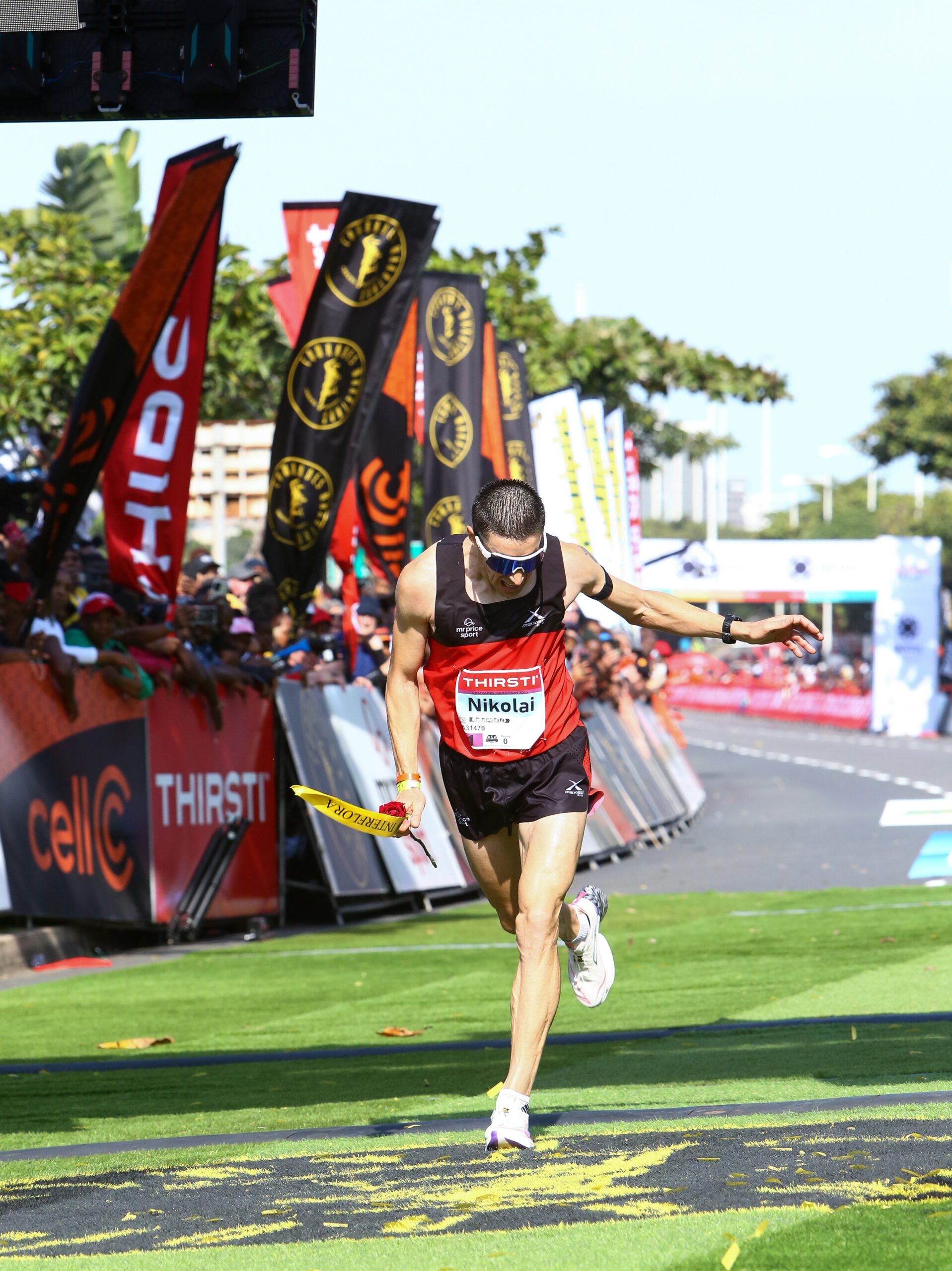
Comeback of the year must go to Nikolai Volkov. He was in the chasing brunch at Drummond in 2024. This is what I wrote about his race from there last year, “However, special mention must go to Nikolay Volkov who gets well and truly Volkoved up by the Inchanga hills and the second half of Comrades and ends up finishing in 4923rd place with a 9h32.”
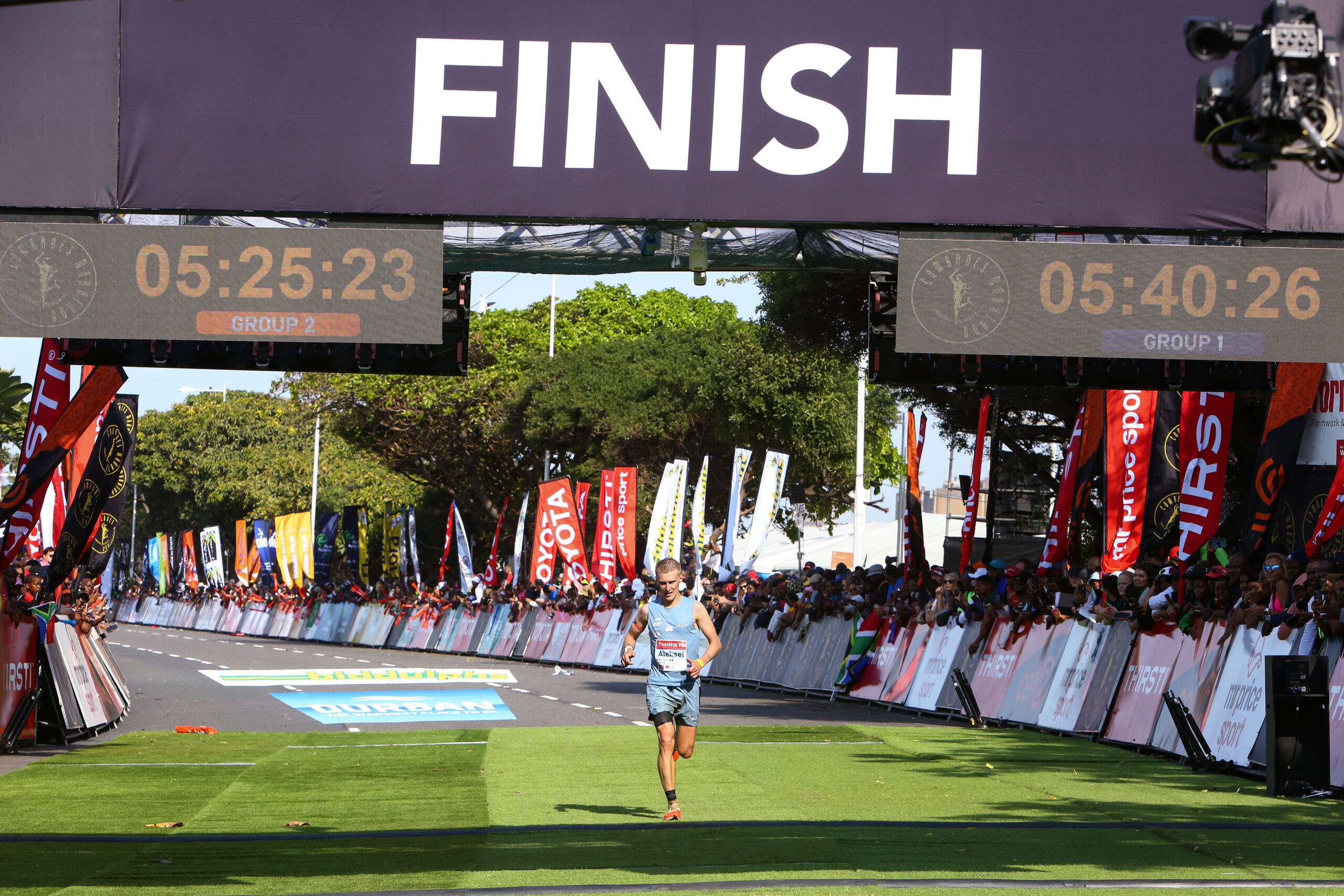
Comrades Commissions must go to comrade Aleksei Beresnev who has two consecutive 11th placed finishes.
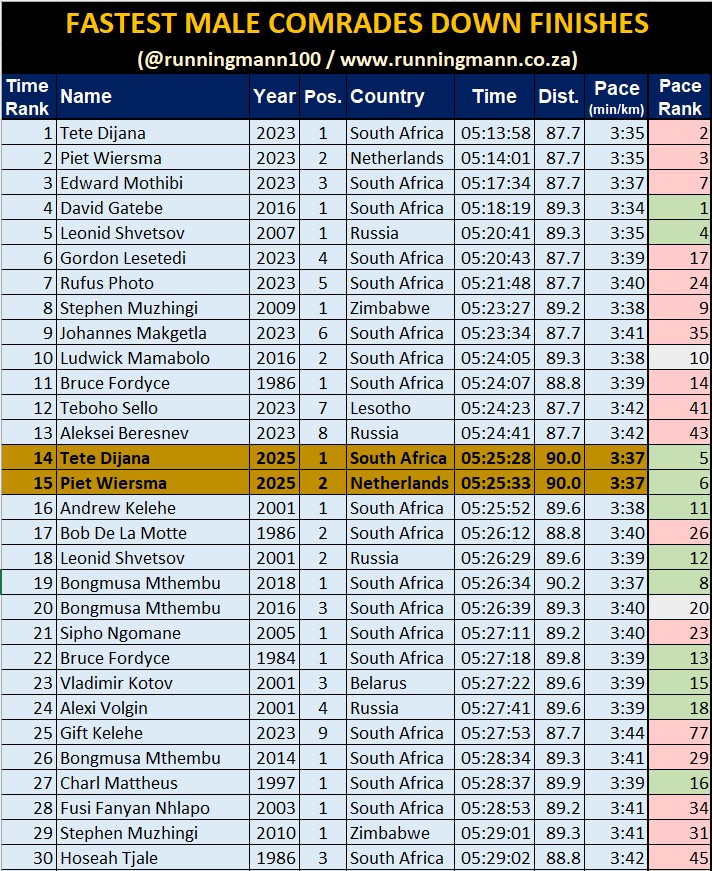
On the Top 30 by time, Dijana and Wiersma are the only two to crack the list in 14th and 15th position.

The 2025 men perform well on the fastest pace by position table with everyone making it onto the list. However, unlike the women, no one can grab a ‘fastest pace’ ever spot. Piet Wiersa and Gordon Lesetedi manage seconds, there are six thirds and two fourths.
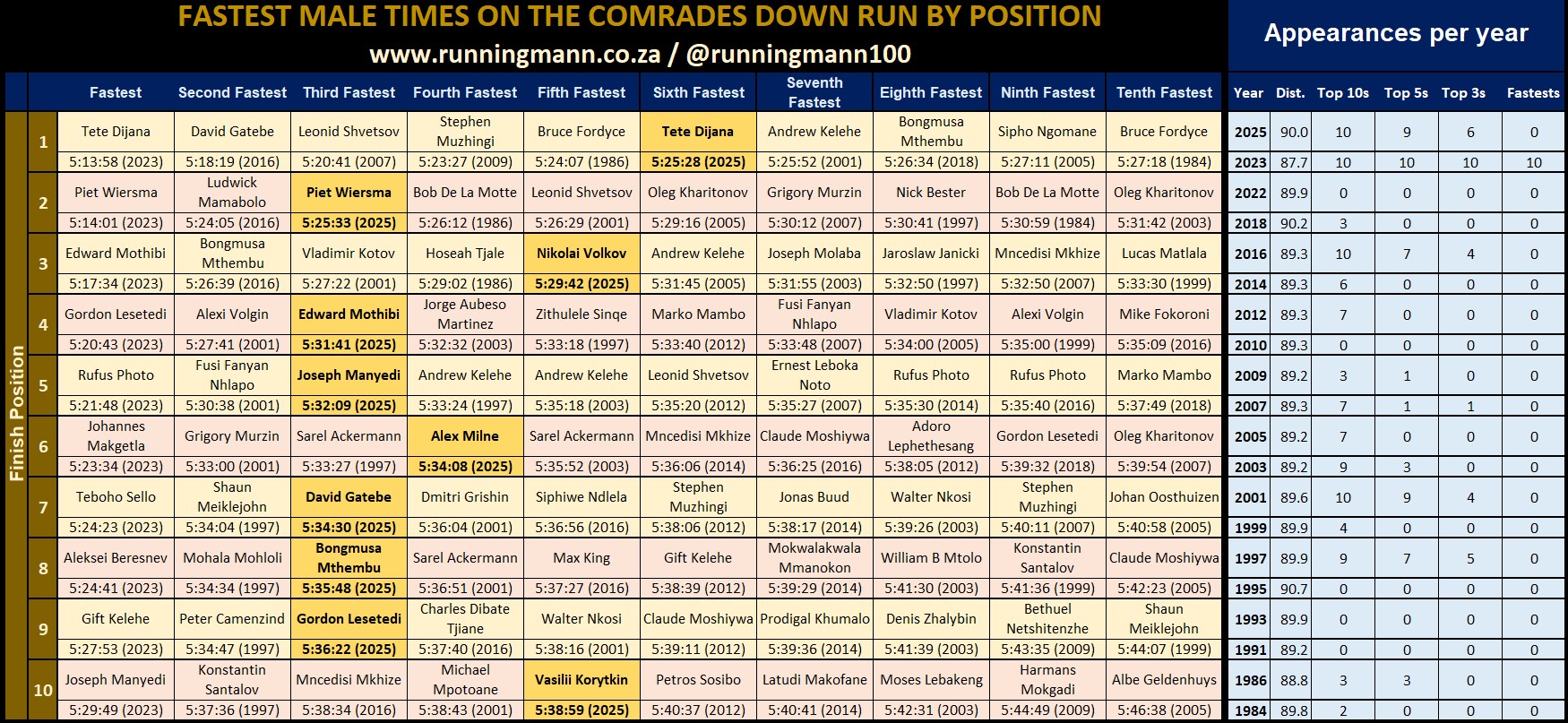
All the men also crack the chart for fastest position by time.
Gold Medal Demographics
After a dip in 2023 and 2024, South African men are back to dominating the gold medal table. However this is the first year since 2004 when a runner from another African country has not claimed a gold medal.
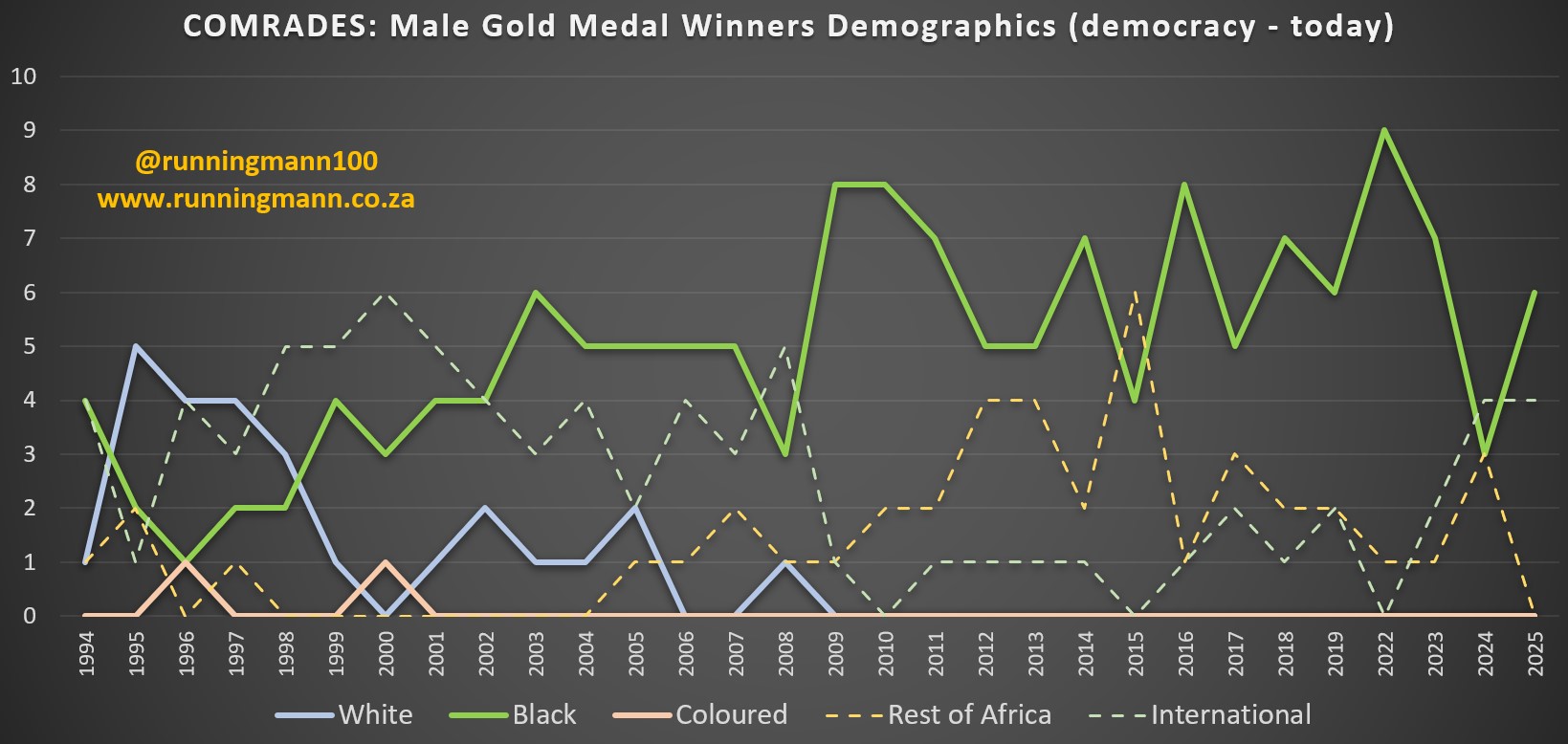
According to the Americans white men can’t jump and (barring a few notable exceptions) it looks like us melanin challenged South Africans are not that great at ultra running either. The last gold was Johan Oosthuizen in 2008. All eight this millennium have been won by just three runners Albe Geldenhuys, Sarel Ackermann and Oosthuizen. We are also still waiting for a first Indian to win a men’s gold.
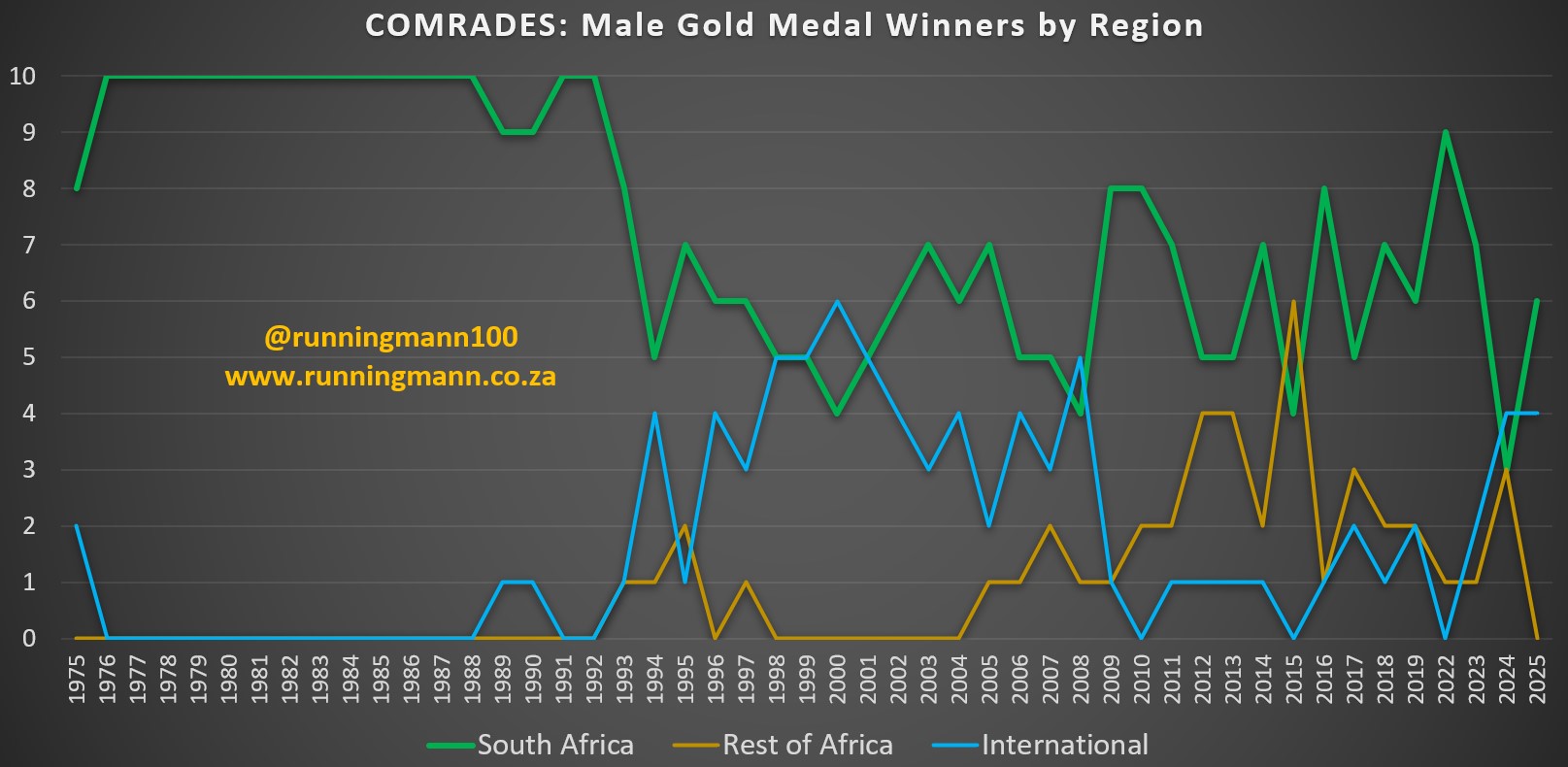
I’ve also included a graph showing golds by region. From 1975 onwards.
Men’s Gold
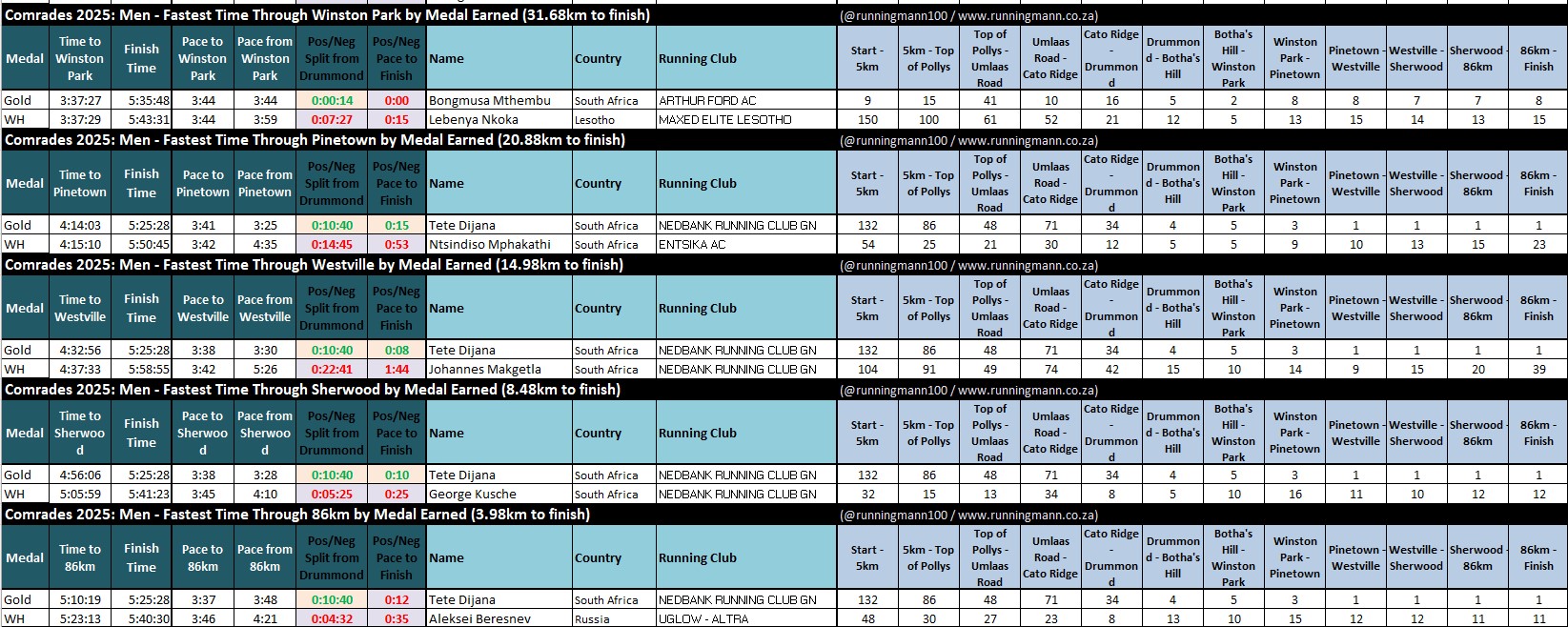
The Gold medal pace by split comparison graph provides a good illustration of race day tactics and where the race was won. It’s all about being sensible and sticking with the pack until Botha’s Hill – from here the pace steadily increases until Westville. The split from Pinetown to Sherwood separates the good from the great and Tete Dijana is the fastest to climb Cowies and ultimately this is the difference between first and second.

Presenting the same information by position in the race at each split provides an interesting perspective. Eight of the golds are outside of the Top 30 at Cato Ridge (over 30km into the race) but from there it’s business time. The Drummond to Botha’s Hill stretch is where the big moves come, the large buses disintegrate and most of the gold medals are won.
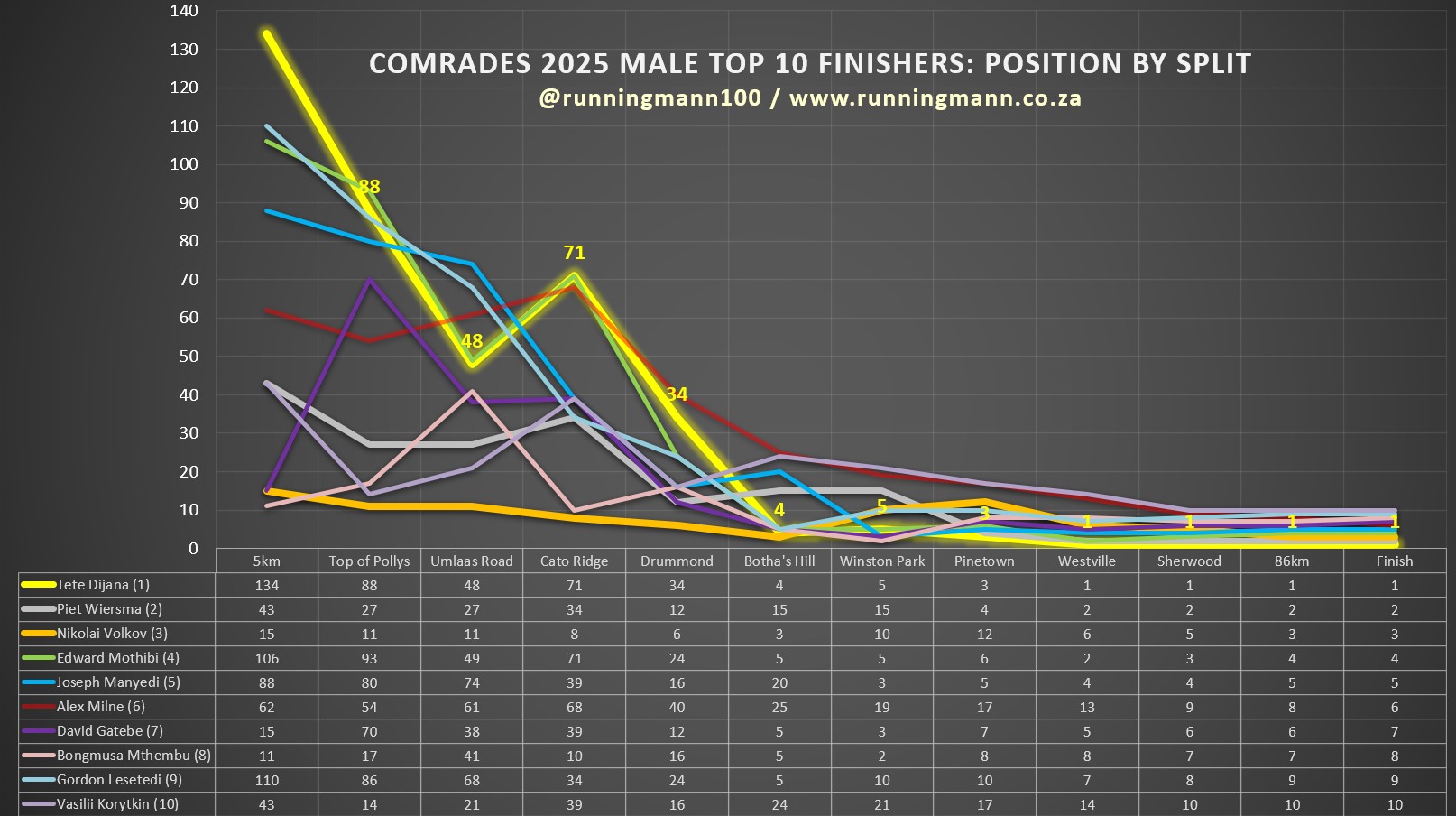
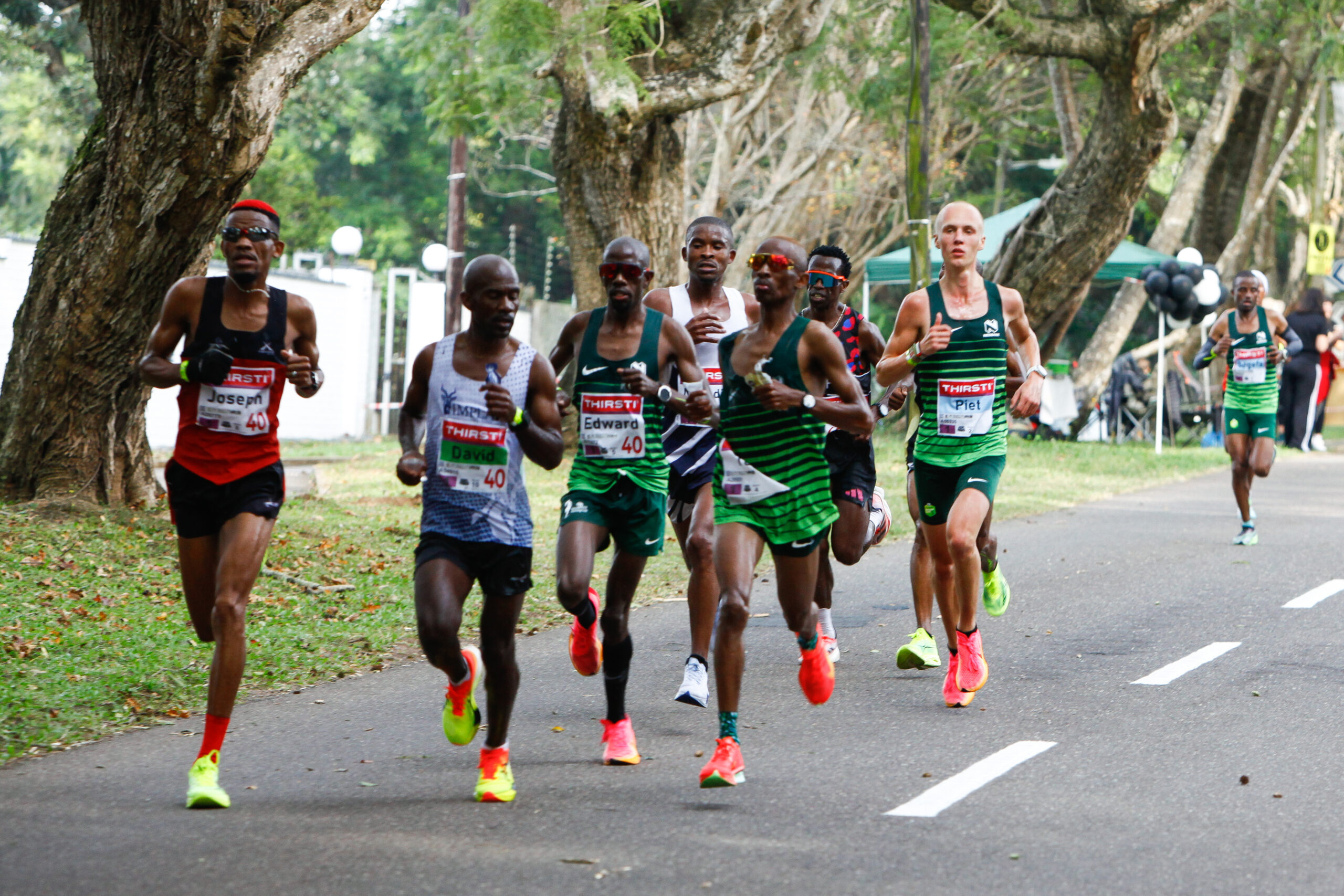
There are two notable exceptions. Third placed Nikolai Volkov who hovers around the Top 10 positions for the entire race and Englishman Alex Milne who is lurking in 40th position at Drummond and steadily picks off the field from there to finish in sixth.

Hot 100
Here are some tables providing detailed analysis of the Top 100 men’s finishers. Outside of the Top 10, negative splits and pace are very rare with just Alpha Centurion Musawenkosi Sibiya (46th) and Russian Aleksei Grigorev (60th) achieving this accolade. The second half of the down run should theoretically be much easier indicating how few runners get their pacing strategies right.
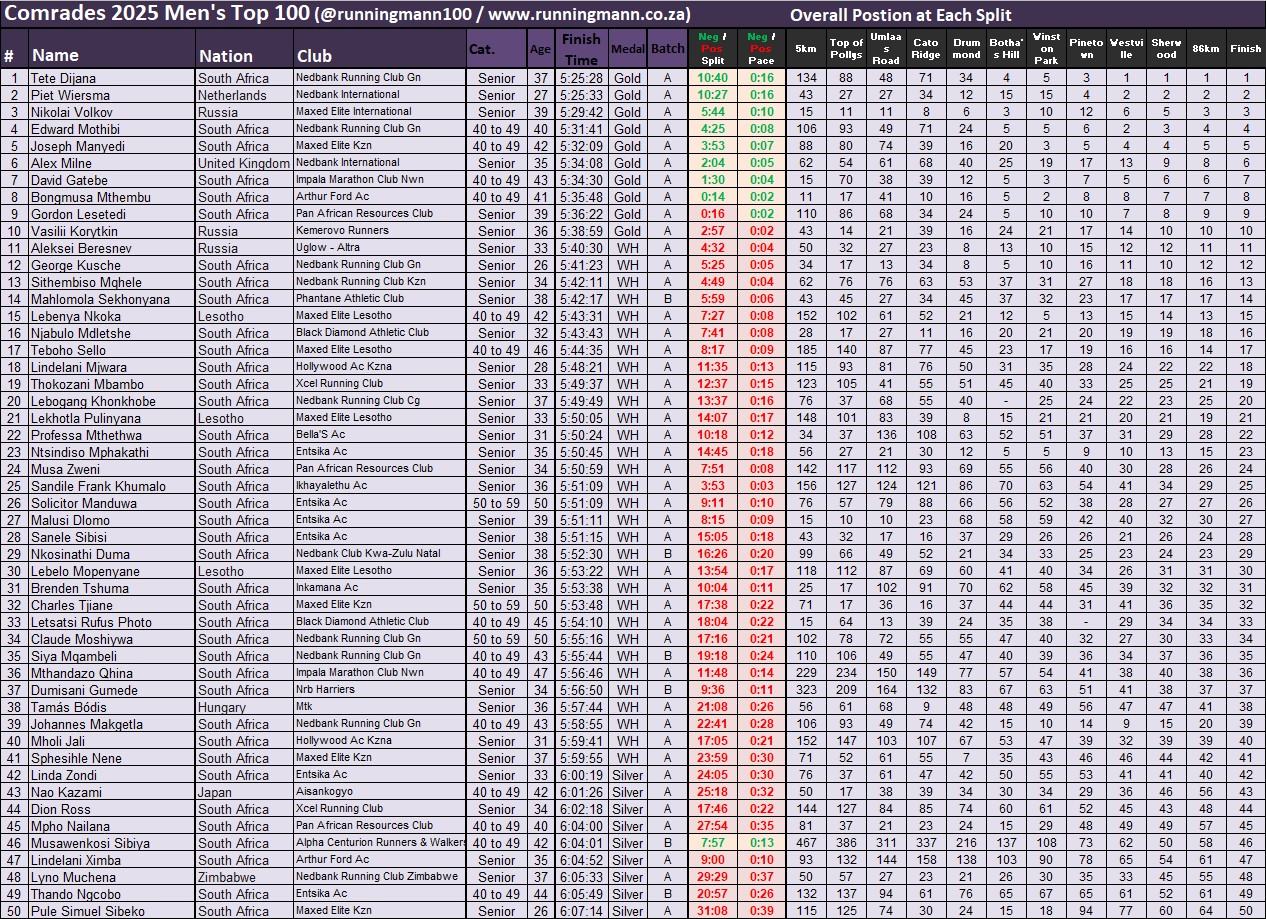

The tables also provide overall position at each split, split pace, split rankings and summaries thereof. Just four men are able to run a split under 3:15/km and they finish in the Top 4. Of those just two run two splits under 3:15/km and they finish first and second.


Analysis of the fastest and slowest splits recorded by the top 100 is telling. Just 3 men in the top 100 run their slowest split during the much tougher first half and they all do so on the Umlaas Road to Cato Ridge split. Those three men are first placed Tete Dijana, second placed Pieter Wiersma and sixth placed Alex Milne (who overtakes 34 people, more than any other gold medallist over the second half). The most positions gained over the second half was 175 by Stella AC master Alasdair Leslie who went from 271st at Drummond to 96th overall.
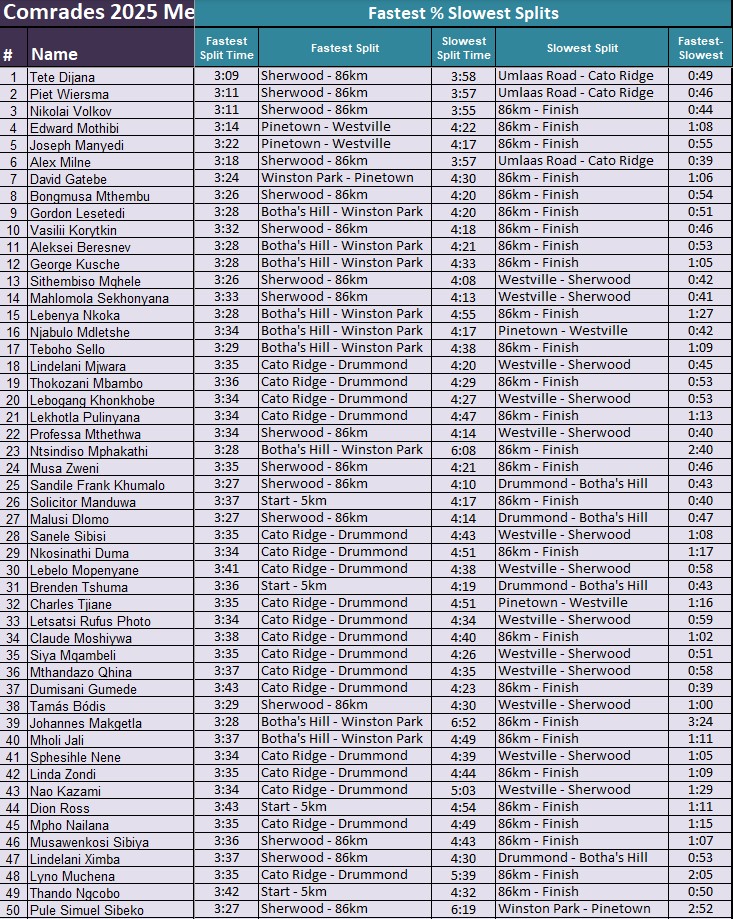

61 men run their fastest split in the first half with 37 of these doing so in the final split before halfway which, based on the low number of negative splits, is way to soon. No one runs the post halfway split to Botha’s Hill as their fastest but for 9 it is their slowest.

It also appears that the majority of the Top 100 men want to catch their breath so as to look their best for the television cameras on the finish line as 54 run the last 3.98km as their slowest of the day.
Age Graded Results
Who really won Comrades? We all know that Tete Dijana crossed the line first but I decided to do age grade adjustments which kick in from age 36 onwards. I used an algorithm to convert everyone’s Comrades time based on the world’s best marathon performance for that category, taking into account age and sex. This produces an “age-adjusted” time, letting performances across ages be compared on an equal footing.
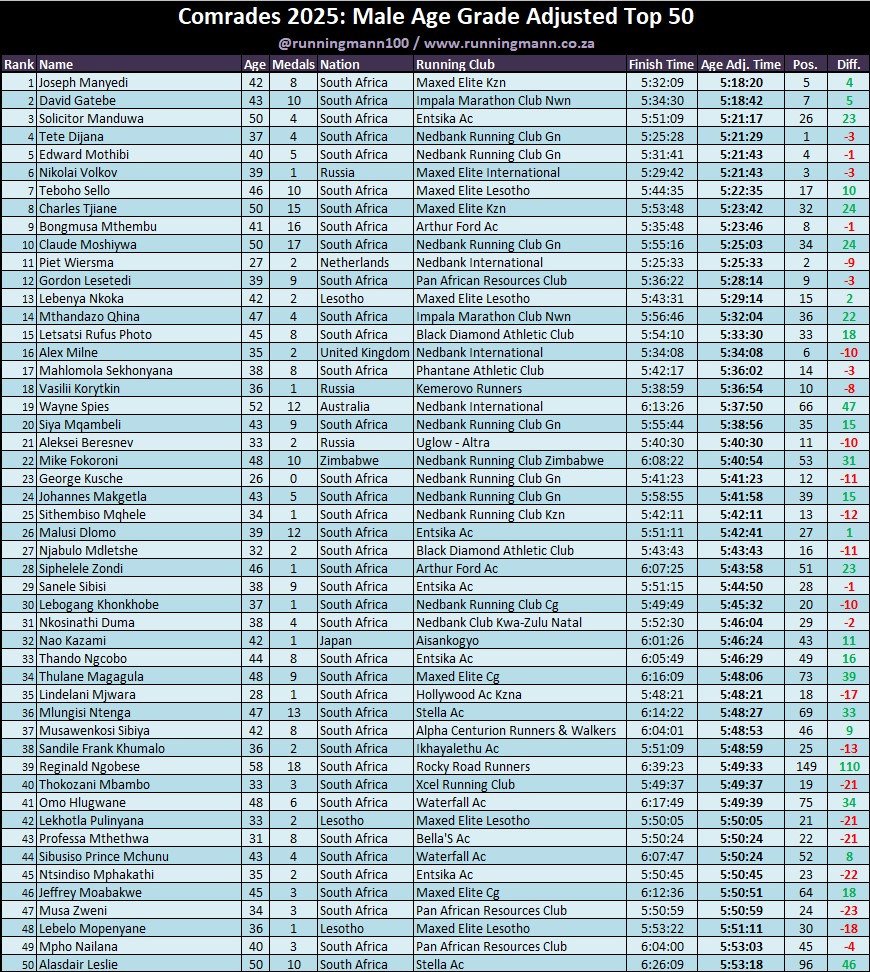
This produces some fascinating results with Dijana slipping to 4th and Piet Wiersma not even earning a gold medal. The new winner is 42 year old Joseph Manyedi in a time of 5:18:20, followed by 43 year old David Gatebe in 5:18:42. Solicitor Manduwa, who hit his half century in April, ran a 5:51:09 which converts to 5:21:17 to round off the podium.

The column to the furthest right shows the positional movement after the age grading. The biggest jump is earned by Rocky Road Runners’ Reginald Ngobese who makes a massive 110 place move from 149 to 39. The 58 year old ran a 6:39:23 which would be an easy Wally on the age adjusted scale.
Comrades may not be an old man’s race – but if we allowed age graded results it would be!
Fastest Qualifiers
The table shows the fastest 50 male qualifiers and how they performed at Comrades 2025. Note: Where an ultra was used, an adjusted marathon time is calculated using an equation giving a ‘distance discount’.

The qualifying time is a not nearly as good a way to predict eventual gold medals as it is for women (where there is much more consistency). With a 2:14:03 at London, Alex Milne was the fastest qualifier followed by Joseph Manyedi with a 2:18:00 at Elands. They are the only two of the Top 20 fastest qualifiers to secure a gold. However, Manyedi finished second to Tete Dijana at Elands but Dijana used his slower Soweto time as his listed qualifier.

Just 5 golds come from the top 50. The lowest seeded gold was Vasilii Korytkin in 85th (Korytkin used his time from the Russian 100km Champs as his qualifier). This year Comrades reduced ‘elite’ status for men to a 2:25 marathon time but the data suggests that those running 2:30 are still serious contenders for gold medals.
There were 12 DNFs and 8 DNSs from the fastest 50 qualifiers. The biggest positive jump from ‘seeding’ to finish place for top 50 fastest was Bella’s AC runner Professa Mthethwa (49th fastest / 22nd place) whilst Maxed Lesotho’s Tsotang Maine had the biggest slip (34th fastest / 1605th place).
Difference Between Good and Great
The graph compares the average pace at each split between the gold medallists, the top 100 finishers and the fastest 100 runners over each split.
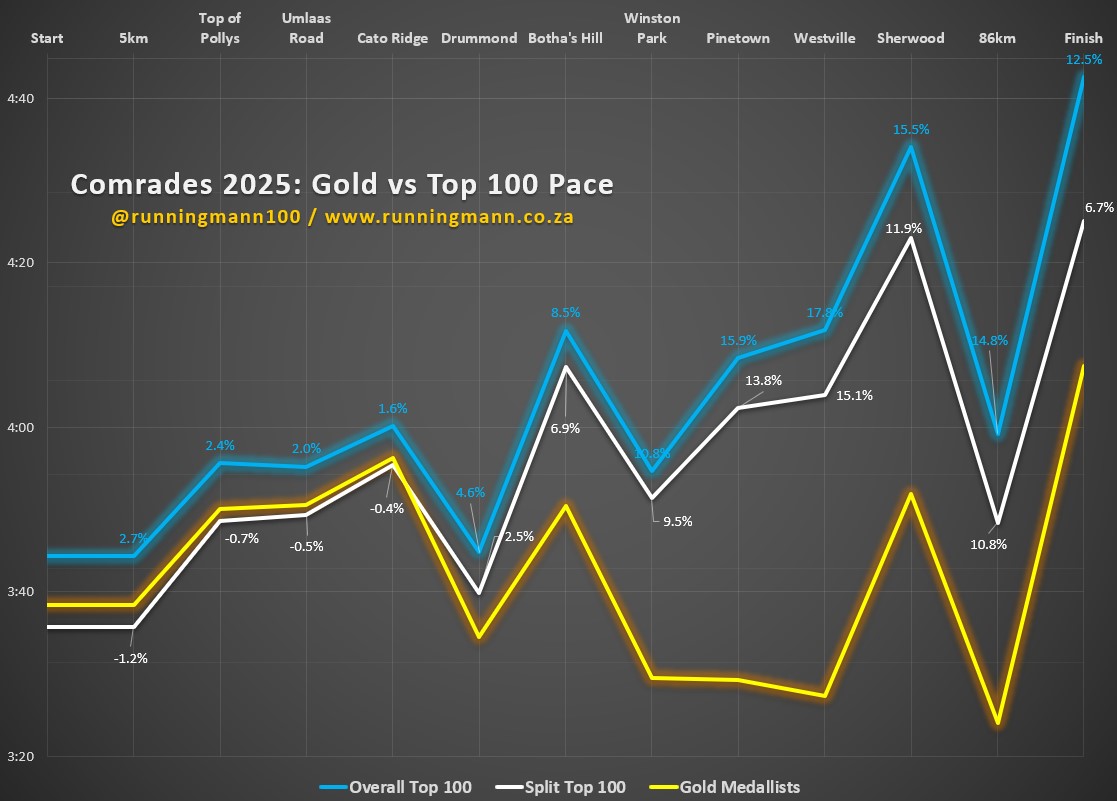
The average pace of the show ponies (who included many DNFs and massive positive splits) is faster than the golds all the way to Cato Ridge. The gap between good and gold is fairly consistent until the split to Drummond. Here the gap changes from around 2% to 4.6% between the top 10 and top 100 finishers. It doubles again to Botha’s Hill (8.5%) and then steadily increases until Westville. The gaps closes over the last three splits but is still 12.5% on the final split.
Also of note is how the golds flatline the Winston Park to Pinetown split and increase the pace slightly to Westville whereas everyone else slows down significantly.
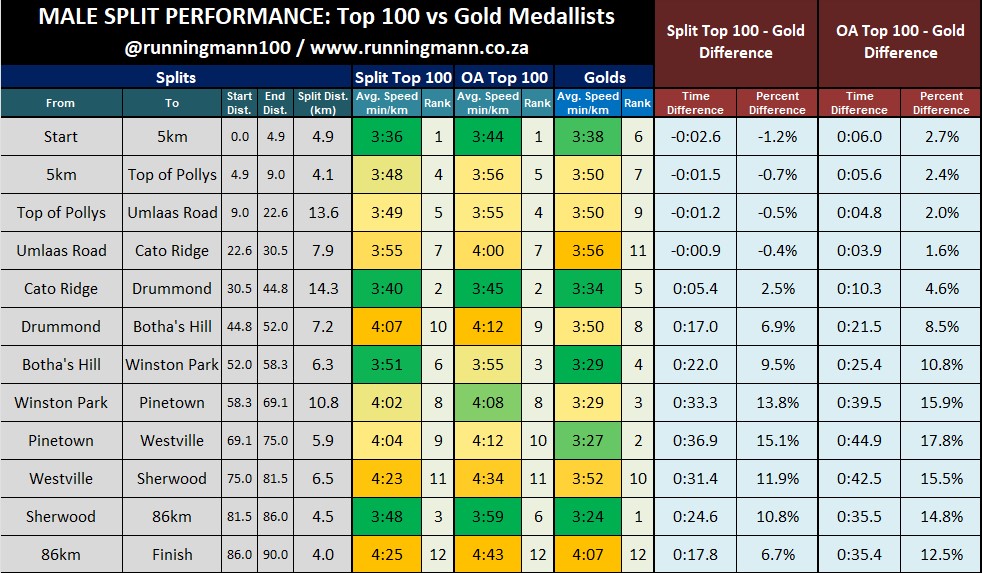
The table provides some further interesting insights. The fastest 100 on the split and overall top 100 have only one top four pace in the second half whereas the golds have all fastest four splits after Drummond. Golds run the first 5km as their 6th fastest split whereas the other groupings have this as their fastest split. I was surprised to see that everyone runs the last 4km as their slowest split of the day.
Elite Men vs Women
The next two graphs provide a comparison between the male and female Top 100 and gold medallists. The much larger gap in the Top 100 (compared to Gold) highlights that there is a lot more depth in the men’s field.

The Top 100 gap is consistently between 18 and 20% until Pinetown. However, the peak is reached at Drummond (20.8%), after which there is a gradual and then steady reduction dropping to 14.7% by the final split to the finish. The peaks and valleys are very similar indicating a similar pacing execution.
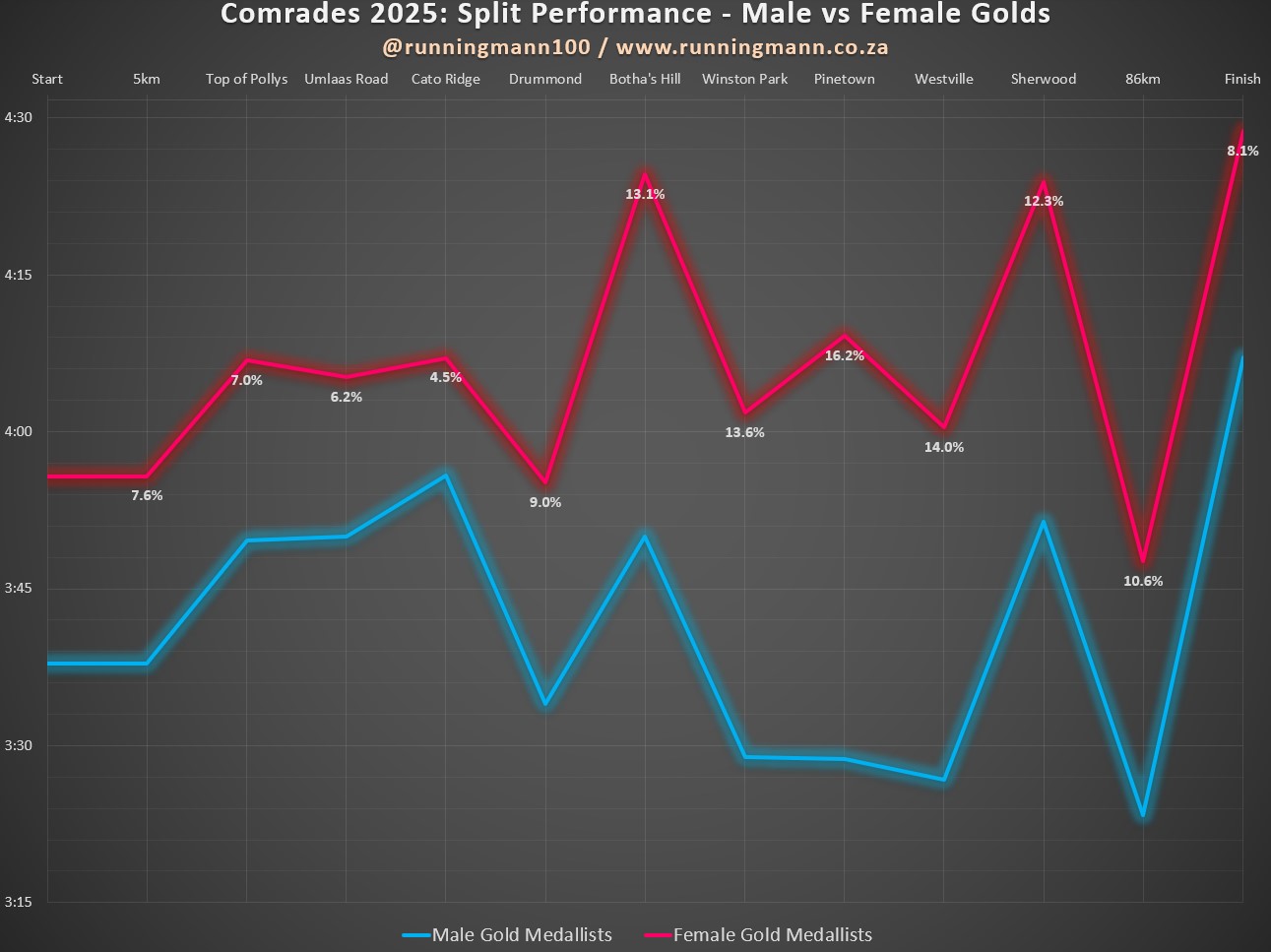
The gold gap is slightly different from previous years. The women actually gain on the men from an initial gap of 7.6% down to 4.5% at Cato Ridge. Here the gold men turn on the gas and the gap doubles to 9% on the next split to Drummond. From there it reaches a maximum of 16.2% at Pinetown before decreasing at a rate of 2% a split to culminate in 8.1% at the finish. The peaks and troughs on this graph do have some deviations indicating the different race strategies of male and female golds.
Additional
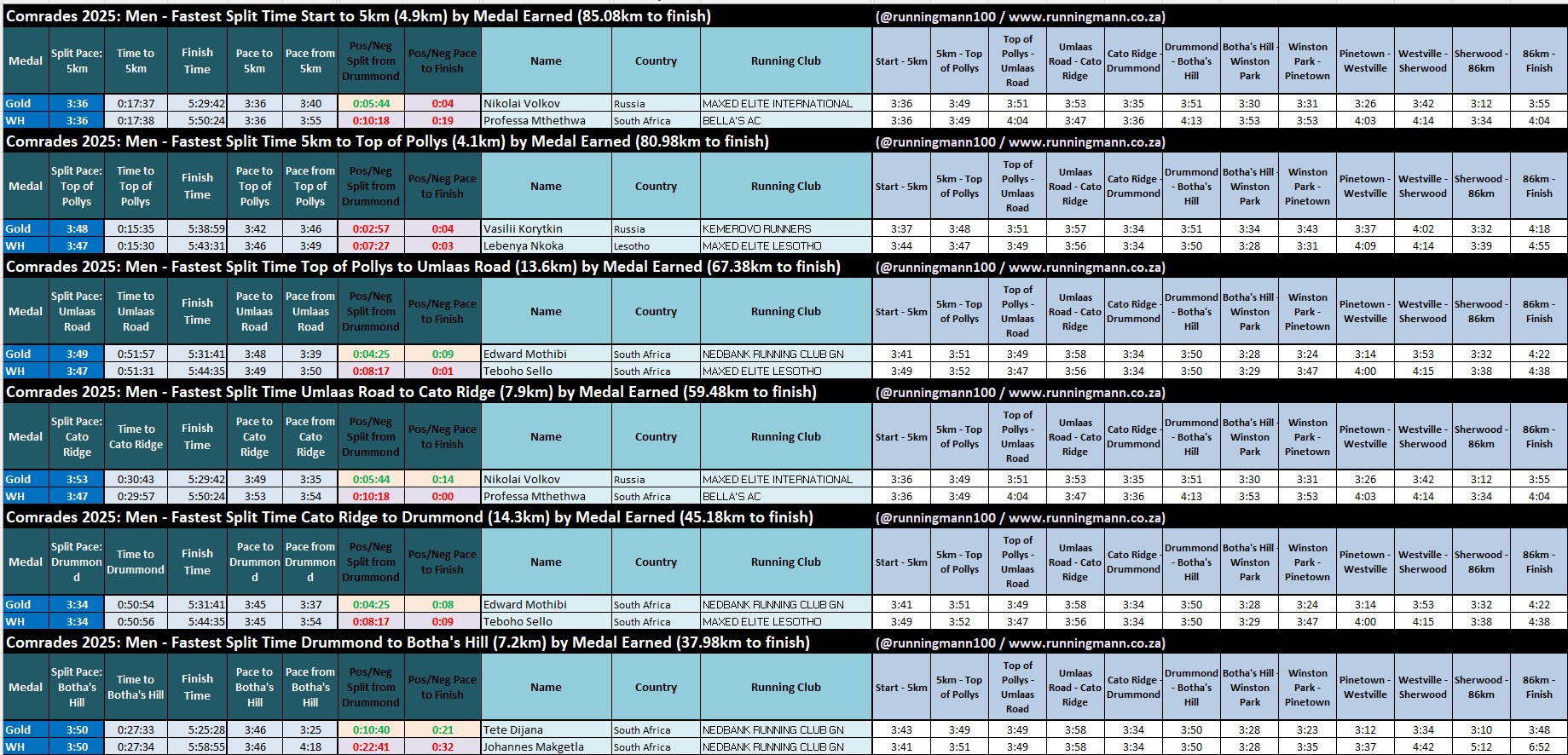
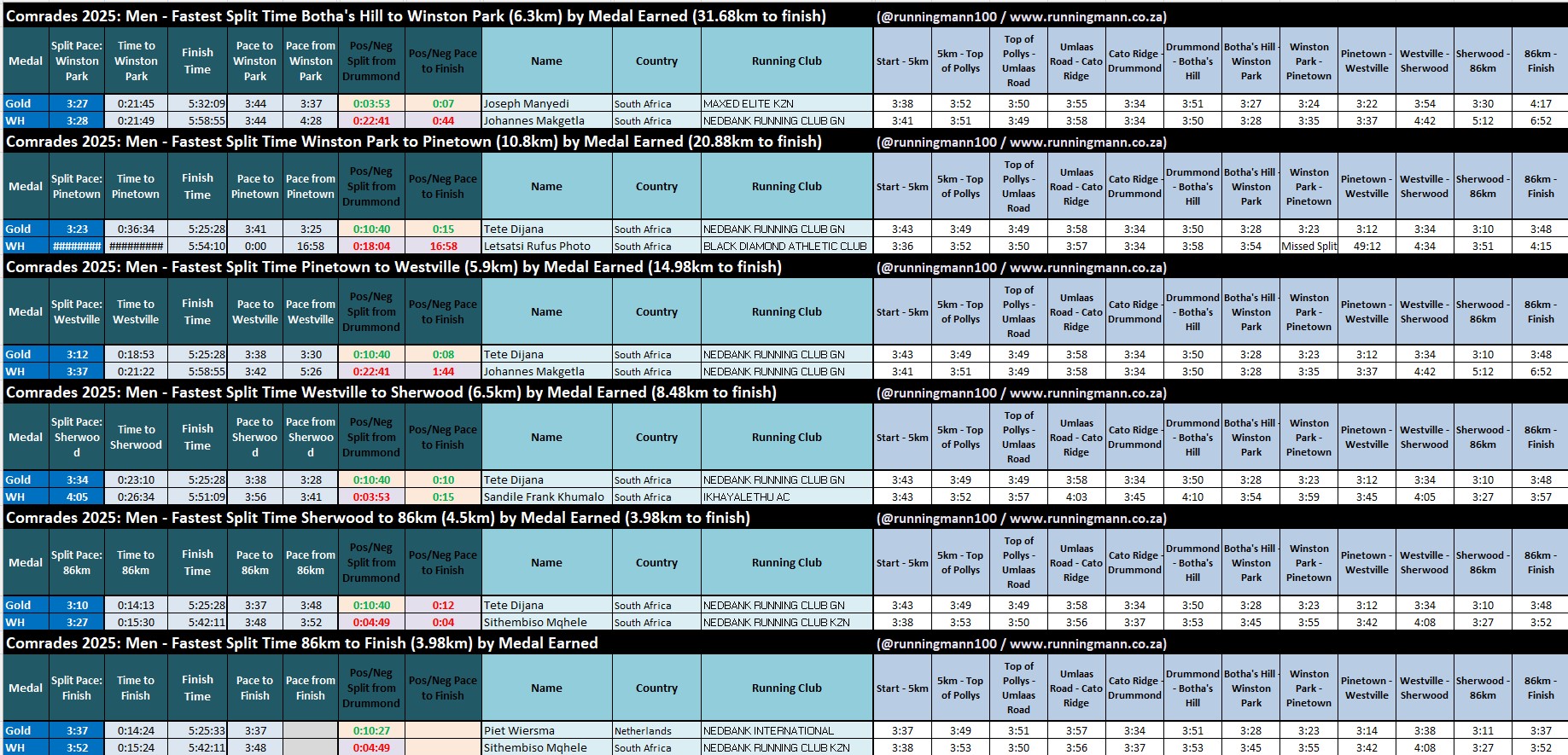
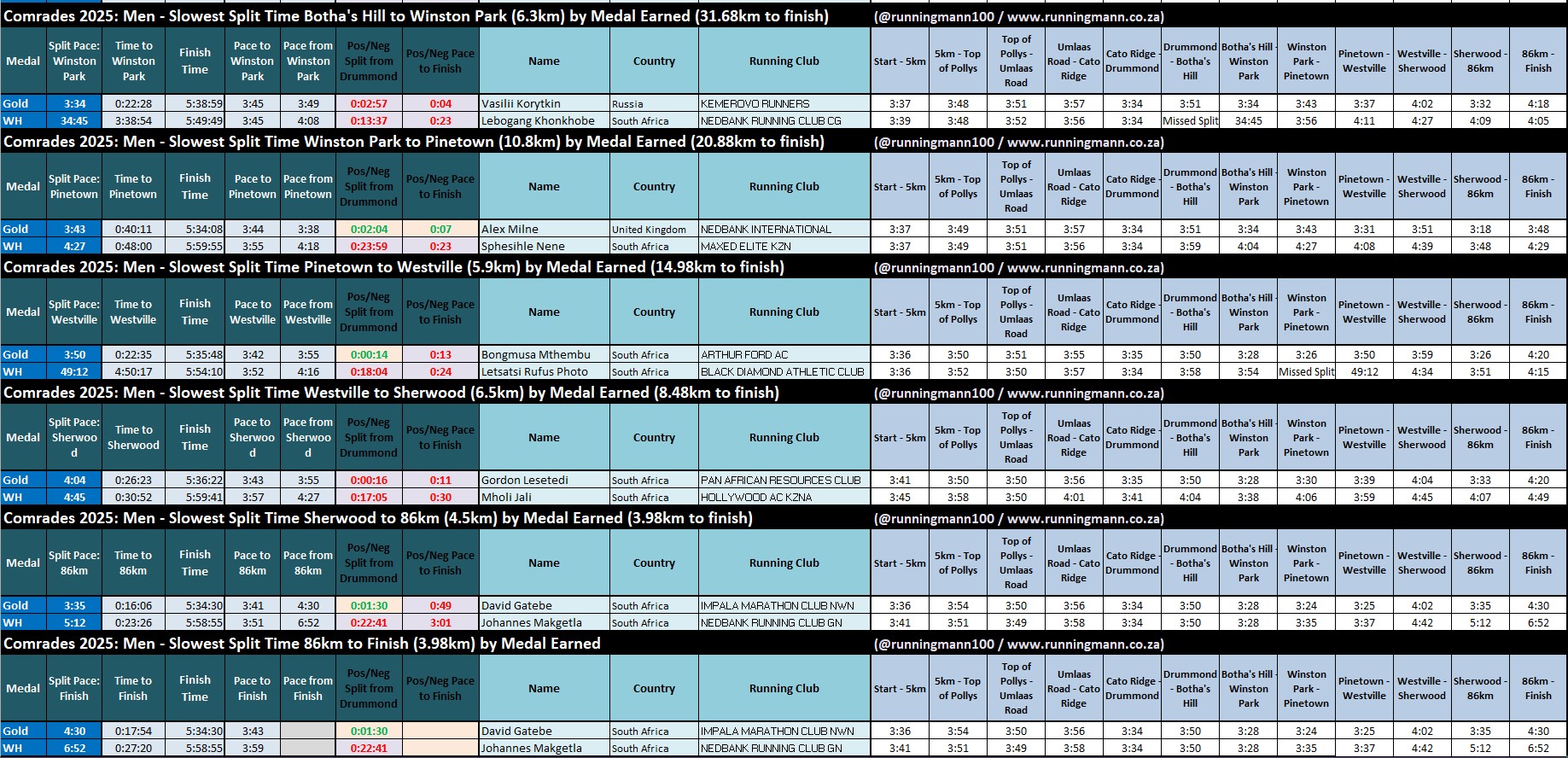
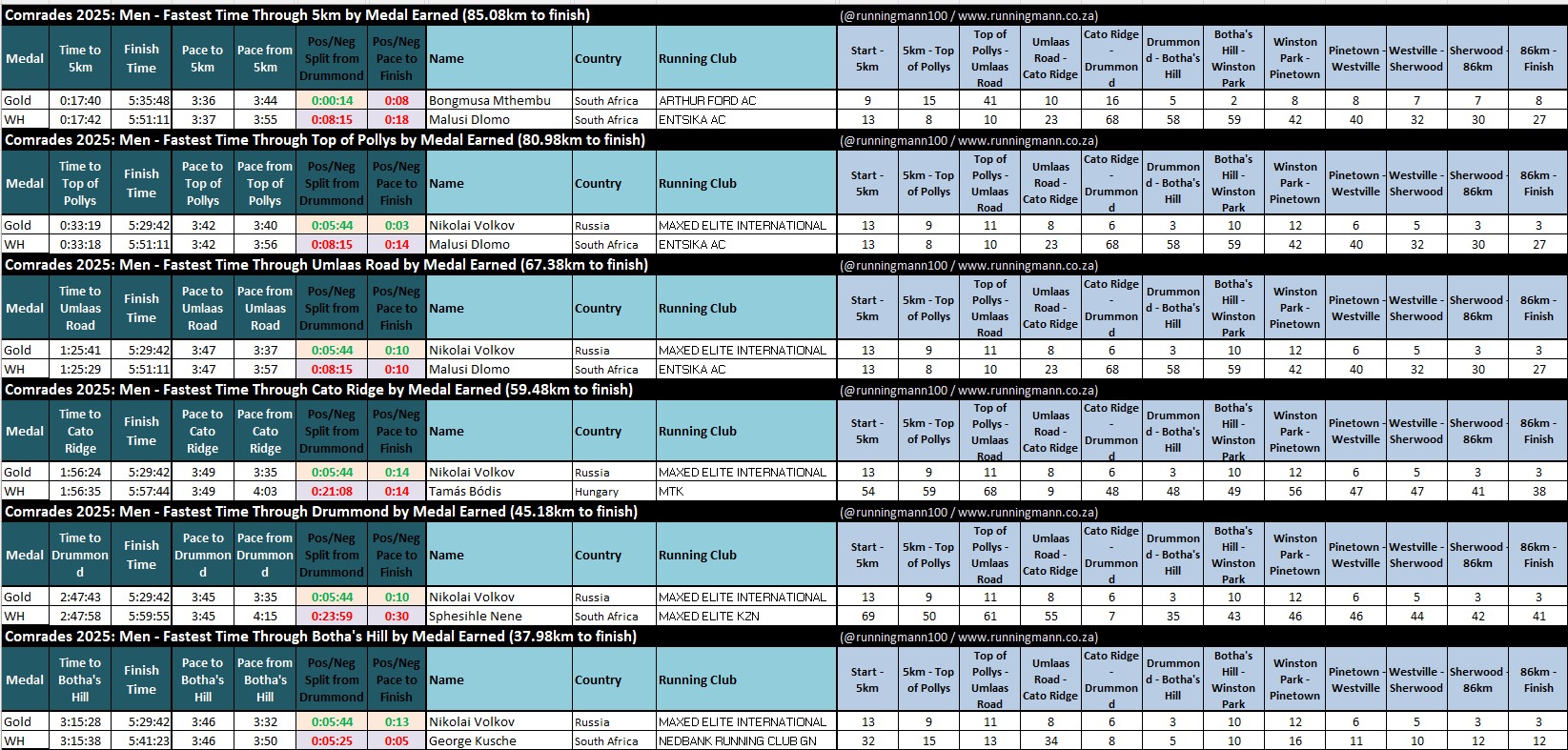
The graphs below are provided without commentary as this is provided in other Comrades 2025 stats articles.





All photos courtesy of Comrades Marathon Association unless otherwise indicated.
Follow Running Mann:


