

This is part of a series of statistics articles on Comrades 2025. Other articles published: entry stats, shoe stats. Other articles to come: elite women, elite men and full field statistics.
Getting Provincial
Whilst 38% of the field comes from Gauteng, only 24% use marathons within the province to qualify. KZN are more parochial with 18% of the field and 16% using the province for qualification purposes. Many runners travel for their qualification marathon with the Western Cape (9% of entrants but over 20% of qualifiers) and Mpumalanga (4% of entrants but almost 15% of qualifiers) getting most of the tourism benefit.

Overseas international marathons account for close to 10% of the qualifiers and, combined with those qualifying in other African countries, brings the total to exactly 12%. The largest but least populated province in the country, the Northern Cape, cannot quite break triple figures for Comrades entrants and only 75 of their residents return home with a Comrades medal. The Northern Cape also has worst finish rate (80.6%) but does produce the second fastest average qualification time (3:53:21) behind the Internationals (3:47:54). Gauteng has the slowest average qualification time with 4:06:20.

KwaZulu Natal marathons can boast producing the fastest average finish time (10:02:18) narrowly followed by Limpopo (10:05:38). Free State qualifiers result in the slowest average finish time of 10:30:32 with the Eastern Cape (10:26:57), Gauteng (10:26:23) and Mpumalanga (10:25:08) also getting good value for their Comrades entry fee.

The only region to secure a 90% or better success rate are other African countries with the majority of those coming from neighbouring marathons. The Western Cape is the best performing province with an 89.6% finish rate.
Month
With 24%, March is by far the most popular qualification month. October, largely off the back of Cape Town Marathon (by far the most popular qualifier with almost 3000 entrants), is second with 16% followed by April with 13%. The rest of the qualification period is fairly evenly spread out with the low numbers in September, December and January explained by the lower number of marathons available during those months.

Comrades changed the qualification period to be full year but the marathon calendar still needs to catch up – only 1% of the field qualifies between June and August. Roughly one third of the field qualified in 2024. Last minute qualifications are the order of the day for 11% of the field who qualify on the first weekend of May.

Other than for June (with a tiny sample size of 14 runners), the eventual Comrades finish times are very even indicating that when you run your qualifier does not impact eventual finish time. However, the general trend is that the earlier you run your qualifier, the better your chances are of earning a medal but this trend is slightly less pronounced than in previous years. Of the months with over 100 runners, only October breaks a 90% success rate.

Distance
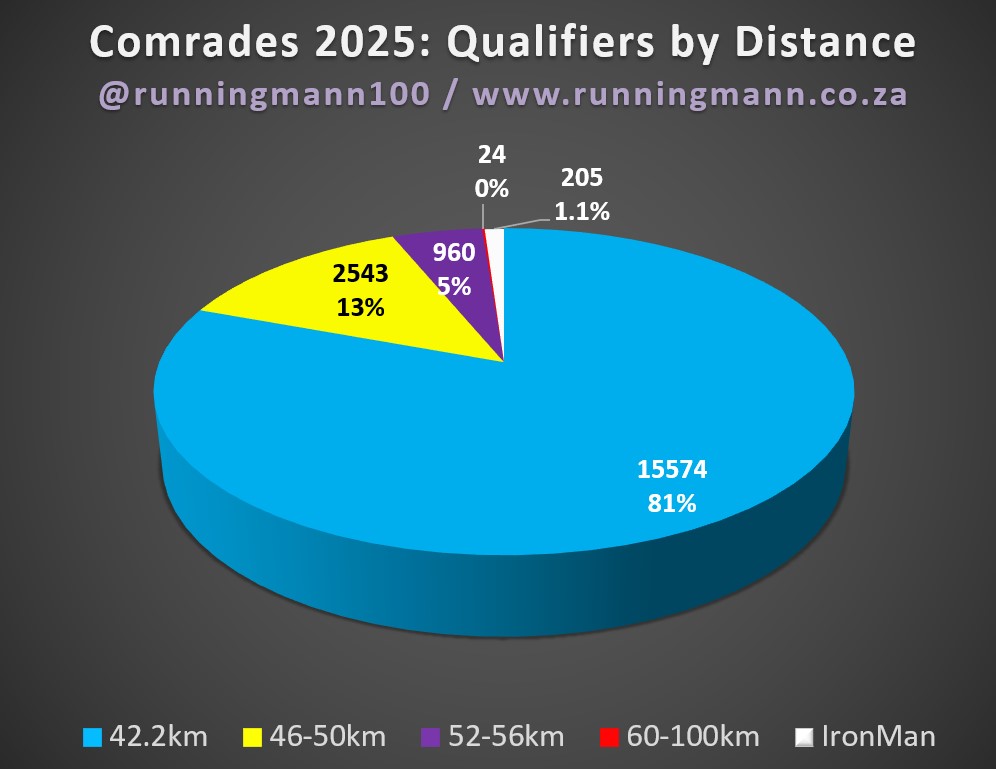
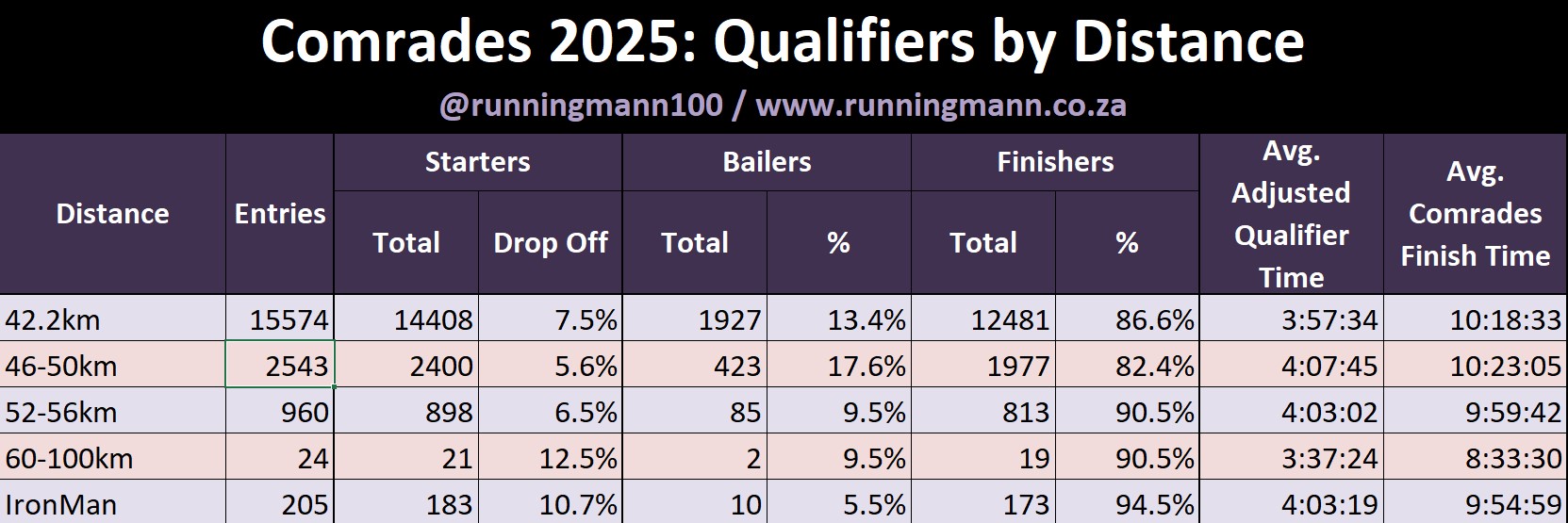
A standard marathon is the qualification distance of choice with 81% going this route. Most of the remaining 19% run a ‘short’ ultra (which generally have a much easier average pace for seeding). There are 24 runners who qualified with a run of 60km or longer (including 7 athletes who flexed using a 100km qualifier) and a further 205 who used the final leg of an IronMan triathlon as their qualifier marathon.
There is not much difference in the success rate whether you run a standard marathon or ‘short’ ultra. Success rate improves if you run a longer ultra but remains constant whether you qualify anywhere between 52 and 100 km. However, by far the best performers at Comrades 2025 where the IronMen and Women with 94.5% medal count. Is this proof that we should all be doing more cross training?
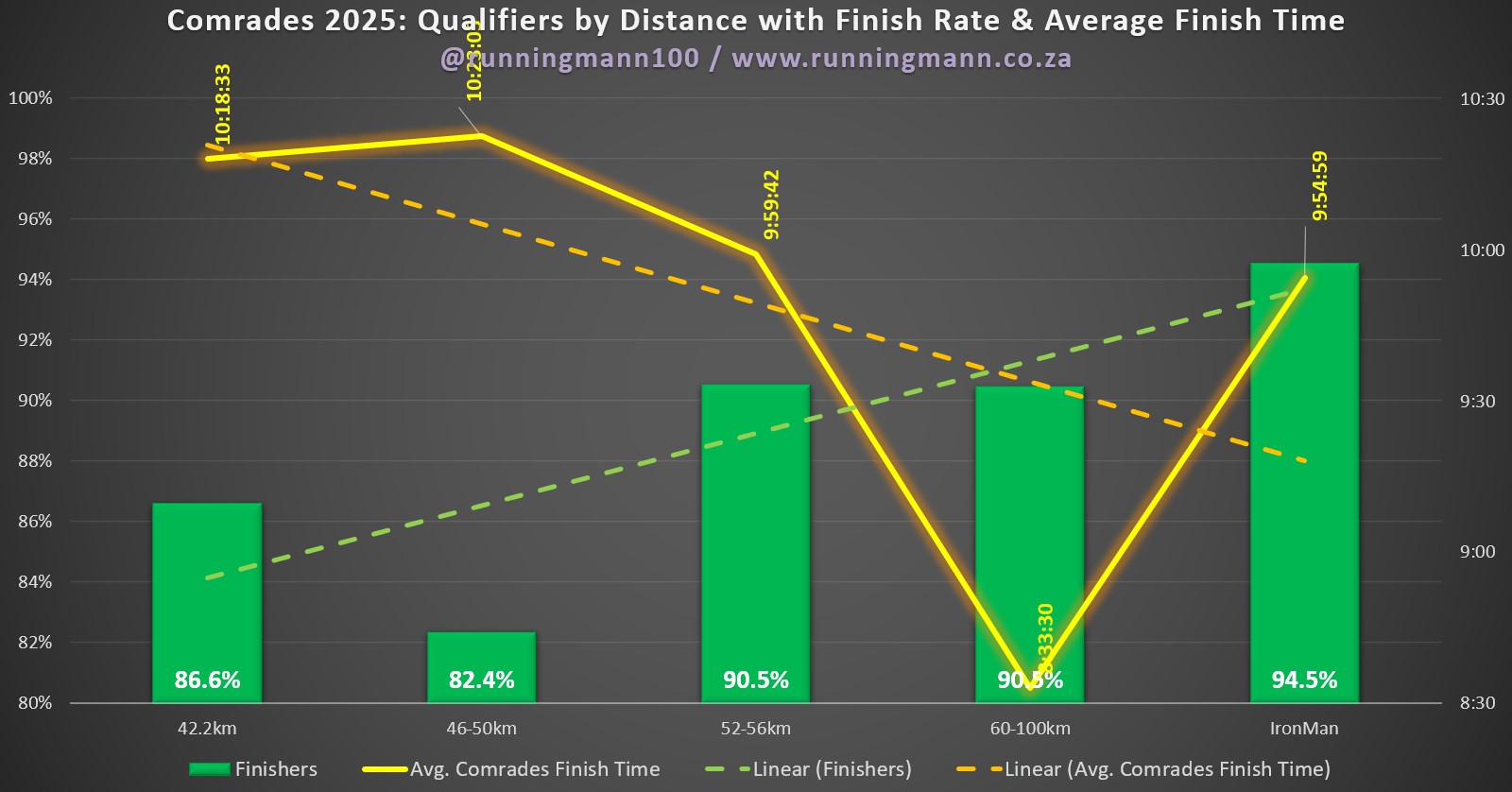
Size definitely matters when it comes to average finish times – those using a qualifier of 60km or more finish in easy Bill Rowan territory whilst the 52-56km and IronMan cohorts are in Robert Mtshali range.
Most Popular
Cape Town maintains its position as the most popular qualifying option for Comrades runners with Elands (a downhill flyer and 4th largest in 2024) the only other marathon to break 1000. Durban International breaks into the Top 3 after being 6th on the list in 2024. Kaapsehoop (another downhill flyer) drops from 2nd to 4th but the big loser is Two Oceans moving from 3rd to 9th.

Gauteng dominates the table with 8 events in the Top 20. The only other provinces represented are Western Cape (4), KwaZulu Natal (3), Mpumalanga (3), Eastern Cape and Free State. This year Benoni Harriers reclaim the battle of Benoni by 7 more entrants, 3 more starters and 65 more finishers than Benoni Northerns.
Looking at the percentage of finishers of each race that used the event for their qualifier: Incredibly, 45% of Durban International and 41% of Elands runners use these events to qualify. Other marathons where more than one in three of the finishers use as their qualifier are Dolphin Coast, BNAC, Durban City and Sasolburg. On the low end are Two Oceans 6%, Peninsula 12% (who had a terrible headwind this year) and Cape Town 17%. However, the actual runners completing those events and entering Comrades would be far higher.
It looks like the qualification entry data was cleaned up after I did pre-race stats which results in some significant shifts in the most popular international qualifiers. Mumbai is back at number one followed by Berlin and the Old Mutual Harare marathons. These are also the only marathons to crack triple figures for entries.

The marathon majors are well represented although neither Boston nor Tokyo make the top 20. Zimbabwe, Botswana and Zambia all get two marathons on the list and Kenya gets one.
Note: Adjusted times are used to calculate a marathon equivalent time for ultras using an equation which allows some compensation for the additional distance.
Success Rate
The Moscow Marathon storms in at #1 with 53 out of 54 of their qualifiers (98%) finishing the race. They also do so with by far the best average time of 8:56:11. Although they’ve deserted South African running, Old Mutual still sponsors marathons in Zimbabwe with the Harare Marathon in second and the podium is rounded out by the Polokwane City Marathon.

Two Oceans, which started out with the express purpose of being a long training run for Comrades, finishes in a strong fourth. They are joined by just one other ultra, the Prince Mangosuthu 52k, in the top 20
Interesting to see so many international marathons in the top 10 this year. Mumbai and Valencia have strong performances, with the latter recording the second fastest average finish time. Capital City gets one acclimatised to the Maritzburg air in fifth and Die Vlakte provides a second Western Cape marathon in the top 10. The only time that the Berlin and Standerton Marathons will be used in the same sentence is to mention that they finish joint ninth with a 91.8% success rate.
Buffs is the only downhill marathon on the list and Cape Town does well to secure a top 20 spot as it was by far the most popular qualifier with almost 3000 entrants. A criterion of 50 entrants or more was used for this table.

The other side of the table is dominated by April and May marathons. One in four of the runners who survive the 50km along the N12 between Potchefstroom and Klerksdorp fall on the road between Pietermaritzburg and Durban. Ironically, the marathon named after the 4-time Comrades winner and 44-time finisher, Alan Robb, is second. Third is the NMC Fast Marathon, a downhill flyer in Mpumalanga.
Gauteng races dominate the list with eight entries and there are a lot more ultras on this table. The Francistown Marathon is the only non-South Africa race on the list. As with the success rate, a criterion of 50 or more entrants has been used.
Finish Times
International marathons dominate the top 10 qualifiers resulting in the fastest Comrades finish times. Moscow takes line honours from Valencia and is the only qualifier with an average finish time below the Bill Rowan cutoff. The Prince Mangosuthu 52k from Nqutu to Dundee is a small field big prize money event that attracts enough talent to earn third spot ahead of another KZN 52k ultra, the challenge of Chatsworth.

With 8 entries in the top 20, KZN is the best represented province on the fastest list. Gauteng is the only other province to crack the top 10 with Johannesburg City edging out Soweto for this honour.
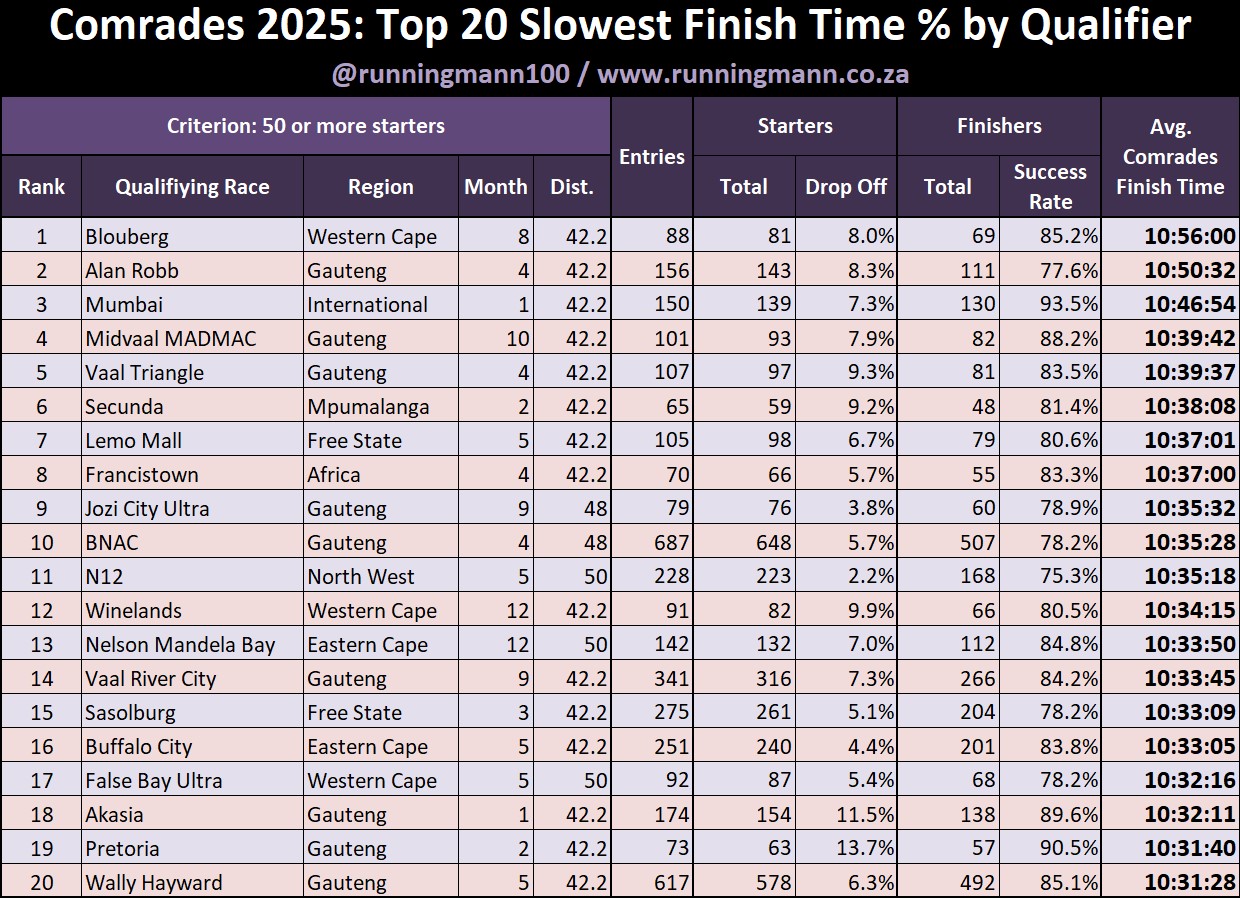
Alan Robb might have only finished second once at Comrades but the marathon named in his honour finishes second on both the most DNF and slowest average finish time lists. However, Blouberg just makes the bronze cutoff by 4 minutes to top the list. Mumbai in third brings some international flair to the podium.
Fastest & Slowest Qualifiers
Who says life is more fast paced on the highveld? Another myth busted, when it comes to marathon running anyway, with Gauteng providing a massive 14 out of the top 20 slowest qualifiers. Benoni Northerns (who host a standard marathon and a 48km) narrowly out-relax the Irene 48km to top the chart.

By contrast the traditionally more sedate Western Cape gets just two entries, the False Bay 50 in 3rd and those who make the most of the vineyards at Stellenbosch’s Winelands Marathon in 16th. The world’s two largest 50km races, Loskop and Om Die Dam, also make the slowest list.

On the fastest list, it’s a clean sweep of the podium for internationals with Valencia, Moscow and Chicago taking the honours followed by Berlin. North West athletes have been dominating distance running in recent years and their flagship marathon in Klerksdorp is the best performing South African race. The Prince Mangosuthu 52km is the only ultra on the list.
Easy Qualifiers
Some people say that there is no such thing as an ‘easy marathon’ but there are definitely ‘easier marathons.’ What impact does running one of the easier, downhill qualifiers have on success rate and average finish time?

Over 16% of the entrants used an ‘easier qualifier’ to validate their Comrades entry. Notably their drop off rate to get to the start line was almost 2% lower than the rest of the field. Many people suggest that those using a downhill qualifier will come unstuck at Comrades but the success rate was just 1.2% lower than that of the full field.
The difference of 1m23s in average qualification time should equate to a difference of about 3 minutes on finish time but the actual average finish time difference is far wider at over 8 minutes.
Conclusion: Using an easier downhill marathon to qualify for Comrades will have a very marginal negative impact on your success rate and a bigger impact on your finish time.
Tough Qualifiers
What impact does flexing with tough qualification marathon have on success rate and average finish time?
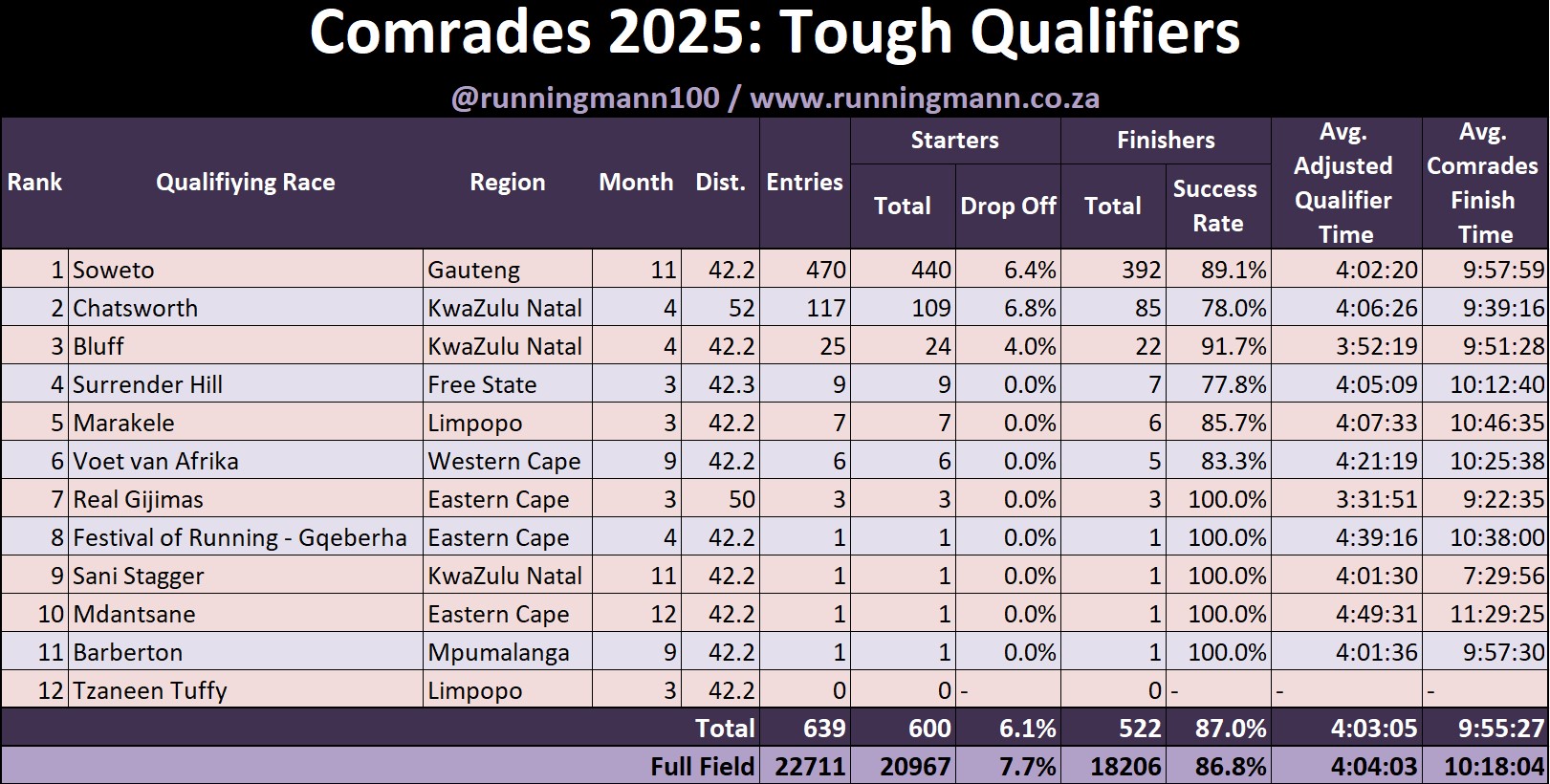
Less than 3% of the entrants use a ‘tough’ marathon to validate their Comrades entry. Those that do so have a 1.6% lower drop off rate to get to the start line than the rest of the field. However, slightly surprisingly, their success rate is only marginally higher (0.2%) than the class average.
The big difference comes in the average finish time. The average qualification times are within a minute of each other but those that qualify with a tough marathon finish about 22.5 minutes ahead of the overall average finish time.
Marathon Majors
Less than 2% of Comrades entrants secure their place on the start line with a qualifier at one of the seven marathon majors. This demographic is dominated by international runners and rich South Africans.

The drop off from entries to starters is almost double that of the rest of the field: 14.1% versus 7.7%. Generally international runners have a much bigger drop off getting to the start line so this is not entirely unexpected.
However, those that make it to the start have a significantly better finish rate, 5.4% higher than the class average. One of my hypotheses is that being a more affluent group than the average Comrades runner, this group has better access to coaching, nutrition, medical support, etc. It could also be a factor of being a cohort of ‘more serious runners.’
The average qualification time of 3:40:38 is far better than that of the full field (4:04:03) but marathon major qualifiers underperform at Comrades. The 23m25s qualification time advantage should translate into an average finish time of about an hour faster than that of the full field but the majors manage just a 28m35s gap between them and the common people.
Heading photo courtesy of Comrades Marathon Association.
Follow Running Mann:


