

In past years, it was easy to determine whether you should use your fastest marathon time or an ultra as your qualifier for Two Oceans as the seeding batches were large (typically 2000 to 4000 runners per batch), there were just six batches and there were published “time tables” for each seeding per ultra distance.
The move to dynamic allocation of seeding batches and much smaller batches makes this process a lot more difficult. In 2025 there were 14 batches (each with 800 – 900 runners) and this will be increased to around 20 in 2026. Hopefully this article will make the process transparent and which time to use as easy as possible.
For those who just want to know which time to use you can stop reading here, download the spreadsheet below and plug in your times per distance to determine which will give you the fastest marathon equivalent time. Those who want to understand the logic in more details can read on.
Everyone would agree that running a 50k ultra at 5min/km is a lot harder than running a standard 42.2k marathon at the same pace. This means that to convert an ultra marathon time to a standard marathon time we need to factor in a ‘distance discount’. The question is what that discount should be.
IMPORTANT REMINDER: Remember to log onto the Two Oceans entry portal to make sure you’ve (a) submitted your qualifier, (b) updated with your 2026 license number and (c) completed to medical questionnaire before midnight on Sunday 15 March.
Paul Murphy, who organises pace setters in the Western Cape and at many of the bigger races, and I worked closely together to figure out the most appropriate discount per distance. This is not an exact science. For example, running an easy 50k ultra like Loskop should produce a far faster time for the same athlete than running the Real Gijimas 50k in Mdantsane (which I make as the toughest 50k in the country). Likewise, weather on the day and many other factors influence runners’ times.

It is also not a straight line based on ability as elite athletes ‘fade’ far less than those at the back of the pack (i.e. as runners get slower the appropriate distance discount would increase). One additional factor is gender – women typically pace and perform much better to their potential than men. At Comrades 2025, you would need to multiply the average male runners’ marathon time by 2.59 to get their predicted Comrades finish time but by just 2.49 for women.
READ MORE: Run Like a Girl (A Guide to Optimal Pacing at the Comrades Marathon)
Both Paul and I had existing calculations that had been used in the past for various purposes so we compared notes, checked what the AI robots thought (which included checking on proper ‘expert’ opinion), looked at actual historic data and applied some real life data from runners.
Our main criterion was that whatever complicated considerations were applied, the resultant calculation itself should be as easy as possible for runners to understand. The simple calculations that we landed on are below – just multiply your ultra time by the appropriate percentage to get your converted equivalent time.
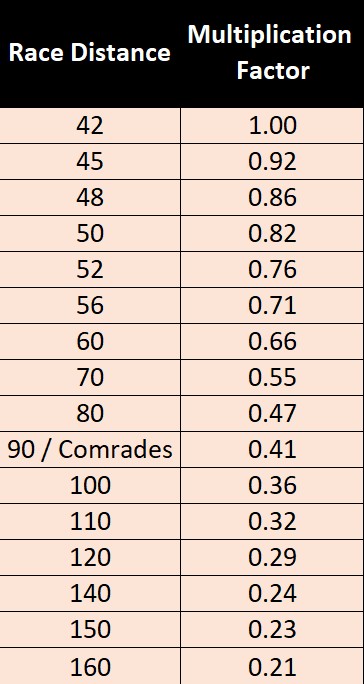
The expanded table below provides an illustration of how the distance discounts would be applied at various min/km paces. Before we finalised them, I shared this table on social media to sanity check the calculations and ratios with runners. Our calculations and logic were met with agreement and this is what has now been loaded into the entry system.

One important note is that with the Comrades distance changing every year, Comrades will always be considered a 90k distance when converting to a standard marathon (in addition, most runners are slower on the Up run despite it being a shorter distance).
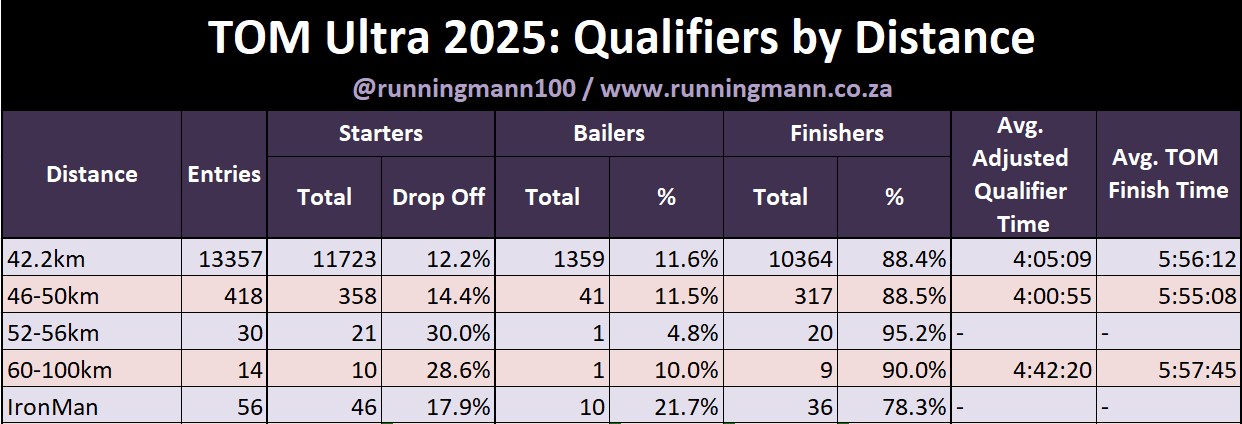
Looking at historic metrics, very few people (just 4% of the qualified entrants) used an ultra to qualify for Two Oceans in 2025. However, this year we’ve extended the qualification period so that Comrades can be used as a qualifier so I would expect the number to increase dramatically [To answer a FAQ: Yes, you can use Comrades 2025 as a qualifier for Two Oceans 2026]. There is also the possibility that in future years Two Oceans will move to full year qualification (as Comrades has recently done) which will increase the number of ultras in the qualification period.

Two Oceans 2026 runners can expect to see start times, seeding batches and in-race cutoff times announced soon. I plan to write some explanatory articles on those topics as well. Two Oceans is in a renaissance period and we’re keen to be as transparent and inclusive as possible, feel free to contact me with good ideas, constructive criticism or improvement opportunities. You can also contact info@twooceansmarathon.org.za (you can expect a response from the team or your email routed to the correct person).
Follow Running Mann:


