

The 2026 Two Oceans half and ultra marathon batch seedings are out. What’s new, what’s different and how much difference does a good seeding make? This article explains it all.
The big change is smaller batches
The one big change this year is that the seeding batches are much smaller, downsizing from about 1200 to 770 runners per batch in the half and just below 700 per batch in the full. This has resulted in an increase in the number of batches to 19 in the ultra and 23 in the half.
All batches will leave at two minute intervals* and, in the event that there is a start time delay, the in-race cutoffs will automatically be adjusted based on the time that the last batch actually starts. I will do a separate article on the cutoffs but I can confirm that they are both sensible and fair in 2026.
* with the exception of A and B batch where there is a 3 minute gap to allow a small number of wheelchair and blind runners to start 2 minutes after A and then B will start 1 minute after that.
Why Smaller Batches?
Last year it was announced that Stillwater Sports (who also manage the ABSA Run Your City and TotalSports Women’s race series amongst other events) had been appointed as the Two Oceans’ staging partner and would be responsible for the operational side of the event. I can personally attest to the difference it has made having experienced professionals involved for the first time in many years.
One of these is Operations Director Renee Jordaan whose CV includes being Race Director of Cape Town Marathon (2020 to 2022), Event Operations Director of the Cape Town Cycle Tour (2010 to 2016) and Race Director of Comrades Marathon (2005 to 2009).
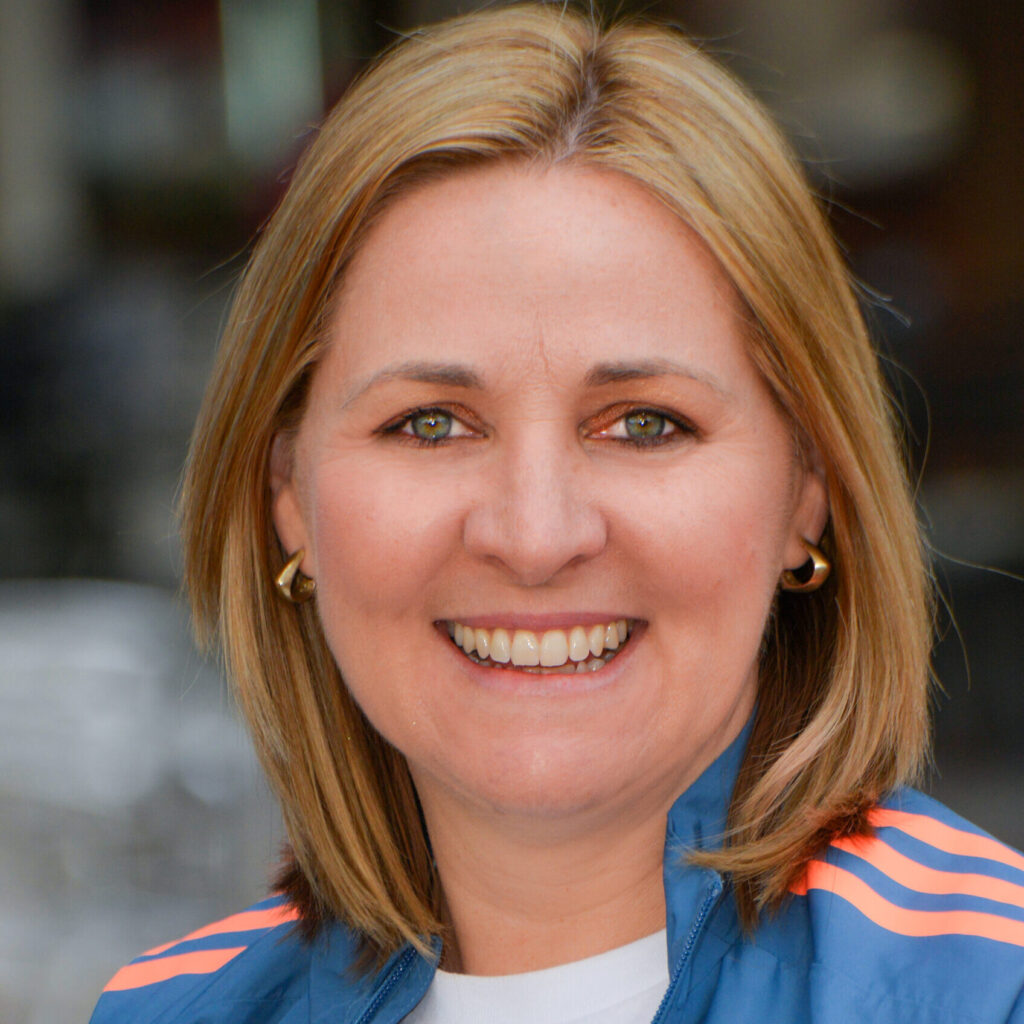
I asked Jordaan if she could explain the need for smaller batch sizes, “For 2026, one of our main priorities was reducing congestion on the route, particularly in the early stages of the race. To achieve this, we had to relook the start procedure, as it has the biggest impact on route flow. From my experience introducing smaller batches at another event in 2021 during COVID restrictions, I saw first-hand how it eased pressure at the start, improved flow on the route, and reduced crowding at waterpoints.”
That event was of course the not-quite-post-Covid Cape Town Marathon. Having participated that year, I was amazed at just how well the batches worked despite the rigorous Covid rules and regulations that had to be complied with.
Jordaan continued, “Building on that learning, and working closely with a highly experienced organising committee, we made the decision to reduce batch sizes to below 770 runners this year. I believe this will give participants a smoother race experience and less anxiety about crossing the start line”
How much difference does a faster batch make?
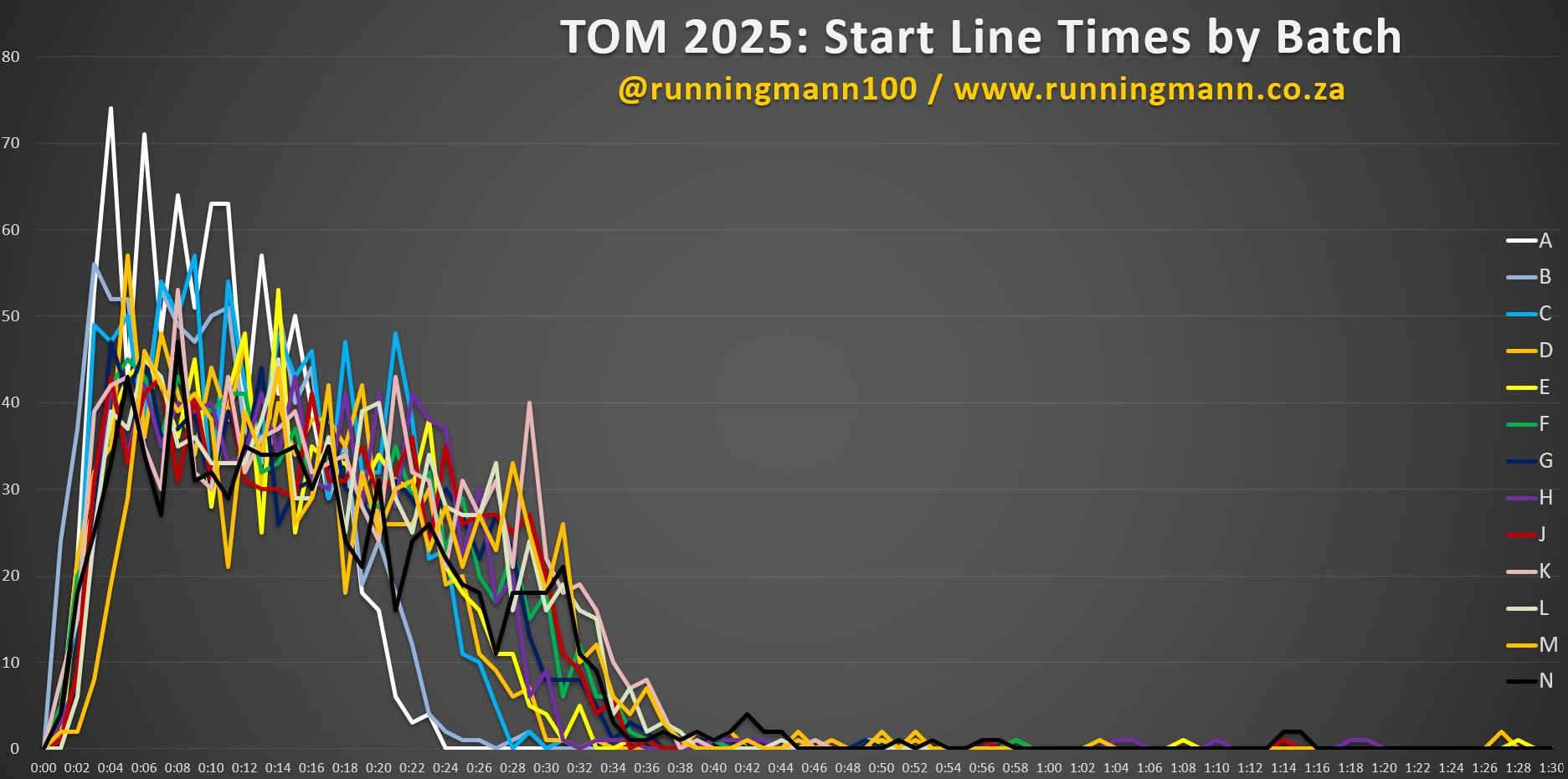
Getting into a fast batch was much more important when there was a mass, single start and back markers would take around eight minutes to cross the start line. At the 2025 Two Oceans ultra, when there were 13 batches, the average starting time was around 15 seconds. With a 40% reduction of batch sizes, the average should drop even lower in 2026.

This highlights that the batch you are in will have very little relevance to how long it will take you to cross the line. It should also be noted that the last batch (N) with a 20 second average start time was impacted by genuine late starters.
The next set of graphs highlight that almost all runners crossed the start line within 30 seconds of their batch gun firing. With both the Two Oceans ultra and half being timed batch gun to mat you can expect a maximum start line handicap of 30 seconds which is negligible on the 7h00 and 3h30 cutoffs for the respective events.

The table provides the underlying data in a heatmap format. You will notice that the total number of starters per batch is lower than the previously stated 1200. This is because there is always a drop-off from entrants to starters and we’d expect roughly the same drop-off percentage in 2026.

So, is there still an advantage with getting a better seeding? I can think of two. The first is that you don’t have to wait around at the start for as long before you get going. The second is that, heaven forbid, should there be a shortage of beer at the finish you have a better chance of getting a proper thirst quencher after the race if you finish earlier in the day.
Don’t be a lousy BJer
In past years blatant cheating has gone unpunished. I am pleased to confirm that the new board has formed a Disciplinary Sub Committee (SC) consisting of three board members (Wietse van der Westhuizen, Nombini Zaku and myself). Twenty runners from the 2025 event were disqualified for various types of cheating. We decided not to discipline 2025 batch jumpers based on the time that had elapsed since the 2025 event and the SC forming as well as that the 2025 event has been acknowledged as a ‘disaster’ and there may have been some accidental batch jumping in all the chaos and confusion.
However, in 2026 there will be a zero tolerance for cheating. Batch jumpers will be caught and disciplined. Sanctions will range from heavy time penalties to outright disqualification and being banned from future events.
Batch jumping is the easiest type of cheating to identify. If you start ahead of where you are seeded, there is a 100% chance that you will be caught.
You’re free to move backwards
Whilst starting ahead of where you are seeded is never acceptable, all participants are free to move back in the seedings to run with friends and family if they so choose. You do not need to get approval or notify anyone, you can ‘just do it’. A runner’s race time will start with the gun time of the specific batch that they start in regardless of which batch they were originally seeded in (i.e. if you drop back to a later batch, you will be automatically re-batched).
Just to be 100% clear. If you move back to batch M and start 10 minutes after your seeded batch, you will have 7 hours in the ultra and 3h30 in the half from the start gun firing for batch M to cross the finish line and get an official finish.
Blue Number Club batch privileges
There was a lot of criticism before the 2025 event about the loss and downgrading of various Blue Number Club (BNC) privileges. The loss of the traditional BNC batch was a particular bone of contention. BNC batch privileges have been restored in 2026.
In addition, a new perk has been introduced. If you are an ultra BNC running the half or a half BNC running the ultra, you get BNC batch privileges.
In the past, with single starts and much bigger batches, BNCs started in C which was around halfway in the overall field as there were only five or six batches in those days. We’ve tried to keep to the same principle in 2026.
For the ultra, all BNCs (including half BNCs) and Yellow Numbers (those going for ten in 2026) will be in J batch which is batch 9 of 19. This essentially gives all ultra BNCs a sub-4 marathon seeding as the qualification range just ahead in batch H is 3h55 to 3h59. BNCs who qualified faster than 4h00 are seeded ahead but can drop back to ‘join the club’ if they wish.
The half is slightly more difficult because of the much wider range in expected pace per kilometre (below 3min/km to over 10min/km). You also have a lot more BNCs running the half than the ultra (1345 vs 894). After much deliberation, the Race Advisory Committee (RAC) decided to have two BNC batches for the half.
The first is L (batch 11 of 23) for all BNCs who submitted a qualification time with an expected half marathon finish time between 2h15 and 2h30. As with the ultra, faster runners are seeded in higher batches but can move back to L if they wish. The second is in S (batch 17 of 23) for all other BNCs.
Essentially BNCs in L are ahead of 59% of the field and those in S are ahead of 34% of the field. The RAC felt that this was the best compromise solution to recognise the dedication and loyalty of BNCs whilst balancing route congestion and runner safety.
How are seeding times determined?
Here there is another difference between the ultra and half. For the ultra you have to have run a marathon under 5 hours or an ultra within the defined times for that distance during the qualification period (1 June 2025 to 15 March 2026) to validate your entry. The qualification times are verified by clubs.
For those that use an ultra as a qualifier there is a “distance discount” equation that is used to calculate the equivalent marathon time. I wrote a detailed article about that here: Should you use your marathon, ultra or Comrades time for your Two Oceans qualifier?
For the half marathon, runners are asked to submit a recent 10k, 15k or half marathon time. This relies on trust and there is no club verification (about 50% of the half marathon field do not belong to a club). The conversion factors for the half marathon predictor are to multiply a 10k time by 2.3 and the 15k time by 1.5. These conversion factors are higher than typical online calculators / predictors due to the challenging nature of the half marathon route.
Batch Exceptions
Apart from the BNC batches already covered in this article, there are a few exceptions to simply using qualification time.
Batch A is smaller in both races (around 250 runners) and contains elites, very fast sub-elites as well as good for age category contenders. Some of the subsequent batches will also have age category contenders grouped together. The general principle used by the RAC was to place all age category contenders in the same batch as the fastest qualifying runner in that age category.
As for what gets you into A batch on speed alone. In the ultra the ‘slowest’ non-good for age contender male qualifier is 2h47. The hardest medal to earn at Two Oceans is the ultra silver for ladies. In most years a sub-4 hour finish will be good enough for a top ten gold medal for the ladies. Therefore, all women with a sub-3h marathon (who have a shot at silver) are seeded in A.
In the half marathon you need a 21.1k time of 85 minutes or better as a male and 87 minutes as a female to get A batch privileges in 2026.
Batch Time Range Tables
Below are the ultra and half marathon batches showing total batch size as well as the fastest and slowest qualifier times per batch (the slowest time excludes good for age contenders).


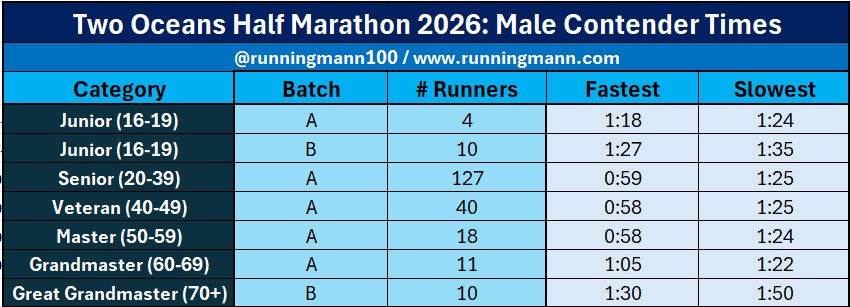
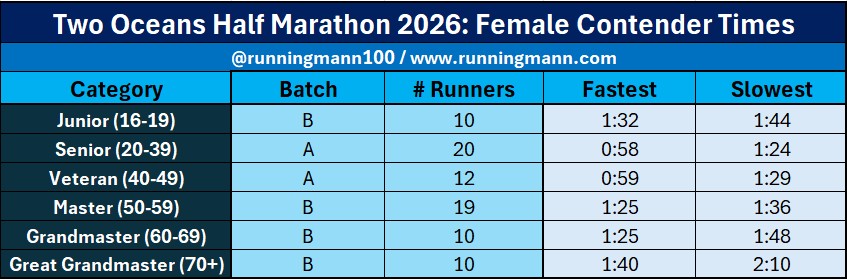
Age category contender qualification times
The tables below show the fastest and slowest qualification times for male and female age category contenders in the ultra and half marathons. As with the table above, the data excludes a small number of elite athletes.
Note: In some cases where there was a wide variance in the top 10 qualification times for a category, the decision was made to split the contenders across two batches. However, on the day, the fastest running times will count for prizes.




Thanks Stu and your Team For all your efforts to clean up this amazing Race. I just wish 1 critic of creating a colour change for the half marathoners permanent number vs the 56. Dilutes it a bit for me , Red , Pink , Kawasaki Green RAL C6 Number who cares just so that blue numbers can have some meaning for the fulls vs 10xHalves 🍻
It’s always been Light Blue for the half – if you want to have the same colour then just leave your Dark BNC out in the sun for an extended period! 🙂
Happy to hear the hardline on entitled batch jumpers, let the technology sort them out. The infamous Ms Print will need much more than her Epson to make it into A batch this year.
It’s so easy to detect. Ms Race Number Scrapbooking did try to enter again this year but is currently serving a 2 year ban from Oceans.
Access control at Dean Street should be introduced to restrict entry beyond Dean Street to batches that are lining up in the starting pens as crowding by runners from later batches make it difficult for runners about to start to get to their pens.
Quite an informative article. I wish the information on utilising the Comrades finish time was made clear earlier – or did I miss it😒….
Hope the issue of use of water sachets can revisited, whilst recognising that littering is a serious issue. Cups do have deficiencies – can’t carry, not suitable for watering self, not suitable for grab and go, water temperature in hot weather, among others.
Thank you for cleaning up last year’s debacle – hope to see results on 11th…
I did this article and a couple of social media posts about using Comrades and ultras as qualifiers: https://runningmann.co.za/2026/03/10/marathon-or-ultra-for-your-two-oceans-qualifier/
With regards sachets, they will be at the first 2 tables (and tables on both sides of the road). After that we’re running alongside SANParks ground and cannot use sachets. However, there are 3 more tables, all tables will be longer and they will be better organised.
You’ll definitely see a much better performance on the 11th. The race is in a totally different space from the disaster of 2025.
Good read
A pity the qualifying times or smaller / stricter batch requirements were not communicated ahead of time. As someone that comfortably runs under 2:47 in a marathon, but took Peninsula as a long training run and ran a 2:48, it is disappointing to miss out on batch A by 1minute this year. Especially given we missed out on the opportunity to “race” Cape Town marathon and in the past a sub-3 pretty much ensured an A-batch entry. The change effectively means I start 3 minutes behind the people I trained with for 4 months.
Hi Ronald, I’ve sent you an email directly.