

This article is being updated continually in the build-up to Comrades 2026. After 14 June I will start with stats on elite men and women, full field, etc. in separate articles.
Age
The average age of the Comrades class of 2026 is 44.3 – making this the second oldest Comrades field after 2024. The average age of the Comrades runner has steadily increased since 1990 from 35 to over 44 post-Covid.
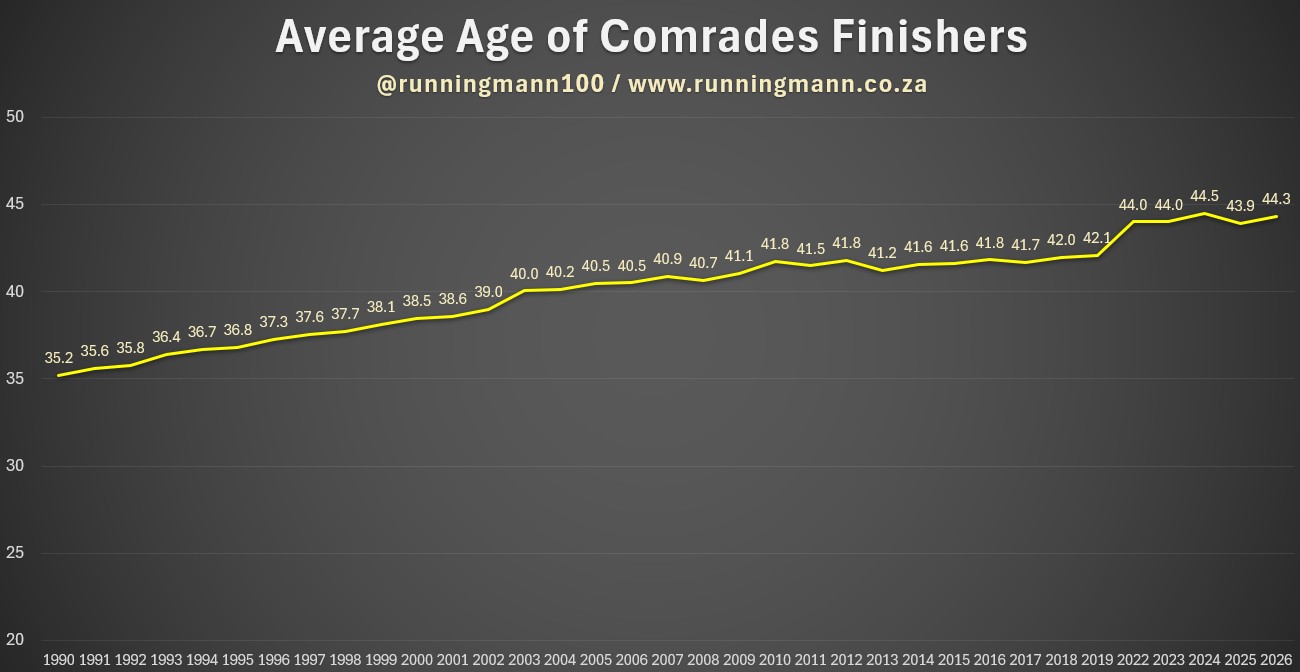
Two noticeable step changes happened. The first was a full year increase from 39 to 40 in 2003 when the cutoff time was permanently increased to 12-hours. However, the biggest increase was the first post-Covid event which went from 42.1 in 2019 to 44 in 2022. I believe this is largely due to new joiners to the great sport of road running being “lost” during the Covid shutdowns with no road running fixtures (and most participants in 2022 were already “marathon runners” pre-Covid).
All data is based on finishers except for the current year which is qualified entrants. In 2024, the average age of qualified starters was 44.3 and I expected that average finisher age for would likely decrease from 44.3 as youngsters have a far higher finisher percentage rate than the old timers. However the final average age for finishers actually increased to 44.5 because a higher proportion of youngsters did not arrive at the start line. In 2025 the opposite happened – the average age of qualified entrants was 44.5 and this dropped to 43.9 for finishers. It will be interesting to see what happens in 2026.

Almost three quarters (73.5%) of the qualified field is between the age of 35 and 54. Most Comrades runners take early retirement – there are less than 450 runners over 65 and just 97 over 70. On the other end of the spectrum, less than 1,000 starters (934) are under the age of 30. The youth of today…


The male and female charts are very comparable with a slight difference being a higher percentage of women between 35 and 44, a trend that is reversed in the older categories. The average age of men at Comrades 2026 is 44.7 and for women 42.9.

I’ve tracked novices separately. Interestingly, the bell curve is very similar but everything happens 5 years earlier with 75.7% of novices being between 30 and 49 years of age. The average age of qualified novices is 40.1 showing that Comrades is the perfect cure for a mid-life crisis.

Detailed Batch Breakdown
Here’s a comprehensive breakdown of what the batches look like at Comrades 2026. There are 21,668 qualified entrants (up from 20,574 at the last Up run in 2024 but less than the 22,670 we had in 2025 where 24,000 entries were taken). Normally the number of starters drops by 10% so I expect around 20000 starters on 14 June. This will make it the second largest Up run ahead of 2019 (19,078 starters) but well behind the overall record of 23,961 starters at the 2000 Up run.

The drop off from entrants to qualified is just 4.4% which is the lowest ever. In 2025 it was 6.2% and the 2024 Up run was 14.6%. The step change was increasing the qualification cutoff times by 10 minutes to 5 hours in 2025 which has had a big impact.
We’ve got 16 batches (as in 2025; prior to that 8 batches were used) but there are 3 starting groups in 2026. The batches are now much smaller than in the mass start days (between 1,200 and 1,550 per batch). The 2025 stats showed that everyone benefitted from the two pot start and three starts should further reduce both the average time taken to cross the start line and congestion in the early sections of the race.

Group 1 consists of just under 10,000 entrants, Group 2 just under 7,000 and Group 3 just under 5,000. This means the biggest beneficiaries of the three pot start are the 5 hour qualifiers for whom every minute counts as they should lose minimal time crossing the start line. As one would expect the average age of those within each batch generally increases as one goes down the alphabet.
What is interesting is the very different distribution of the male and female entrants by batch. There is a lot more testosterone in Group 1: 40% of the men start in Group 1 but just 5% of the women will be setting of at 5:00am. On the other hand, Group 3 has 19% of the men and 37% of the women. This further highlights how the sensible return to a 5 hour qualification time (which was changed to 4h50 arbitrarily by a former race director) benefits female runners the most.


Ironically, considering this is the best ever entrant to qualification rate, there has been some controversy around the substitution process. This year, as in previous years, substitutions closed before the qualification period closed. The difference this year was moving to a ballot system for substitutions. In the past a lot of the substitutions were coordinated directly between club members so if you were a member of one of the large traditional clubs like Pirates or Jeppe you could be almost guaranteed getting an entry if you wanted one.
Personally, I would suggest Comrades close substitutions shortly after the qualification period ends. It’s also worth noting that, the entries were slightly ‘oversold’ (22,000 stated / 22,668 allocated) – this is normal practice as there is always a dropoff. However, whist 1,000 entries went unqualified, only 332 are ‘missing’ from the 22,000.
Qualification Times
Breaking the qualification times into 15 minutes increments shows that 56% of the field takes 4 hours or longer to qualify. The average qualification time is 4:05.52 and median is 4:09:05. The biggest cohort is at the back of the pack: 4h45 and above at 16%. The next biggest cohort is the 3h45 to 4h00 range at 15.5% and a great example of the goal gradient effect (where humans will exert extra effort to finish just below the hour mark than just above it). Just 5% of the field qualifies in under 3 hours.
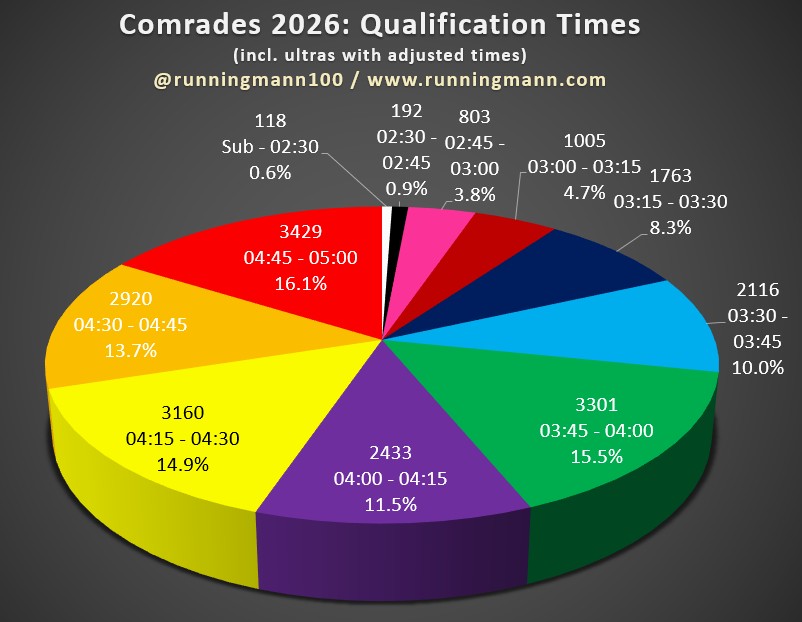
Comparing the male and female graphs further highlights the difference in speed between the genders. Almost 27% of the female field qualify in the last 15 minutes highlighting that reverting to a 5-hour qualification is playing a major factor in the increased number of female entries over the last two years. In 2025, exactly half of those who qualified between 4h50 and 5h00 went home with a medal. I expect that the success rate will increase slightly in 2026 as we have a ‘short’ Up run this year compared to a ‘normal length’ Down run in 2025.

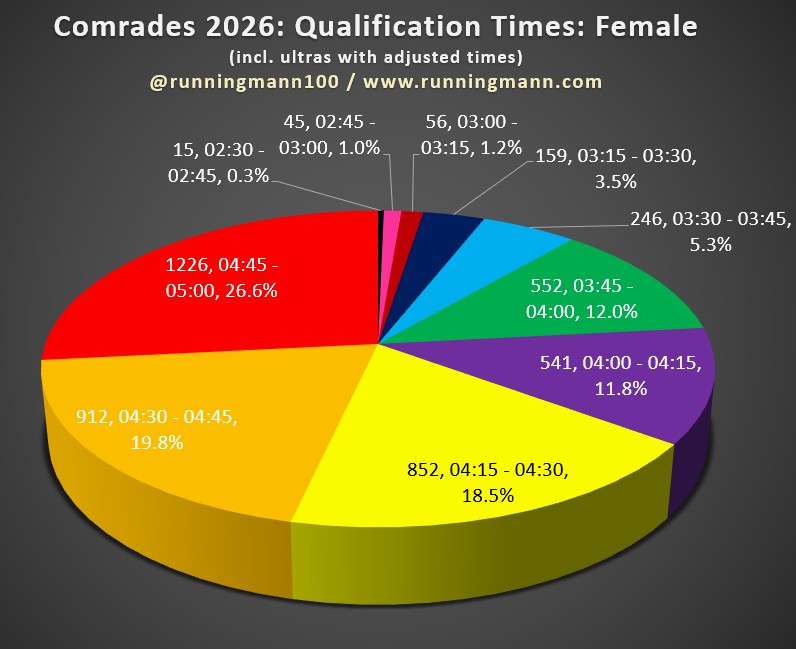

There are 2,543 entrants in 2026 who’ve benefitted from the extra 10 minutes to qualify including 1,630 men, 913 women and 938 novices. The average qualification time for men is 4:01:13, for women 4:22:35 and for novices 4:14:31.
Breakdown by Previous Finishes
Just over a quarter, 26%, of the field are novices and a further 17% are going for their second finish (no doubt the majority of these are aiming for a back-to-back medal). This is almost exactly the same percentage as in 2025. There’ll be plenty of fresh legs on display as we head up to Pietermaritzburg with 72% of the field having run 4 or fewer Comrades. Just 10% will be running in a Green Number.
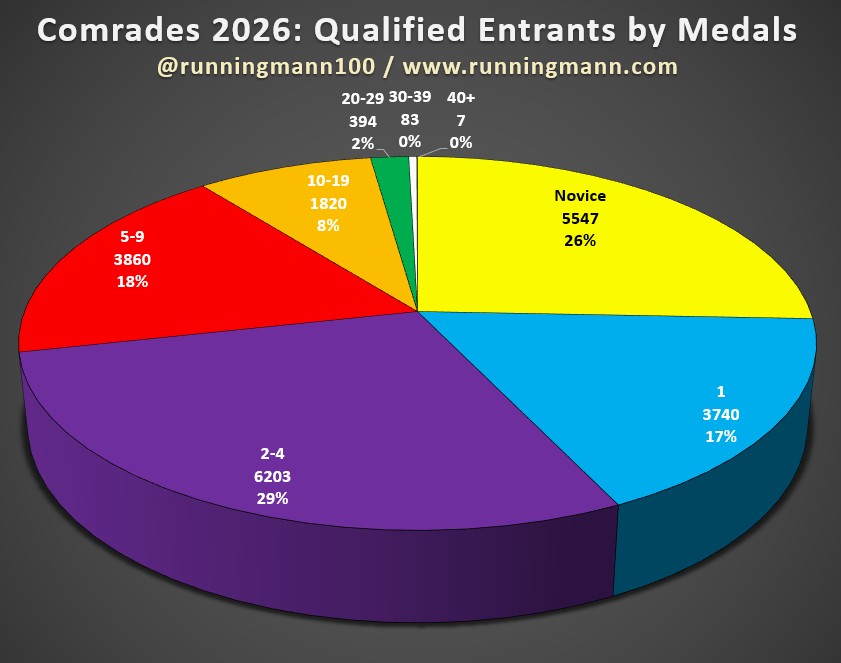
The male and female graphs look very different with more than half of the female field going for their first or second finish and just 6% running in a Green Number. In comparison, the male graph has over 48% between 2 and 9 finishes (no doubt many of whom have designs on a Green Number).
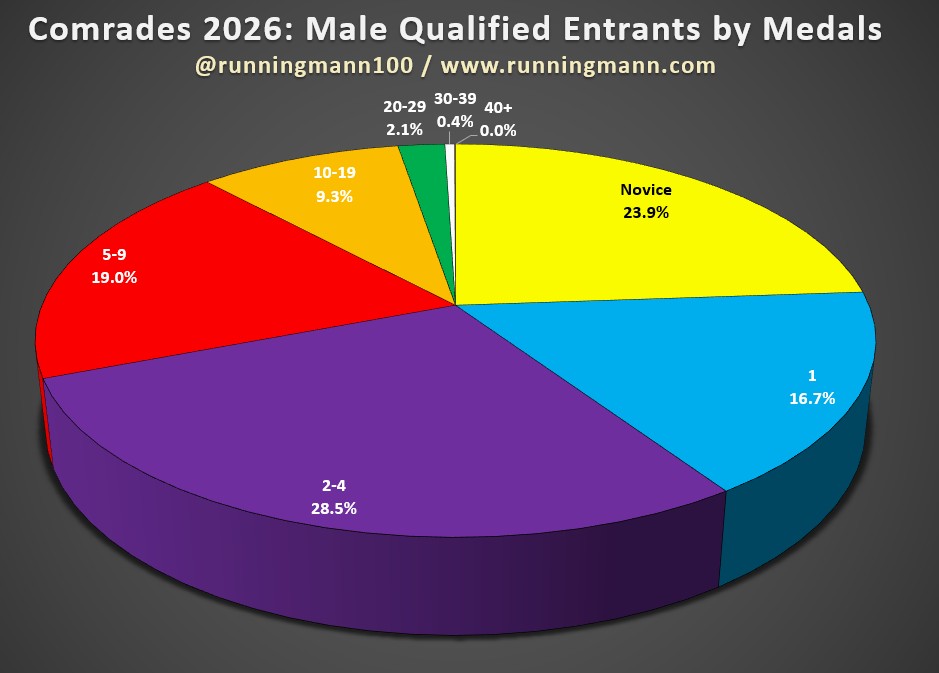
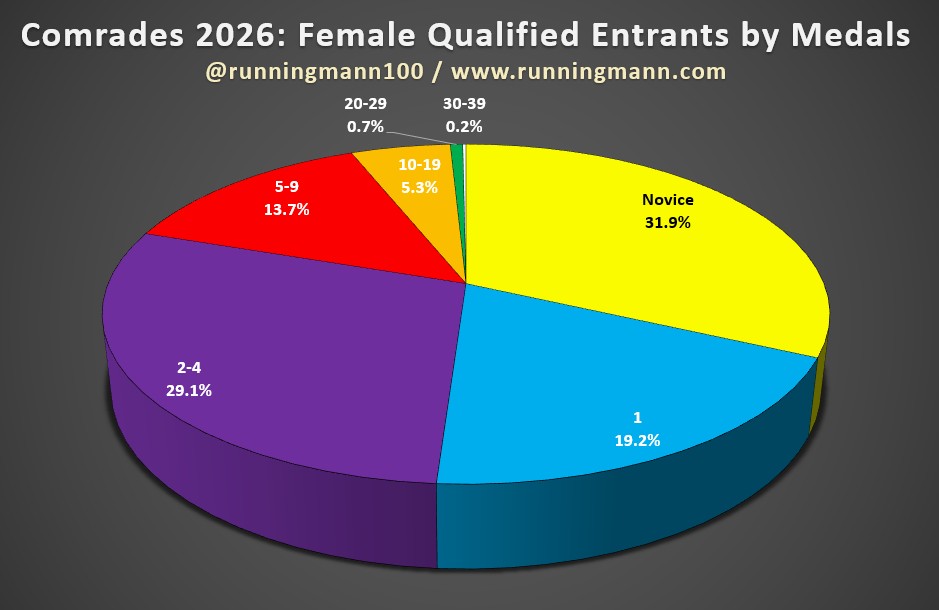
Indications are that most women are Protestant in their approach to Comrades (“two and I’m done”) whereas men have a more Catholic method to the procreation of Comrades medals. The stats have shown that women are much better Comrades runners than men (based on qualification time versus finish time). These figures indicate that they may be more sensible ultra runners as well!
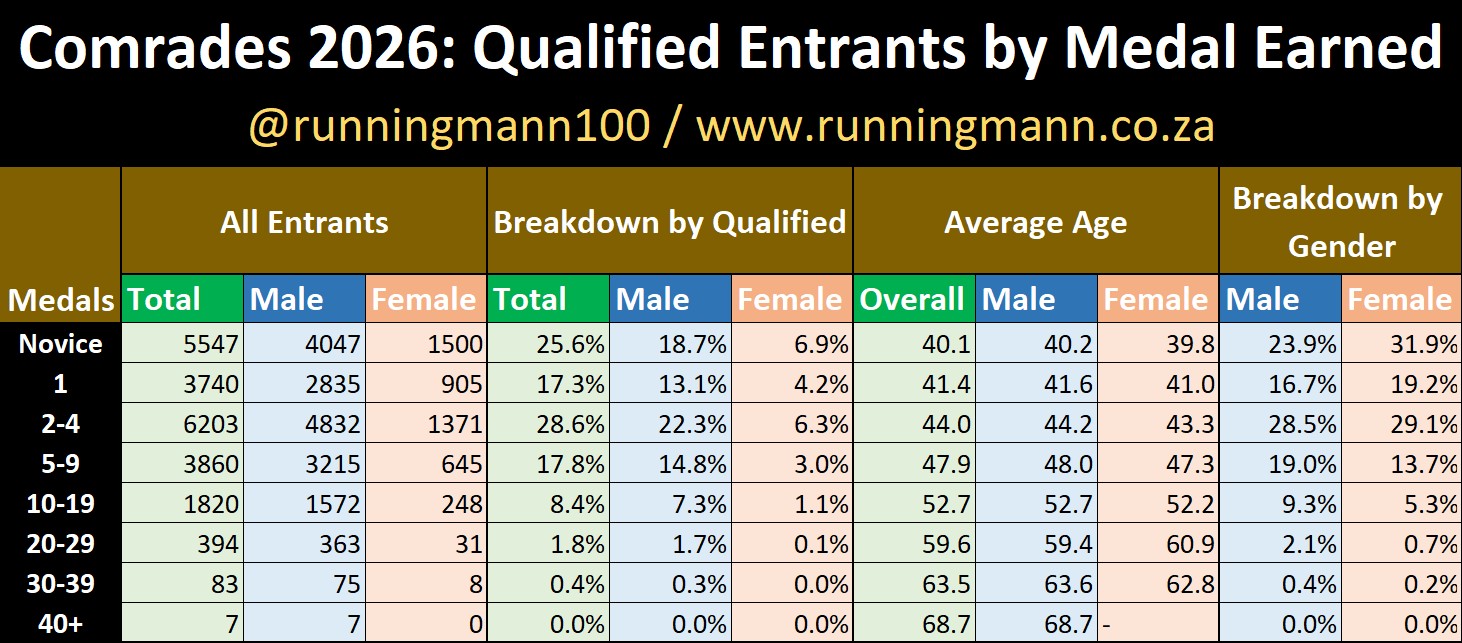
Some of the gender disparity is likely due to it being more difficult for women to train for Comrades. As my wife continually points out, global studies have shown that on average married men have 7 additional hours per week of leisure time than married women (hence my ability to write up these stats)! On a more serious note, environmental factors are definitely at play (e.g. men can run on their own, most women can’t).
There are 8 triple Green women, 6 quadruple Green men on one Louis Massyn with quintriple Green lining up on 14 June. Pinetown & Districts AC (PDAC) club legend, Wayne Scott, is the only man running for quadruple Green this year. Scott has a perfect start-to-finish record as well as 19 Silvers on his Comrades CV.
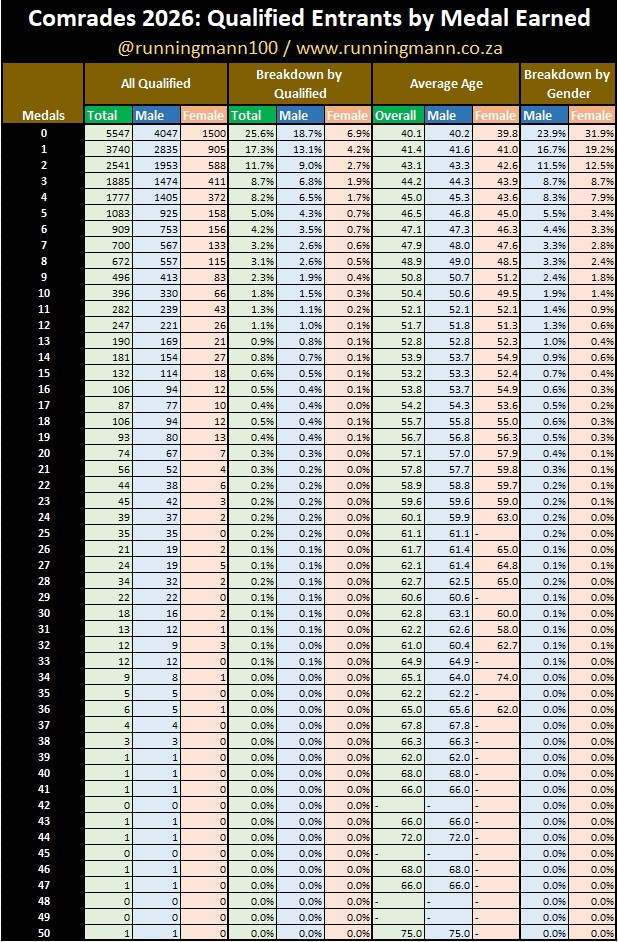
There are 22 men aiming for triple Green this year as well as 93 (80 men, 13 women) going for double Green and a massive 496 (413 men, 83 women) will be hoping to join the most prestigious club in world running. 396 runners (330 men, 66 women) will be falling for the “one in your Green Number” scam. I am one of them.
The cumulative percentage graph provides a good illustration of just how quickly the medal count heads towards 100% and that female entrants have far fewer finishes than the men.

I also took a look at the DNQs by medal. Over 40% of the DNQs are novices with over half of the female DNQs coming from novice entries. I would assume that this is because of the early entry requirement and high risk of injury in your first year of marathon running (I entered Comrades 2002 but only ran my first in 2003 due to injury). Sad to see 15% of DNQs come from Green Numbers – especially those with 30+ finishes who no doubt would like one more chance to hear Chariots of Fire before dawn. Of those with less than 10 finishes, the lowest dropout rate is those with a single finish (11.5%).
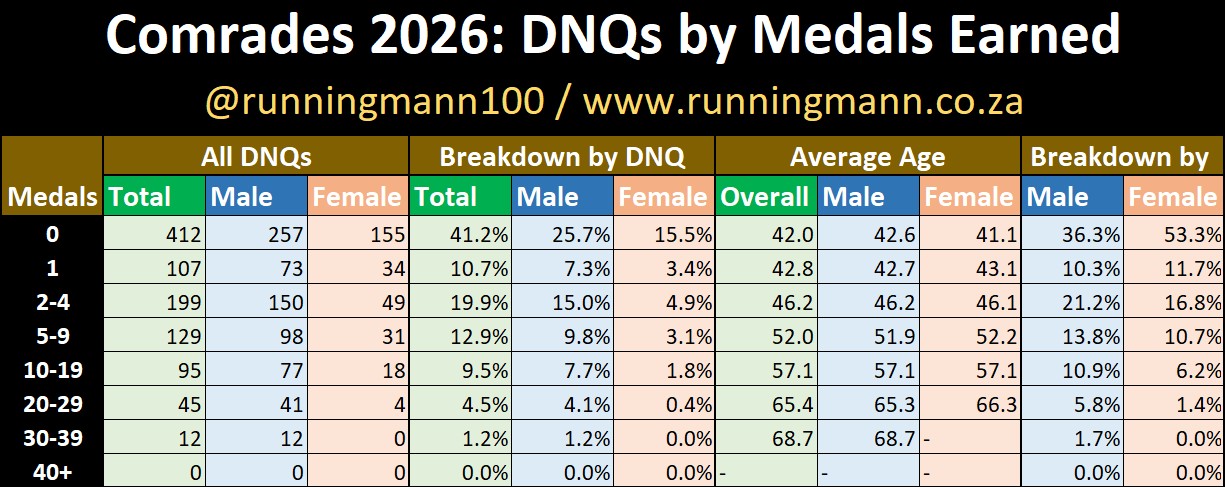
It would also be interesting to know how many women got out of this year’s Comrades by falling pregnant (my wife missed her second Comrades, the 2008 Up run, with this escape clause). Out of the blue she decided to enter this year’s Up run and it is therefore her fault that I’ll be falling for the “one in your Green Number” scam (I rationalised that it’s easier to run Comrades than to support Comrades).

Entrants by Region
Entrants by region is very similar to 2025. The biggest change is a 2% drop in international entrants which I would attribute to the race selling out in record Bill Rowan time (8h45).
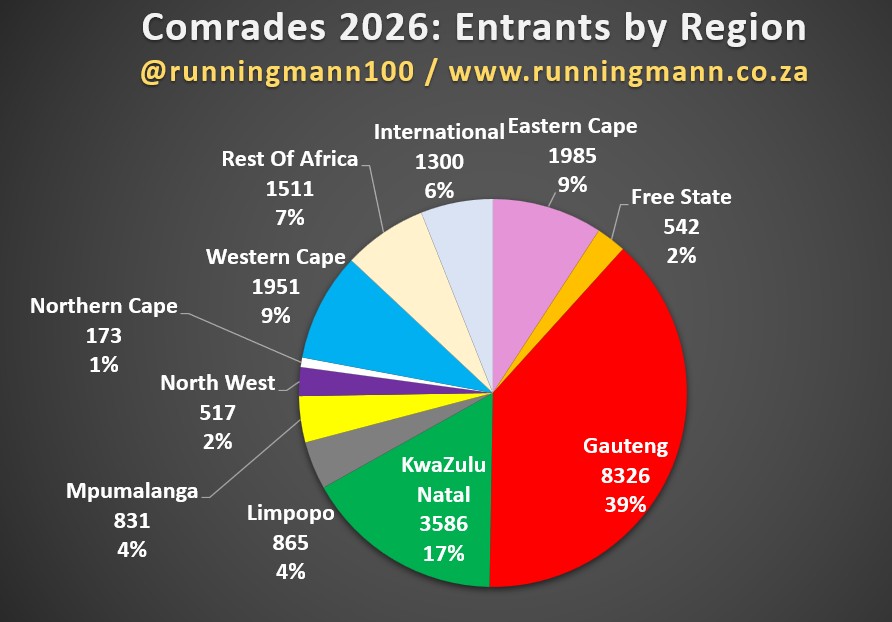
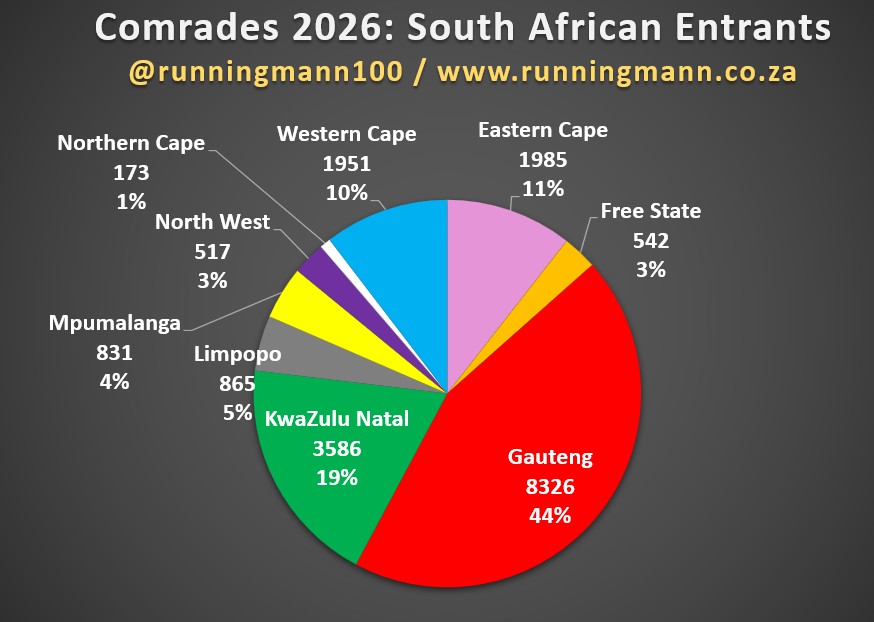
Gauteng has more than twice the number of entrants than any other province / region and, combined with KwaZulu Natal, make up 63% of the qualified South African entrants. A notable change is that for the first time, the Eastern Cape overtakes their Western neighbours for third spot. Only 173 Northern Cape runners qualify for Comrades but this may be attributable to their idiotic referees making up new rules to disqualify their runners (see https://runningmann.co.za/2026/05/24/khonkhobe-incorrectly-disqualified-by-agw-referee/ for context).
Qualifying Marathons
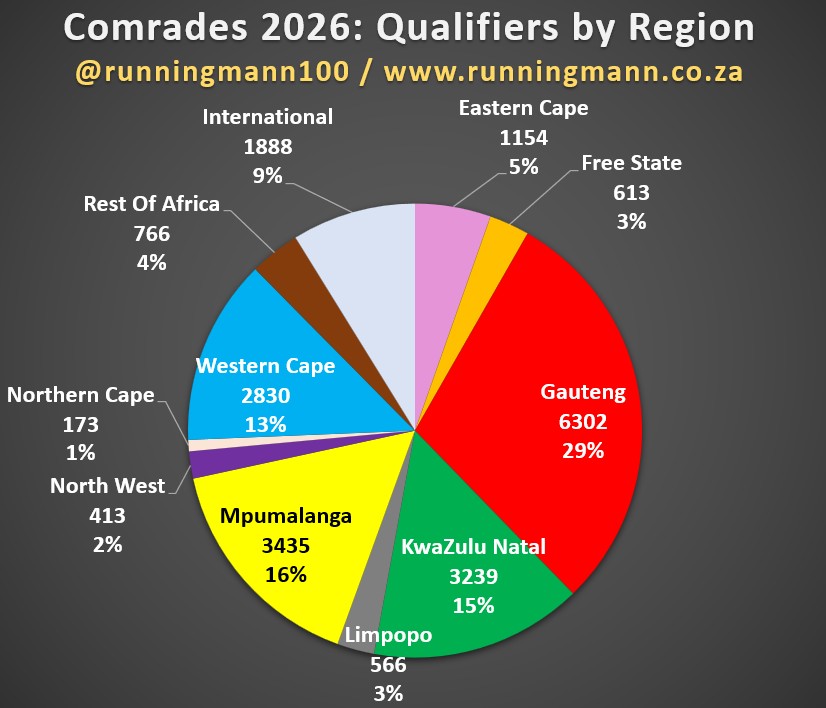
Whilst 39% of the field comes from Gauteng, only 29% use marathons within the province to qualify. However, this is 3% higher than last year. KZN are more parochial with 17% of the field and 15% using the province for qualification purposes. Many runners travel for their qualification marathon with Mpumalanga (4% of entrants but 16% of qualifiers) getting most of the tourism benefit. The Western Cape has traditionally benefitted from running tourism but drops from 23% to 13% largely as a fallout from the 2025 Cape Town Marathon cancellation.
When it comes to speed, the Eastern Cape is South Africa’s fastest province to qualify in (3h55 average) but they are pipped by international qualifiers (3h53). No other province manages under 4h. Life might moves fast on the highveld but marathon runners don’t – Gauteng is the slowest qualification province with a 4h11 average.
This year, February (20%) pips March (19%) as the most popular qualification month. This is largely due to Elands Marathon moving a weekend earlier to be in the February catchment window in 2026. April (15%) and November (14%) are the next most popular months. With Comrades offering full year qualification, the other months are starting to catch up somewhat. Last minute qualifications are the order of the day for 10% of the field who qualify on the first weekend of May.

A standard marathon is the qualification distance of choice with 90% going this route. Most of the remaining 10% run a ‘short’ ultra (which generally have a much easier average pace for seeding). There are 23 runners who qualified with a run of 60km or longer including 8 athletes who’ve flexed by using a 100km qualifier.

Amongst this group, perhaps the most interesting to watch out for are the three that used the Adidas Chasing 100 event as their qualifier: South African Sibusiso Kubheka (who famously was the first person to break 6 hours for 100k), Lithuanian Aleksandr Sorokin (holder of the 100k and 24 hour world records) and American Charlie Lawrence (holder of the 50 mile world record). It will be interesting to see how they perform at Comrades with hills and legal shoes.
After the 2025 Cape Town Marathon cancellation, the most popular qualifier title was up for grabs. Elands (a downhill flyer from Waterval Boven to Ngodwana in Mpumalanga) easily takes the gap and is the only marathon to break 1000 entrants. Jacaranda, 11th in 2025, were the marathon that capitalised the most on the CTM cancellation and end up second this year while Durban International maintains third position.

As one would expect, downhill marathons dominate the list. Other than Elands, Kaapsehoop, Tony Viljoen Border Masters, Loskop and Cango all feature. Border Masters also provides by far the fastest average qualifier time of 3h49 with Durban International (3h56) and Cango (3h57) the only others to break 4 hours. Irene 48k (adjusted to a marathon equivalent time of 4h24) is the slowest qualifier. The overall average qualifying time for Comrades 2025 entrants is 4:05:52 (slightly slower than the 4:03:29 of 2025).
Four out of ten finishers at Elands use the race as their qualifier but almost half the Vaal Marathon field (45%) use that race as their qualifier (which is impressive especially considering it was a bad weather year). On the flipside, just 7% of the Two Oceans 56k finishers use it as their qualifier although the race does move up from 9th in 2025 to 4th in 2026.
Gauteng dominates the table with 8 events in the Top 20. The only other provinces represented are KwaZulu Natal (4), Mpumalanga (4), Western Cape (3) and Eastern Cape (1). Benoni Harrier’s Johnson Crane Marathon retains their ‘Battle of Benoni’ title over their Benoni Northerns neighbours.

Comrades’ biggest international growth has come from India and this is perfectly illustrated with India’s largest marathon jumping from 7th to the summit of the international qualification chart. Pune also cracks the Top 10. Harare keeps its runner-up spot whilst Berlin drops from first to third.
Francistown, Botswana’s ‘Capital of the North’, makes a first appearance on this list as does the other African entrant, Zambia’s Lusaka Marathon.
Apart from Berlin, the only other WMMs to appear on this year’s list are Chicago and Sydney. The former is the fastest qualifier on the list (3h41 average time) whilst Pune (4h22) is the slowest.
Fastest Entrants
Seeding time for women is usually an excellent predictor for Gold medallists. In 2024 and 2025, all the female Golds came from the fastest 20 qualifiers. The lady best placed to challenge that stat is Jenet Mbhele who is 32nd fastest. Mbhele has 3 Golds from 3 attempts and is the only black South African woman to be a repeat Gold medallist.
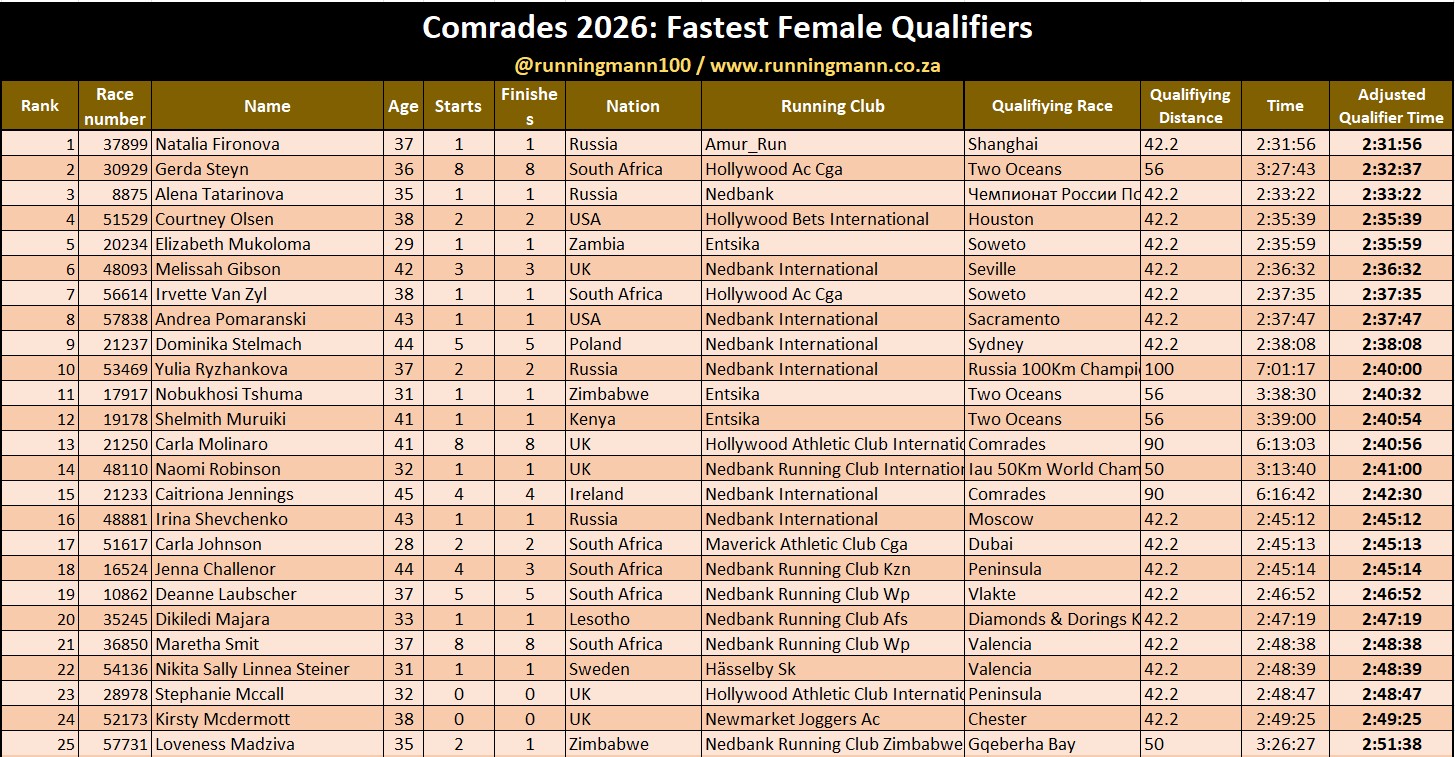
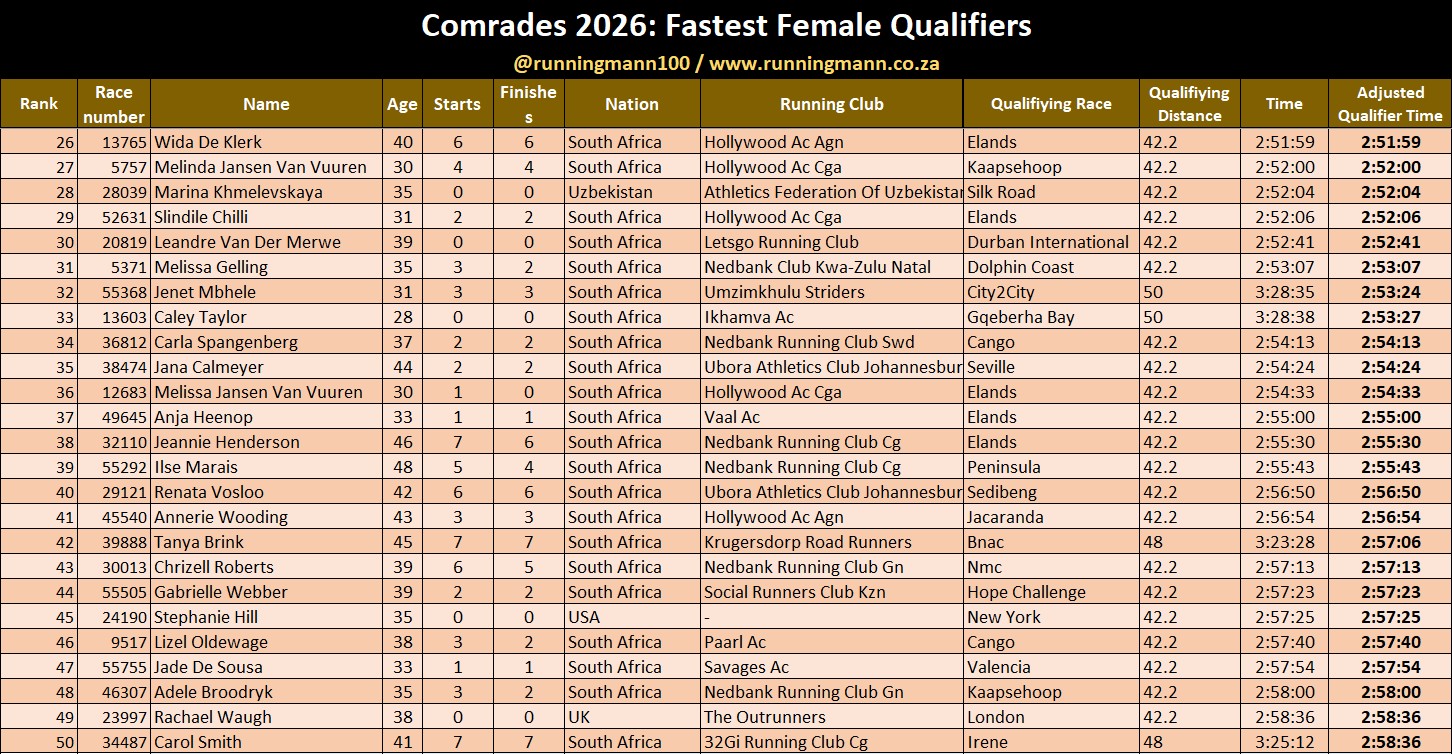
Nine of last year’s Top 10 have returned in 2025. The missing lady is former winner Alexandra Morozova who got married last year. The fastest debutant is Stephanie McCall from the UK in 24th position. Just behind her is another novice, Kirsty McDermott who will not doubt attract the attention of former race director Rowyn James as she is running in Newmarket Joggers AC kit.
One runner to watch will be 4th fastest Courtney Olsen. Olsen podiumed with a 3rd place in 2024 and followed this up with another Gold in 2025. I had a chat with her after the Two Oceans prize giving (where she finished 7th) and she feels that the Up run is much better suited to her running style.
There are just two ladies under 30 in the Top 25 – Zambia’s Elizabeth Mukoloma who finished 18th in 2025 and Carla Johnson from Mavericks AC who will be hoping to improve on her two Silvers to date. The other Carla in the Top 25 (Molinaro) is lining up for a ninth time and will be hoping to get a short cut to a Green Number with a fifth Gold.
The depth in the female field is slowly improving with 60 sub-3 qualifiers in 2026 from 56 in 2025 and 52 in 2024. However, I can’t see anyone challenging Gerda for a 5th Comrades title. Gerda is second on the qualifiers list but I can find no record of Russian Natalia Fironova, who is listed as having a 2:31:56 at Shanghai Marathon in their 2025 results. Fironova finished last year’s Comrades in 8:42:29 and seems unlikely to challenge Gerda in 2026.
The men’s Golds are much more difficult to predict – and this year we have arguably the strongest field of all time. In 2024, seven of the men’s Golds came from the Top 50 and in 2025 it was just five from the Top 50 and two from the Top 20. The slowest qualifier time to earn a Gold in 2025 was Vasilii Korytkin in 85th.
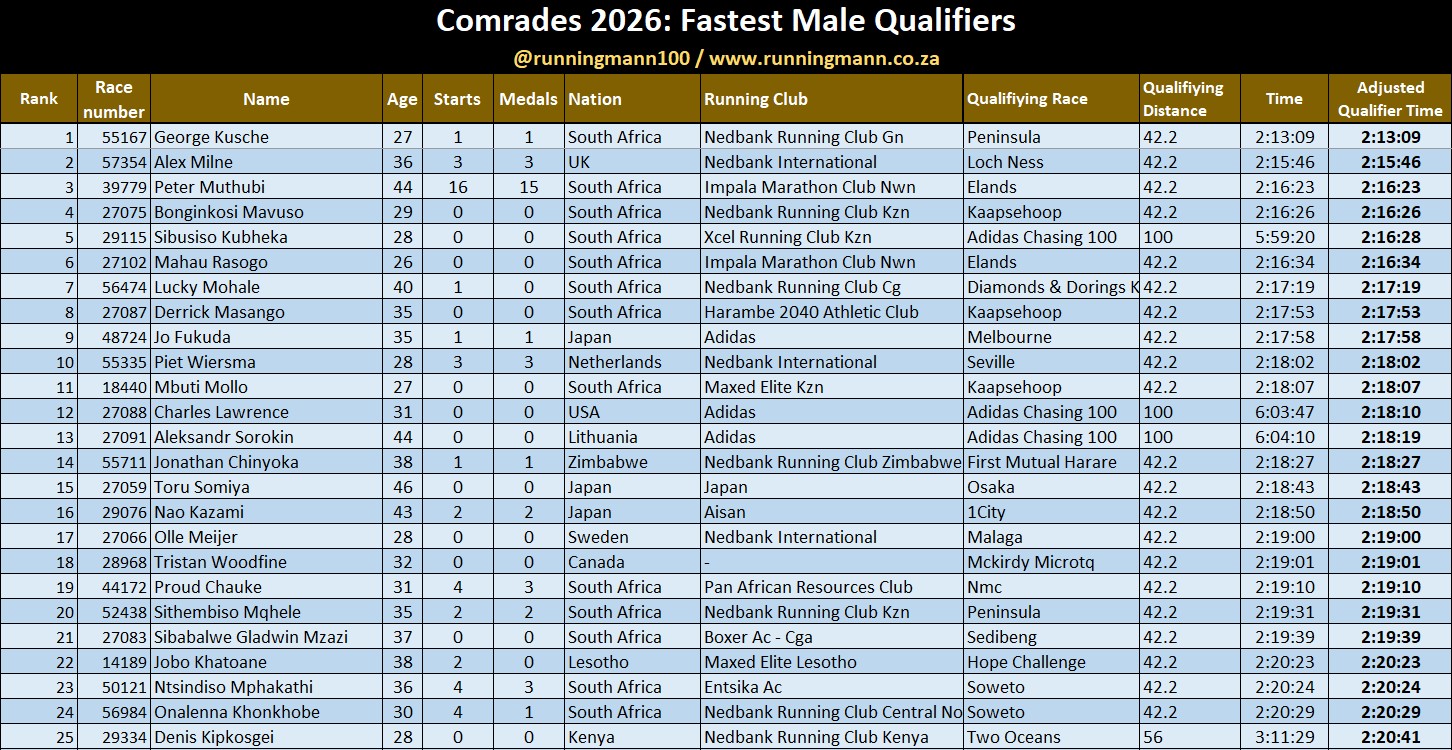
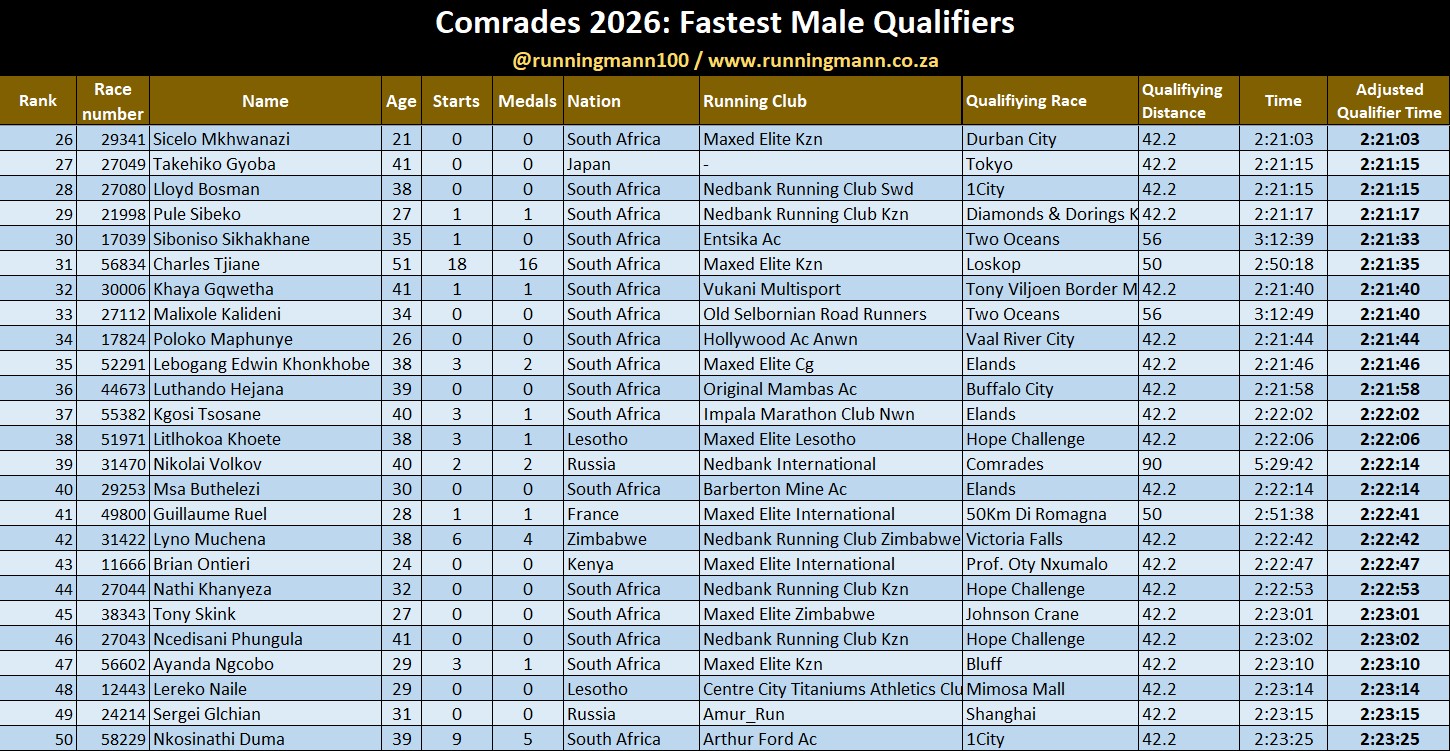
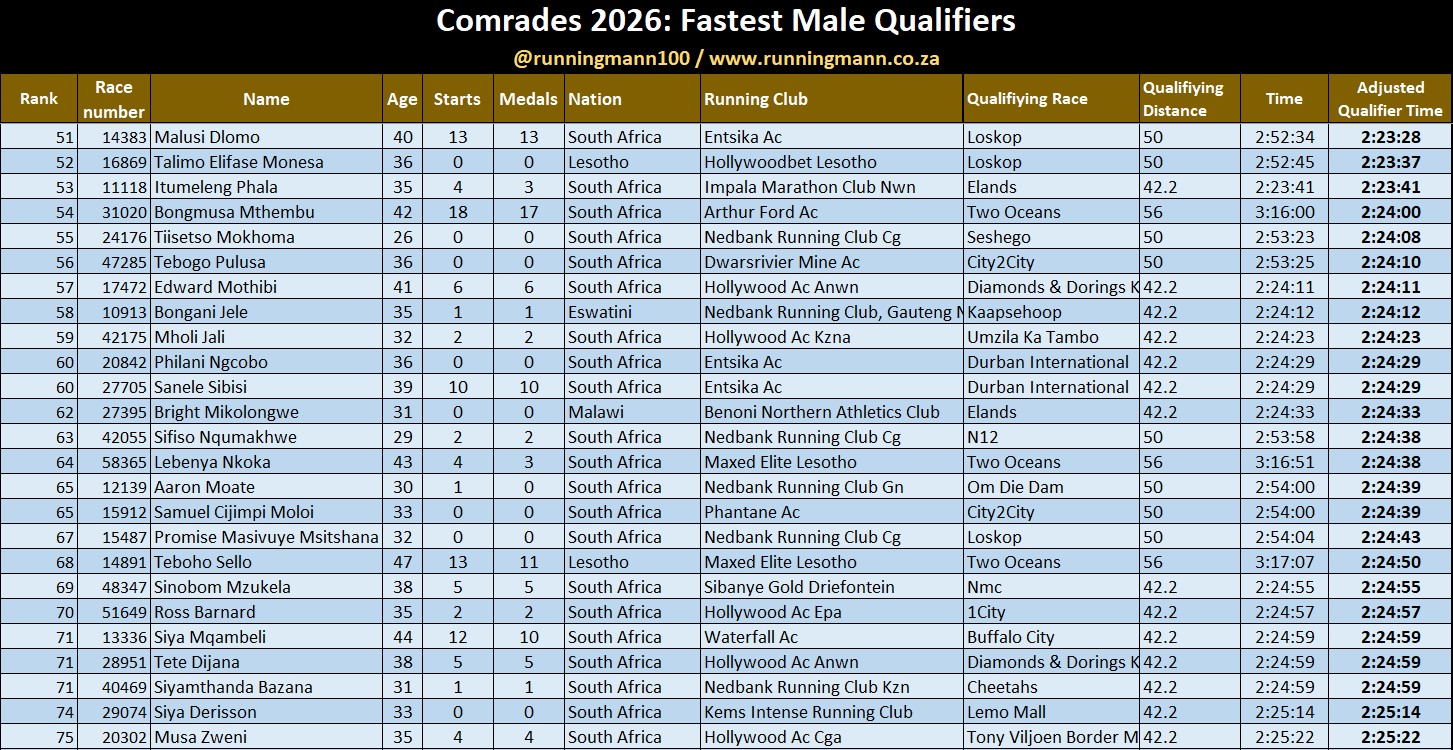
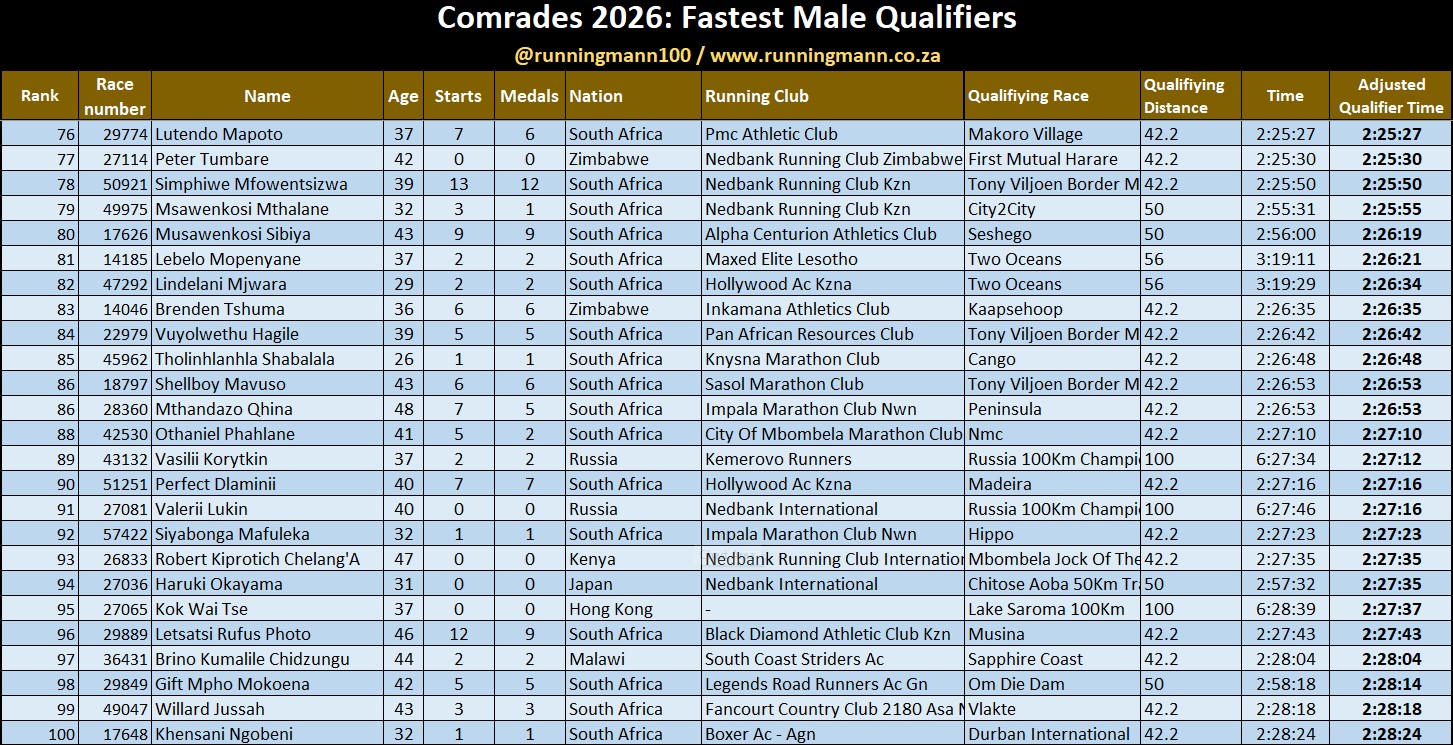
George Kusche has the fastest qualifier with his Peninsula win in February (note the Peninsula time was adjusted from his actual winning time as the course was about 600m long due to a marshalling error). Kusche had an impressive debut run in 2025 finishing 12th and looks to be a good bet to upgrade from a Wally Hayward to a Gold medal in 2026. I was having a Messenger chat with George earlier this week and after mentioning that he seeded #1 he replied, “My philosophy is that none of that matters. I just have to focus on arriving at the start line fresh, focused and ready.”
With two Golds from three starts, Alex Milne in second* is another good bet for another Top 10 this year. Milne comes in with good form having won the 50k World Champs earlier this year in March. Whether Tete Dijana (71st fastest) and Piet Wiersma (10th) continue their rivalry from recent years or have a few gatecrashers to their two-horse party remains to be seen.
* Apparently Milne ran a 2:11:41 at Seville in February which would make him the fastest qualifier had he submitted that time.
All 2025’s Gold medallists return in 2026 but three are outside the Top 100 qualifying times: Gordon Lesetedi (101st), David Gatebe (110th) and Joseph Manyedi (164th). Those further just outside the Top 50 include Bongmusa Mthembu (54th) and the winner of the 2019 Up run Edward Mothibi (57th). Mthembu is currently level with Bruce Fordyce on 11 Golds and will equal Alan Robb’s record haul if he manages another Top 10 finish in 2026.
Last year’s 3rd placed finisher, Nikolai Volkov, is another strong contender for a Gold if he gets his pacing right. On his debut 2024 Up run he bombed badly and ended up with one of the largest positive splits in the field. But perhaps the man who’s pacing will be most closely monitored is one of South Africa’s most exciting ultra running talents, 24th seeded Onalenna Khonkhobe. In 2025 Khonkhobe applied a “lead until you bleed” strategy which ended with a DNF.
Cuan Walker has been instrumental in getting three prominent ultra runners from the Adidas Chasing 100 to the Comrades 2026 start line: Sibusiso Kubheka who famously broke 6 hours for 100km (although the record is unofficial as illegal shoes were used), Lithuanian Aleksandr Sorokin (holder of the 100k and 24 hour world records) and American Charlie Lawrence (holder of the 50 mile world record). It will be interesting to see how they perform at Comrades with hills and legal shoes.
I don’t follow the elites closely so I enlisted the help of Swedish ultra running statistician Daniel Westergren. Westergren’s evaluation of Charlie Lawrence, “Top 6 or DNF I’d say. Did 6:03 in the “illegal” Adidas sub-6 event and 6:07 half a year ago at Desert Solstice. And his 4:48:21 is the current 50M world best.”
However, he was more dismissive of Sorokin’s chances, “Sadly, I think we’ve seen the best of him, at least in these shorter distances, even though he did an impressive 6:04 at the illegal Adidas event. And he has trained like a monster. So maybe….”
Apart from those I’ve already mentioned, Westergren highlighted the following runners to watch:
- Guillaume Ruel. Another with great potential, who DNFed at the 100K WC (like Lawrence). Definitely top 6 potential.
- Haruki Okayama. I’d have loved to see Jumpei Yamaguchi at Comrades, but Okayama was #3 at the last 100K WC and won in 2022. Great guy. Okayama wrote to me: “of course I’m only aiming to win!”
- Olle Meijer. A Swede who is yet to show his full potential. 6:20:51 in my hometown is the Swedish record, but not ideal course. Was in the top trio at the 100K WC when he DNFed. If Elov Olsson could be #7, Olle can fight for the podium.
- Elov Olsson. Well, #7 last year…. always running well and definitely top 20 again.
- Jo Fukuda. Only #20 last year. But won Wings for Life again this year, for the 4th time in the last 5 years. He should do better if he plans the race well.
- Another Japanese, the samurai Toru Somiya! #4 at the 100K WC
- Takehiko Gyoba I know nothing about, other than that he was #2 in the 100K WC in 2018, the only ultra up to now other than the 6:22 he ran at Lake Soroma also in 2018.
- Then there are of course other African runners, like Ketema Ngasa from Ethiopia. And Hong Kong runner Kok-Wai Tse was #8 at the 100K WC, ahead of Elov Olsson, so maybe he should be mentioned too.
Westergren summed up his evaluation of the men’s Comrades class of 2026 as follows, “An EXTREMELY strong international field!” He’s also put together a basic ranking system listing Comrades, Two Oceans, 100km and 50km PBs and link to athlete profiles here: https://ultramarathon.se/comrades
We’ll find out just who prevails and who travails around lunchtime on 14 June.
After posting the above on Facebook, Cuan Walker pointed out the Jumpei Yamaguchi is in fact running:

Top 100 Clubs
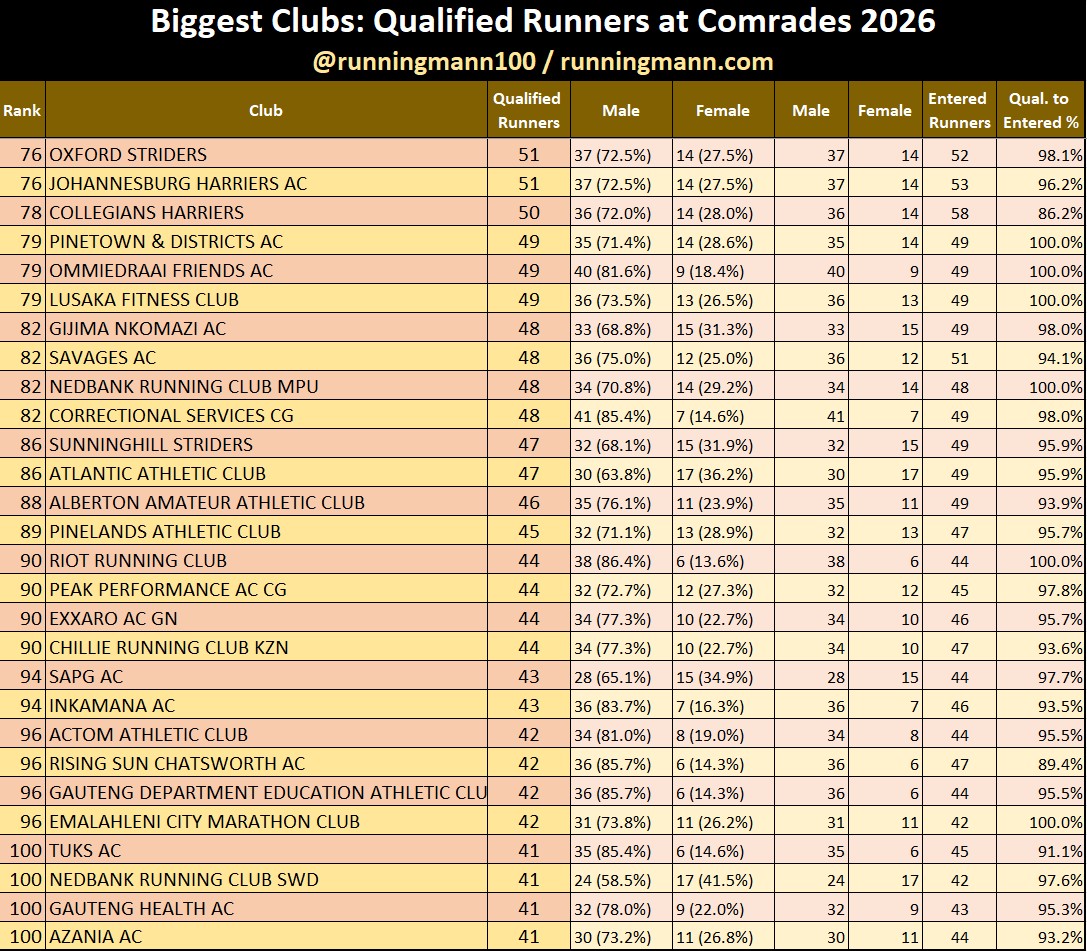
Here are the 100 clubs with the biggest representation at Comrades 2026. Hollywood AC KZNA keep their spot at the top of the chart but can’t quite break the four figure mark this year. They also have an excellent entered to qualified conversion rate of 96.8% (their CGA branch in 6th does even better with 99.1%).
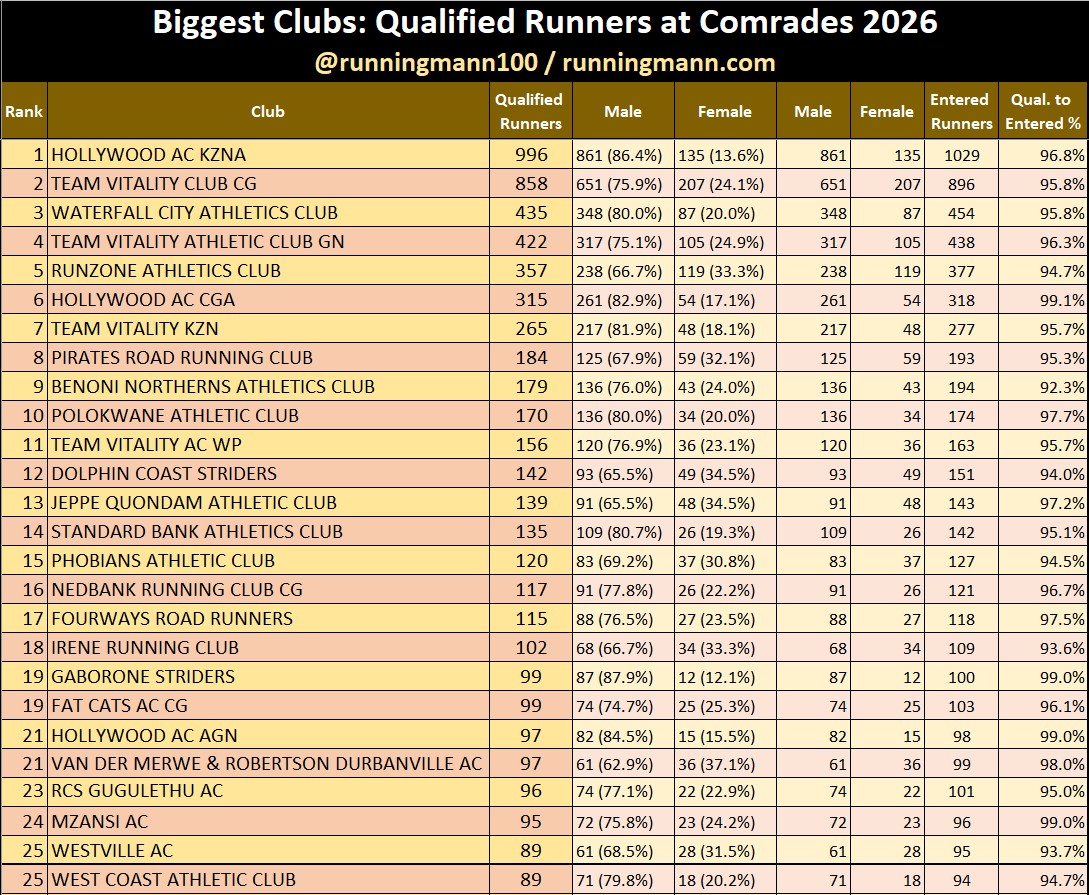
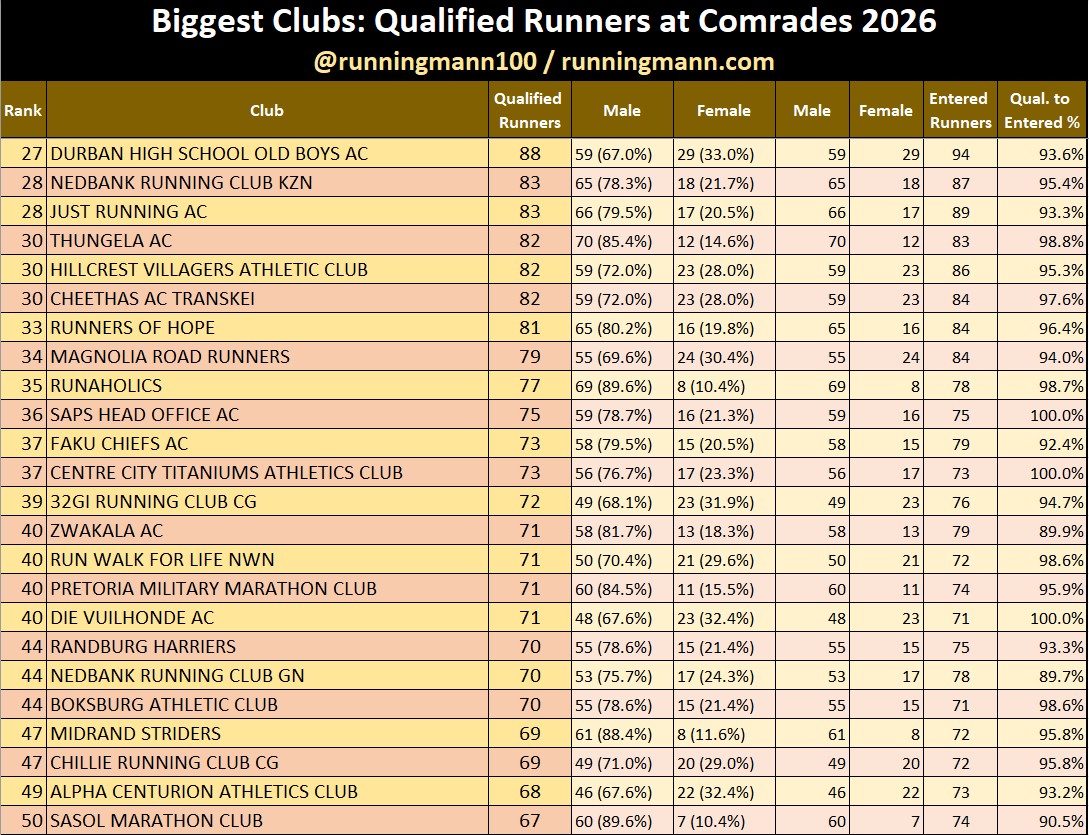
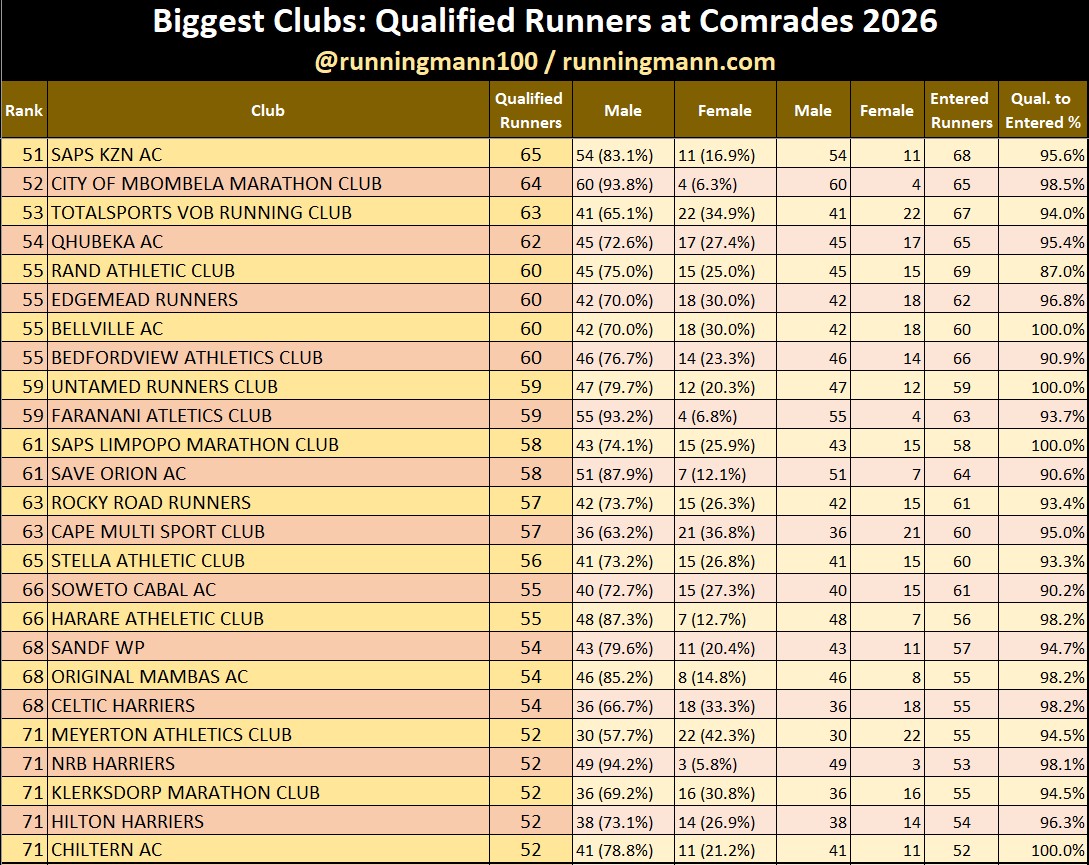
Team Vitality CGA keeps second spot but Waterfall City AC displace Team Vitality AGN to get a podium place for the first time and are the largest ‘regular’ running club at Comrades 2026. The only other regular running club that can compete with the Hollywoods and the Vitalities is RunZone in 5th.
Pirates are the largest of the ‘old school’ traditional clubs in 8th narrowly followed by one of South Africa’s great Comrades clubs, Benoni Northerns in 9th. Limpopo’s Polokwane AC grab the final Top 10 spot.
Barry Holland’s Dolphin Coast Striders are the largest regular KZN club with Westville AC also cracking the Top 25. Pretoria High Old Boys (bolstered by 37 old girls) in 15th grab regular club bragging rights north of the Jukskei. In the Western Cape, Durbanville AC (21st) have one more qualified runner than Gugulethu AC. Gaborone Striders in 19th are the largest non-South African club and Runaholics from Pune, India in 35th are the largest offshore group.
A special shout out to the mighty Fourways Road Runners in 17th who crack triple figures for qualified entrants for the first time in their history. I am pleased to say that I have boosted this number by one for the first time since 2019.
Credit must go to SAPS Head Office AC who are the largest club to score 100% on the Comrades 2026 attendance register (perhaps the allure of over 40,000 litres of free cool drink has something to do with it). Other clubs in the Top 100 with 100% qualification rates are: Centre City Titaniums, Die Vuilhonde, Bellville, Untamed Runners Club (from Gaborone), SAPS Limpopo, Chiltern, Pinetown & Districts, Ommiedraai Friends, Zambia’s Fitness Club, Nedbank Running Club Mpu and Riot Running Club from Zimbabwe.
This year female entrants rises to 21.7% from 20.4% in 2025. However, Pretoria Bobbies (34.1% female) and Meyerton (42.3% female) top the diversity stats. It is notable that three Old Boys clubs – Jeppe Quondam, Durban High School and VOB – manage to have over a third of their runners coming from the fairer sex. Other clubs in the Top 100 that can boast more than one in three ladies are: RunZone, Dolphin Coast Striders, Irene, Durbanville, Cape Multi Sport, Celtic Harriers, Atlantic, Maverick AC and SAPG.
However, if you are a straight lady or a gay guy looking for talent, then the three clubs to join for a training run with potential benefits (90% or greater male) are NRB Harriers, City of Mbombela and Faranani Athletics Club.
Youngest Starters
All but one of the youngest men at Comrades 2026 are novices and 8 of them still wouldn’t be able to drink legally in America. Ruan Uys has the distinction of having spent less days on this planet than any of his compatriots and qualified with an impressive 2h54. However, the fastest youngster is William van Tonder with 2h51.
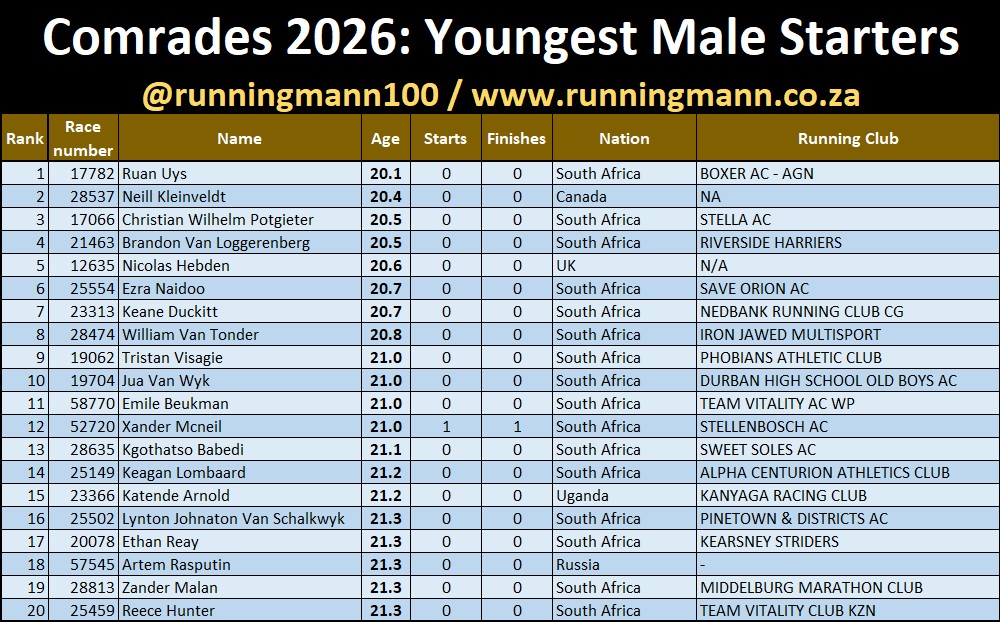
Xander McNeil is the youngest male going for a back-to-back medal. He is a beneficiary of Comrades’ sensible decision making. Xander survived the terrible weather at the False Bay 50 only to get a technical disqualification on the finish line for not displaying his front license number correctly. I’m glad that 2025’s youngest Comrade will be lining up with the rest of us on 14 June.
On the ladies’ side, there is just one under 21, Bailey O’Leary, from the UK. Bailey is probably the worst name you could call your kid if you want them to be a successful ultra marathon runner but I am sure we’ll see her with a medal in Martizburg.

There are three back-to-backers with Minkateko Letsoalo being the youngest. Ela Meiring, on her fourth run, is already close to achieving veteran status and also has the fastest qualifier on this list with a 3h21 from Cango.

Oldest Starters
Here’s the oldest 20 men who’ve qualified for Comrades 2026. Top of the charts is the evergreen Johannes Maros Mosehla who is running for the 4th time in the octogenarian category. He is a good bet to add another digit to the oldest ever Comrades finisher record.
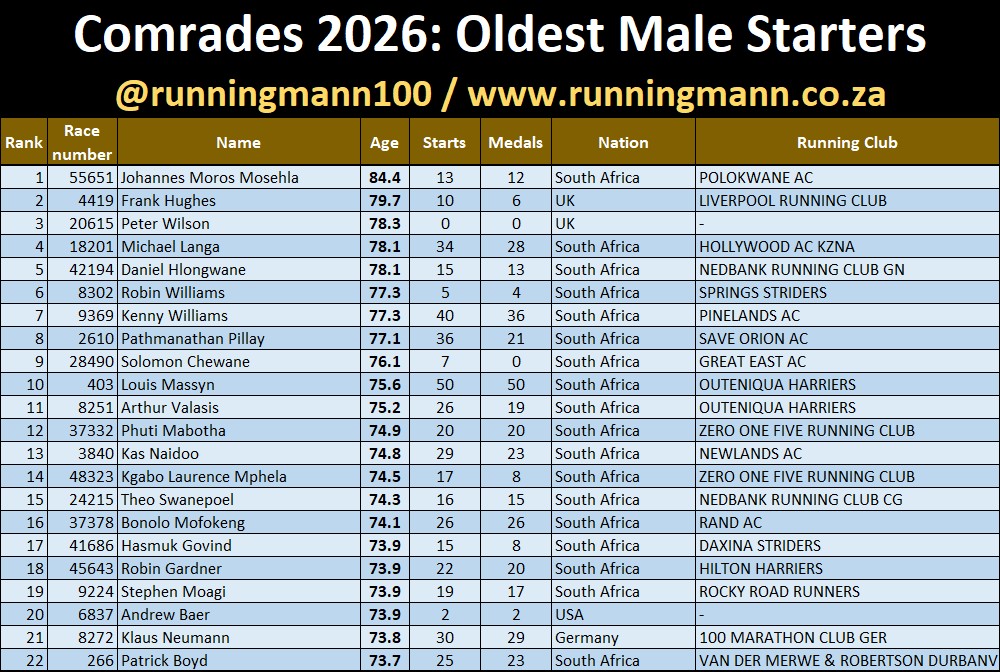
Mosehla is an incredible outlier, there are just three humans who’ve completed Comrades at 80 or older. The first was Wallace Hayward who many would name as the greatest Comrade ever. Last year Matule Headbush became the third but this year there are no other octogenarians lining up on 14 June. Frank Hughes from Liverpool as second oldest is still a few months shy of his 80th birthday.
This year’s oldest novice is 78-year-old Peter Wilson, also visiting us from the UK. If you’re looking for someone to follow on the app and give good vibes, I’d suggest #28490 Solomon Chewane, who has 7 starts but no medal to show for it yet. I’ll definitely be rooting for Solomon on Sunday!
The incredible Louis Massyn finally cracks the Top 10 oldest and will be back for a 51st Comrades medal after this historic half century achievement in 2025. Of note is that the chasing pack are all too young to make this list: Vic Boston 66yo with 47 finishes, Wietse van der Westhuizen 68yo with 46 finishes and Alan Robb 72yo with 44 finishes.
The only man on the list still running sub-4 marathons is Rockies’ Stephen Moagi who cruised around Johnson Crane Marathon in 3h55. I decided to do the list to the Top 22 as I saw that frequent commenters on my FB page Klaus Neumann and Patrick Boyd just missed the Top 20.
Women live 5 to 7 years longer than men but tend to hang up their Comrades shoes much earlier. These two facts may be correlated. There is just one woman who has finished Comrades over the age of 74: Petra Myburgh. Petra is not running in 2026 but there are three great dames over 74 who will be aiming to achieve this impressive feat.
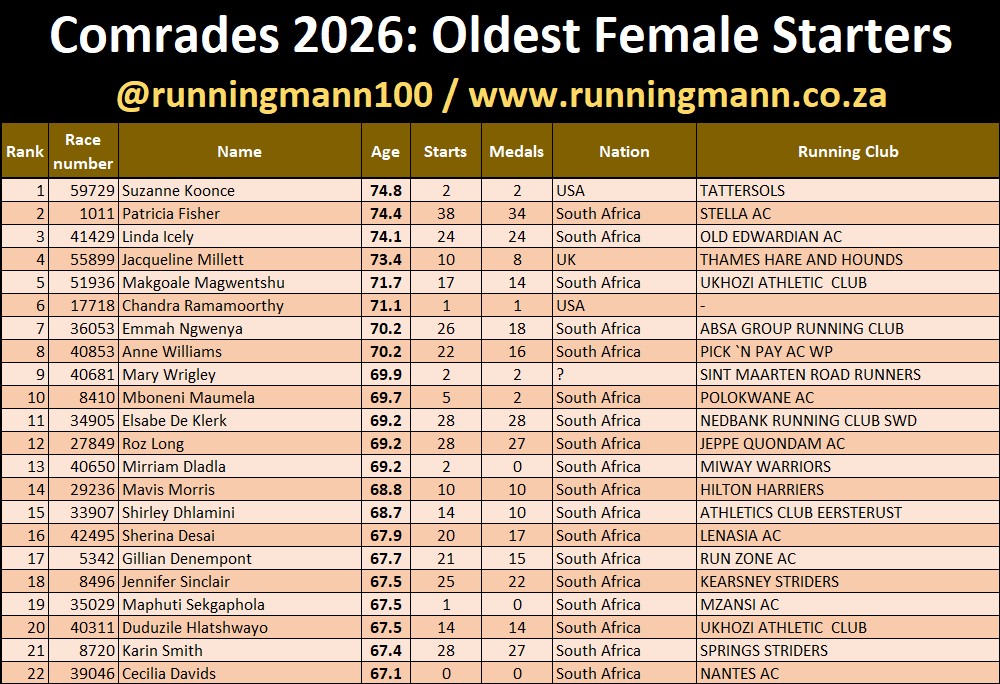
The oldest is Suzanne Koonce from the USA who last ran in 2024 and is back for her 3rd run. When Suzanne crosses the finish line on 14 June, she will be the oldest ever female finisher. Local Stella AC legend, Pat Fisher, went the distance in 2025 but couldn’t beat the clock. She’ll be gunning for her 35th finish. The youngest member of the 74+ trio is Old Edwardians’ Linda Icely who was the oldest lady finisher in 2025 (and a good bet to get her 25th finish and secure free entry to next year’s race).
There are very few ladies who’ve finished Comrades at 70-years or older and this year the 70+ women’s field is just 8 strong. 71-year-old Chandra Ramamoorthy from the USA is the oldest going for a back-to-back medal.
Mirriam Dladla and Maphuti Sekgaphola have previous starts but will be aiming for a first medal and the oldest pure novice is 67-year-old Cecilia Davids. We wish all these ladies well and hope to see them smiling with a medal in Scottsville.
A final note of recognition must go to Kleintjie van Schalkwyk, a relative spring chicken at 62-years-old (and therefore not on the list). Kleintjie will be aiming to extend her most medals for a female record to 37 this year and is the odds-on favourite to be the first lady to earn a quadruple Green Number. Of interest is that there are 8 women with 30+ medals running in 2026 but only Pat Fisher makes the golden oldies list.
Green Numbers
There are 8 women at Comrades 2026 with 30 or more finishes. Kleintjie Van Schalkwyk leads the pack with 36 medals followed by Stella’s Pat Fisher. Stella have two more in the 30+ club with Gina Hinchliffe and Helen Mann (no relation Wesley) returning after earning their triple Greens last year.

Old Selbornian’s President, Sharon Bosch, and Jeppe’s Toni Hesp have the most finishes (32) with a perfect start-finish record. Bosch, together with another Jeppe legend, Kim Pain, are the only women who’ve completed both Two Oceans and Comrades 30 times or more.
There are 13 ladies going for double Green in 2026. The outlier on this list is Candyce Hall – at 42 years old she is the youngest of the Top 50 by a decade. She is also the only lady on the list with a B seeding after running a 3h13 at Cango Marathon.

Some other notable double Green hopefuls are Midrand’s Sharon Newman who earned her double Blue at Two Oceans in April and Bedfordview’s Hazel Moller. Hazel ran 10 Comrades Marathons in 10 consecutive days (with the last day being the actual Comrades) in 2015 and 2017 to raise money for the various animal charities.
These ladies are all incredible – and if there are other great stories about any of the other ladies on this list please share!
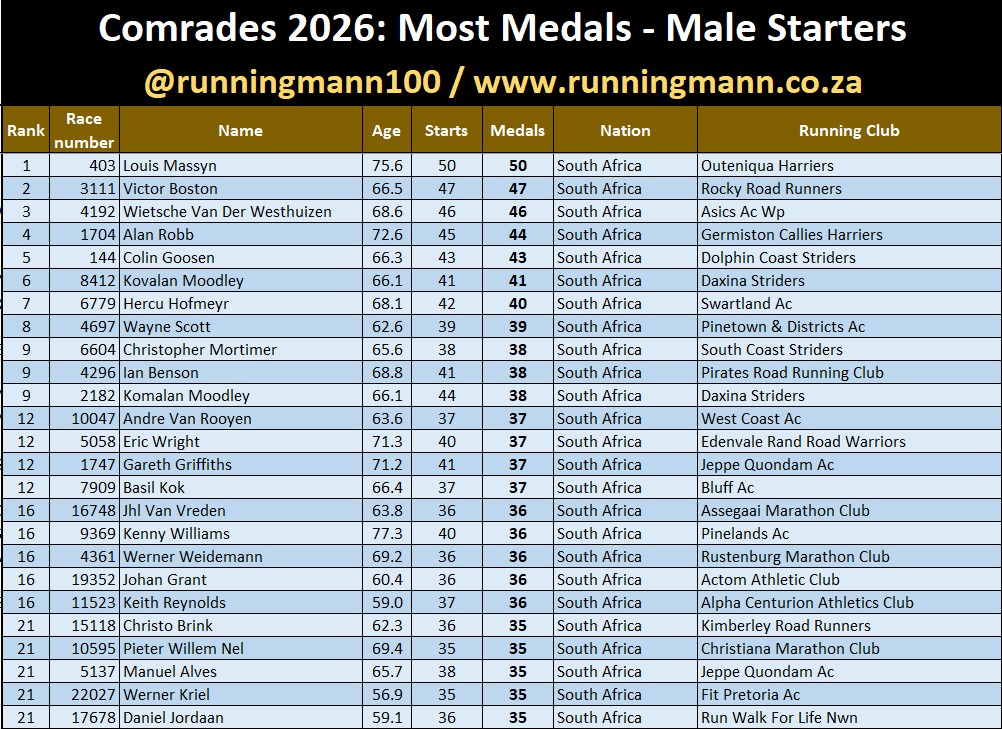
Louis leads the way in the men’s medalists. After his unprecedented 50th finish last year, Massyn is back to extend his finish record. Vic Boston, the undisputed mensch of Rockies, will be going for his 48th in a row (Vic ran his first at 17 after getting a substitution) and my fellow Two Oceans board member, Wietse van der Westhuizen, is one behind and aiming for his 47th consecutive medal.
Four-time winner, Alan Robb, was looking to add one more medal to his remarkable career but sadly I’ve heard he’s injured and won’t be joining us on the jog to Pietermaritzburg. There are 7 qualified entrants with 40+ finishes. Colin Goosen (43) and Kovalan Moodley (41) also have perfect records. Although Hercu Hofmeyer got a DNF last year, he’ll be looking to get at least one in his in quadruple Green number this year.
Hofmeyer and Massyn are the only two men with quadruple Green at Comrades and quadruple Blue at Two Oceans but Pirates’ Ian Benson, who finished his 41st Two Oceans earlier this year, will be looking to get one medal closer to being the third with a 39th medal. Also aiming for 39 are South Coast Strider Christopher Mortimer and Daxina’s Komalan Moodley.
There is just one runner going for quadruple Green in 2026, PDAC club legend Wayne Scott. Scott is one of only two men in the Top 30 who’ve earned a B seeding. The other is the ageless Keith Reynolds who will be doing his last Comrades as a Master.
Reynolds ran Comrades 23 times before earning his first Silver medal which I believe is a record. Another late bloomer is Eddie Mouton who is aiming for triple Green. Eddie took 22 Comrades before claiming the first of his 3 Silvers. Eddie is joined by 21 other men looking to put a third laurel on their Comrades badges.
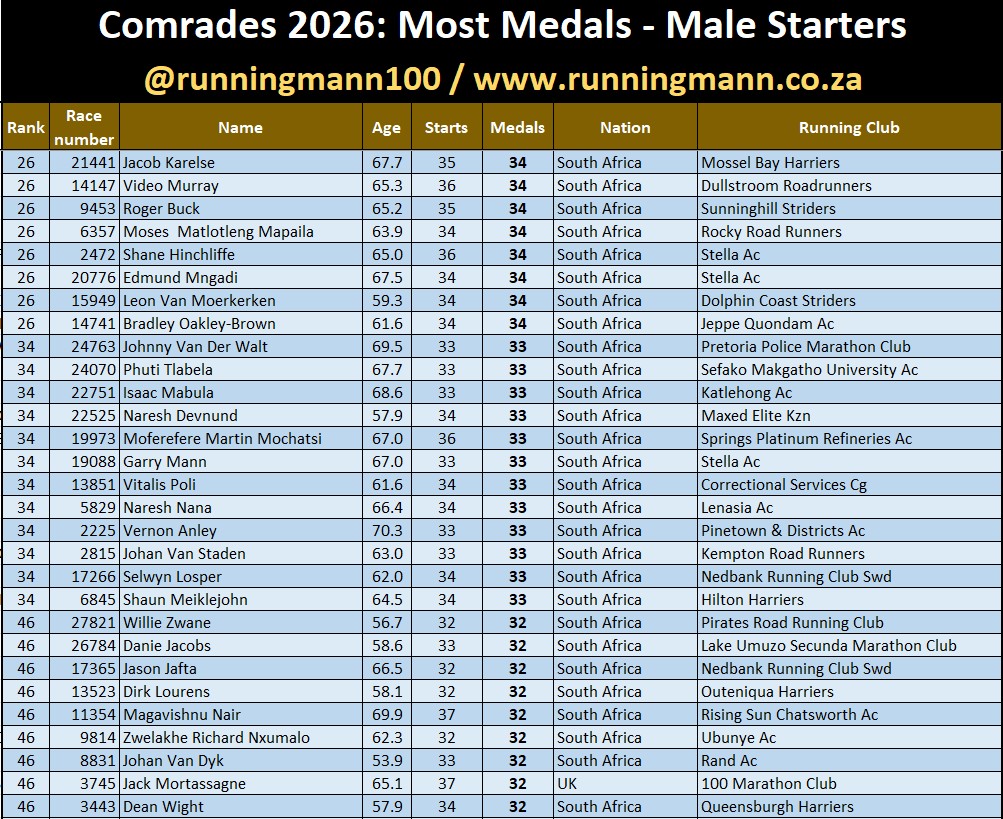
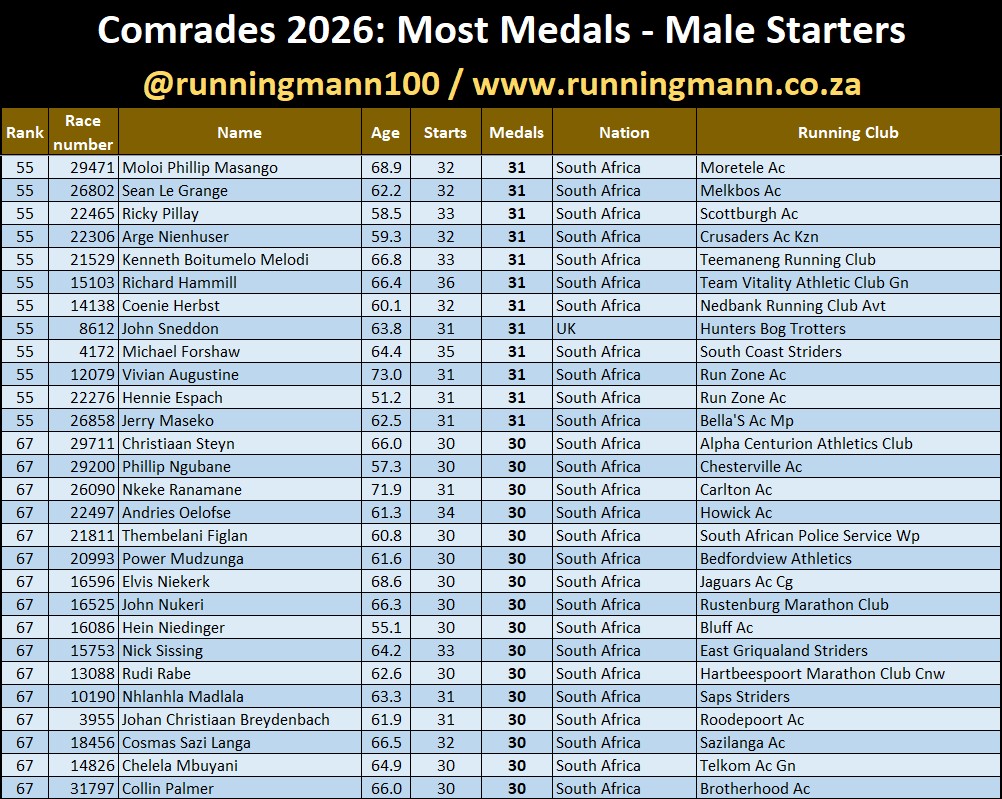
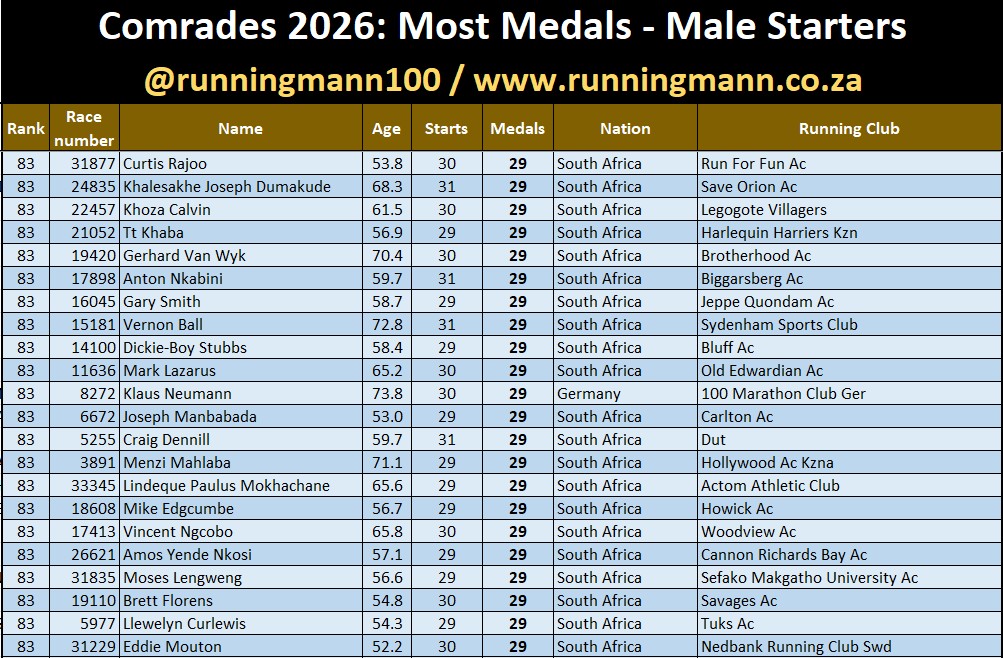
Of note on the 29-going-on-30 list is Klaus Newmann who has come all the way from Germany 30 times. Klaus finished with 43 seconds to spare last year. Although Germans are known for their clinical precision, hopefully Klaus won’t be cutting it quite so fine in 2026. As frequent flyers go Neumann is only second to the great Scot, John Sneddon, who will be going for 32. Although Jack Mortassagne is another UK runner with one more finish than Sneddon, Sneddon has the most medals for an international runner travelling every year (Mortassagne ran his first 7 for Savages and Westville).
There are three men on this list still capable of running fast enough to secure an A seeding. Bella’s Jerry Maseko will be hoping for a 17th Silver on his 32nd run. The other two are both sitting on 33 medals. The one is Selwyn Losper and the other is 1995 winner Shaun Meiklejohn. Meiklejohn’s incredible Comrades CV includes 10 Golds and 22 Silvers.
One final note is to the husbands and wives who have made Comrades their rite of passage. Shane (34) and Gina (30) Hinchliffe and Garry (33) and Helen (30) Mann (still no relation Wesley) all from Stella AC will be looking to add another set of medals to the household trophy cabinet.
Most Medals by Age
By special request (for good reason) from Johan van Dyk, I’ve pulled tables of the youngest 2026 qualified entrants by medal earned and the most medals by age.
Johan, who runs for RAC and is a professor of chemistry, is the 53-year-old with the most finishes (32) as well as the youngest runner in the 2026 field with 32 finishers. However, I noticed that he was not the only RAC van Dyk on the list and on enquiring he confirmed that his son, Jean Pierre, is the 23-year-old with the most medals (4) and youngest with 4 medals.
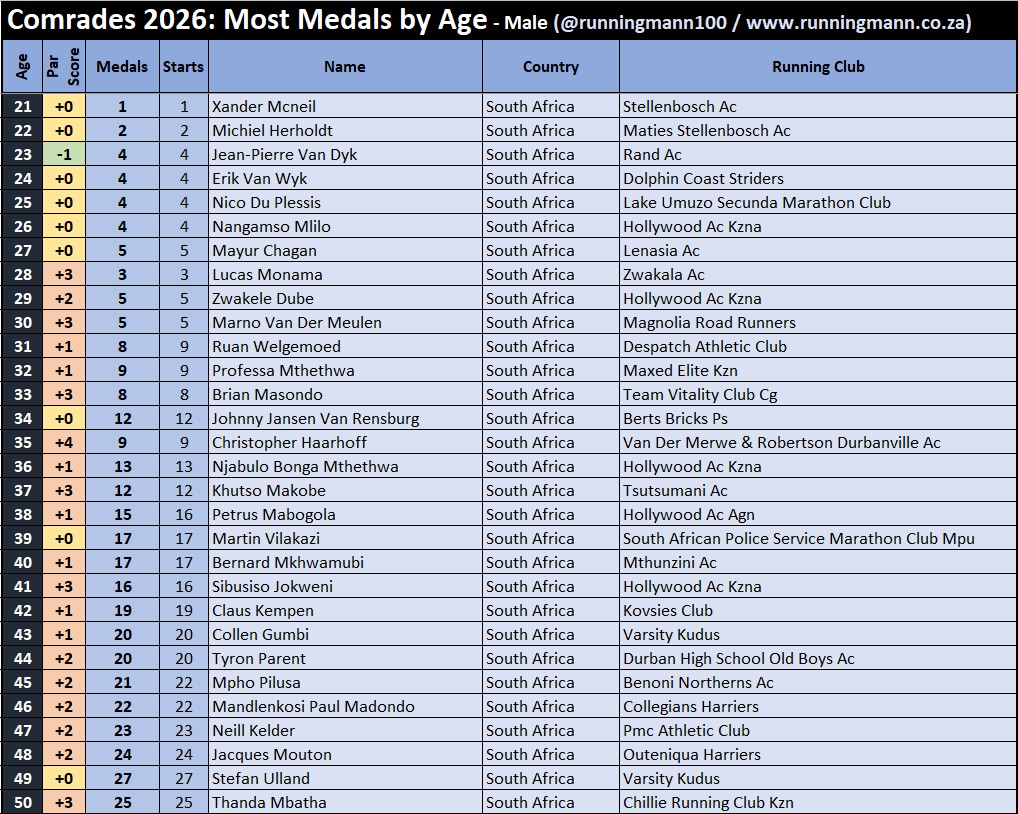

Jean-Pierre ran his first Comrades at the post-Covid August 2022 edition and turned 20 the week before the race. Johan’s wife Karlien, resisted the running bug for several decades but decided that she needed to keep an eye on Jean Pierre and therefore also ran her first Comrades in 2022. Karien now also has four finishes to her name. The van Dyk family are all lining up again on 14 June.
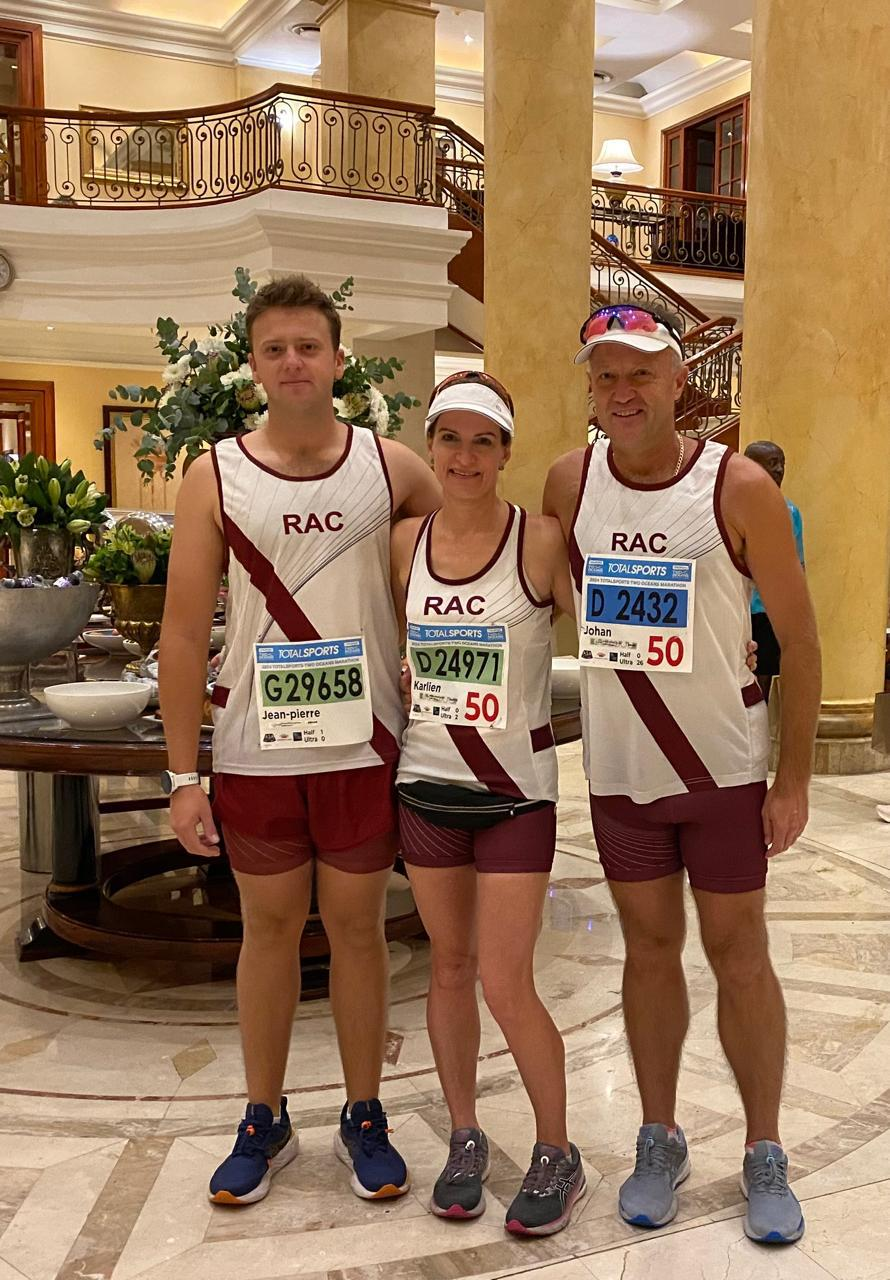

Whilst Louis Massyn is not resting on his five laurels and will be gunning for a 51st finish, there is a lot of interest as to who can match him. To this end I’ve included a ‘golf score’ on numbers of medals to age using the starting age of 20 and taking into account the two ‘lost years’ because of Covid. Note: Before 1993 you could run Comrades at 18 (and a few of people like Vic Boston managed to do so at 17). This allows a select few runners to be ‘below par’.
Both van Dyk’s are below par as are Vic Boston (47 finishes), Werner Kriel (35) and Hennis Espach (31). Those on par with 10 or more finishes are Wietsche van der Westhuizen (46 finishes), Stefan Ulland (27), Martin Vilakazi (17) and Johnny Jansen van Rensburg (12).
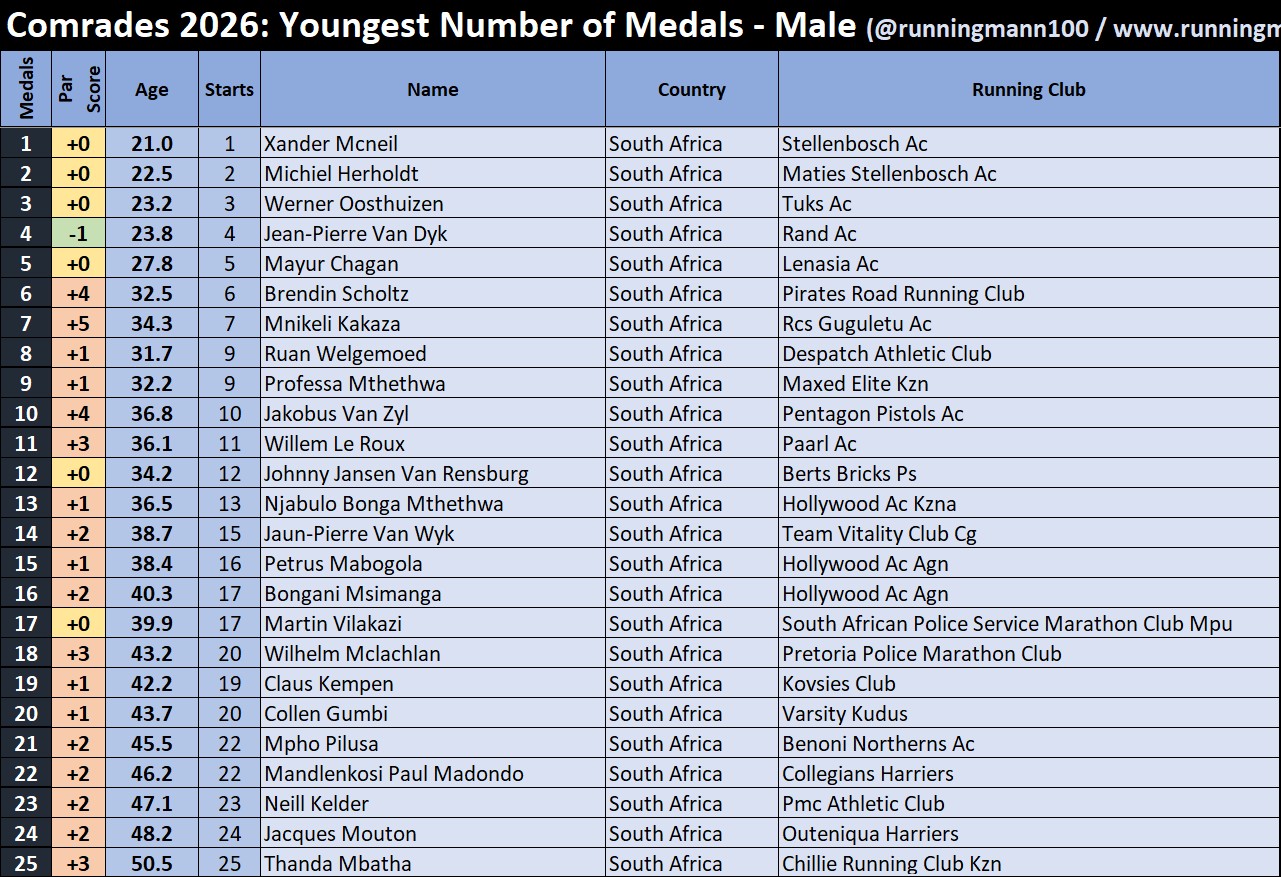
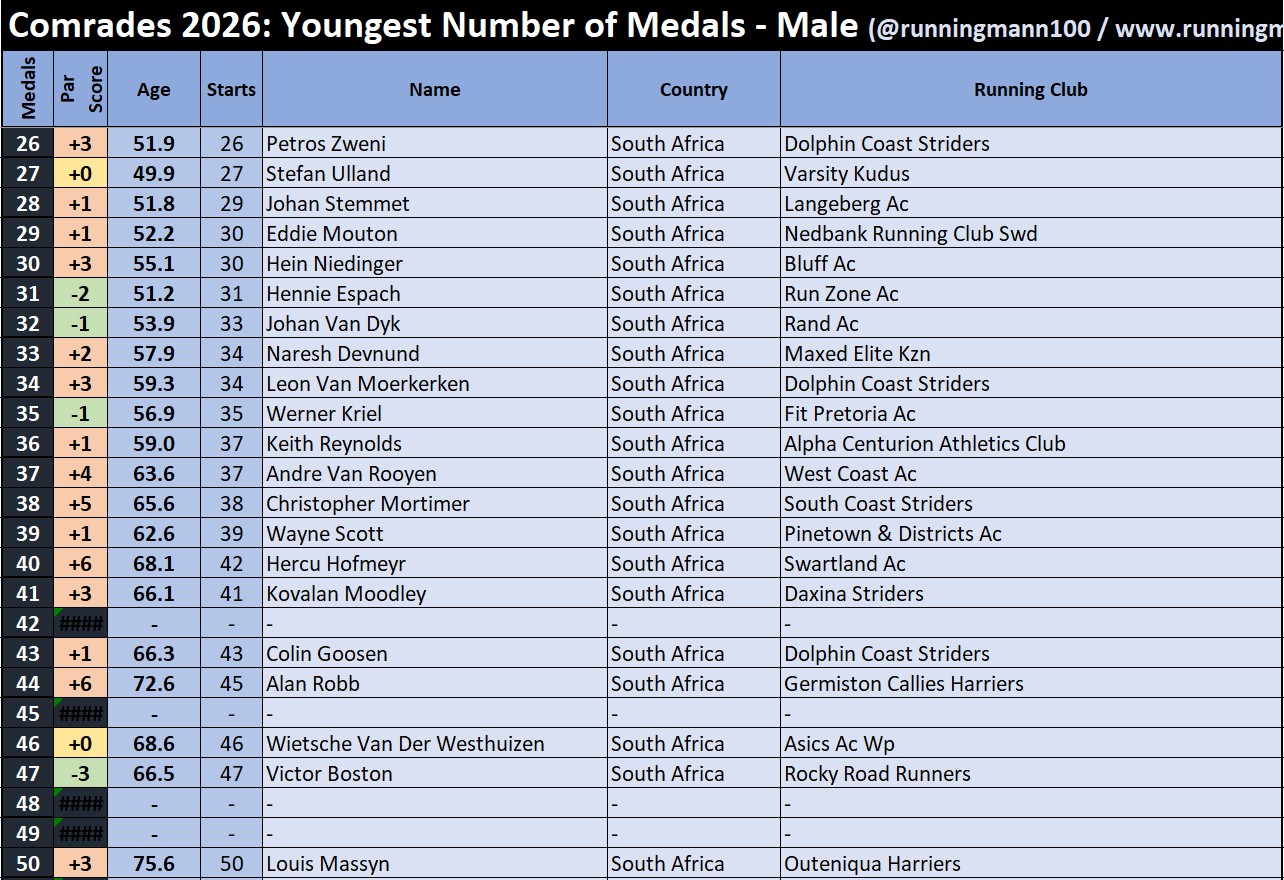
Interestingly there a few ‘young years’ that are ‘well over par’ like 35 (+4) and 28, 30, 33 and 50 (all +3) as well as some ‘old years’ for number of medals earned like the youngest with 6 medals being 32, 7 medals 34 and for 10 medals is almost 37. Claus Kempen, going to double Green and just one over par at 42yo, looks well positioned to make a strong run for a lot more laurels.
On the ladies’ side we’ve got no one under par and only a select few playing their first rounds still at par: Casey- Jane Hall (4 medals), Ela Meiring (3) and Minkateko Letsoalo (1). It is much obviously more difficult for women to run Comrades every year than it is for men.
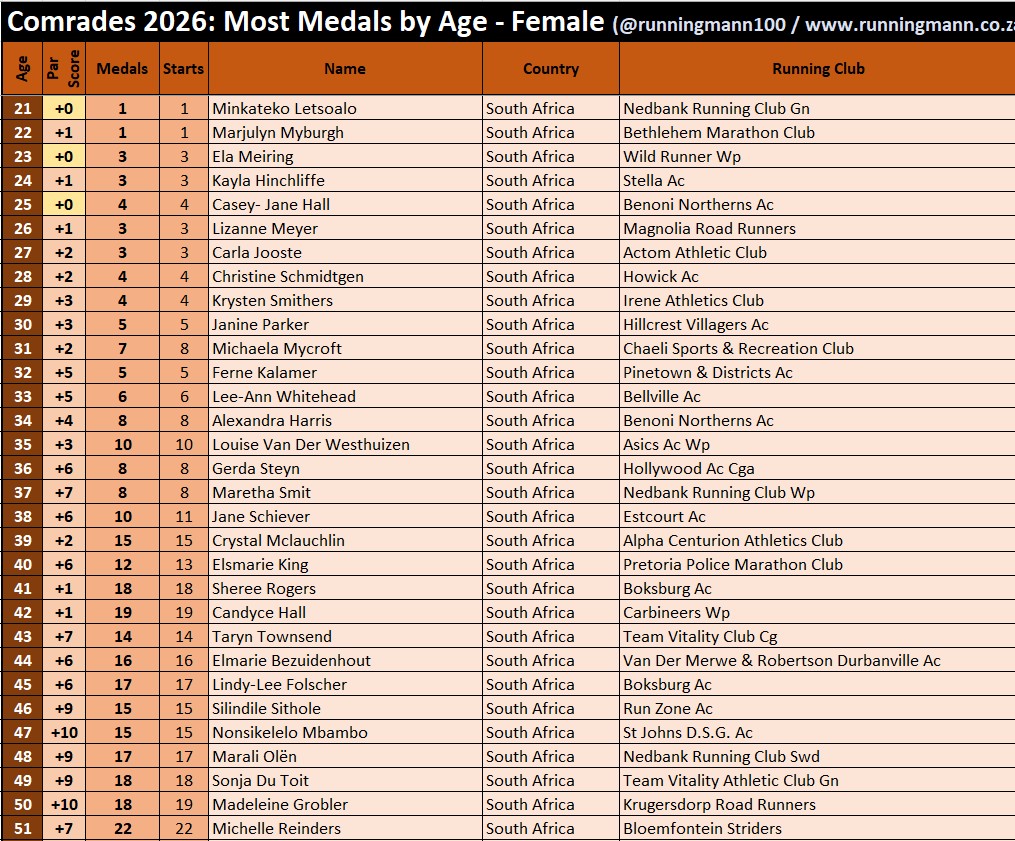

Those with 30+ finishes who have managed to maintain a single digit ‘golf score’ are: Marinda Ludick (58yo, 31 medals, +5), Gina Hinchliffe (59yo, 30 medals, +7), Kim Pain (60yo, 32 medals, +6), Helen Mann (61yo, 30 medals, +9) and Kleintjie Van Schalkwyk (62yo, 36 medals, +4).
Gina’s daughter Kayla (with 3) is the on the most medals by age list as is Wietse van der Westhuizen’s daughter Louise (with 10). At 35, Louise is also the youngest female Green Number running Comrades 2026. If there are other family combos on these lists, please let me know!
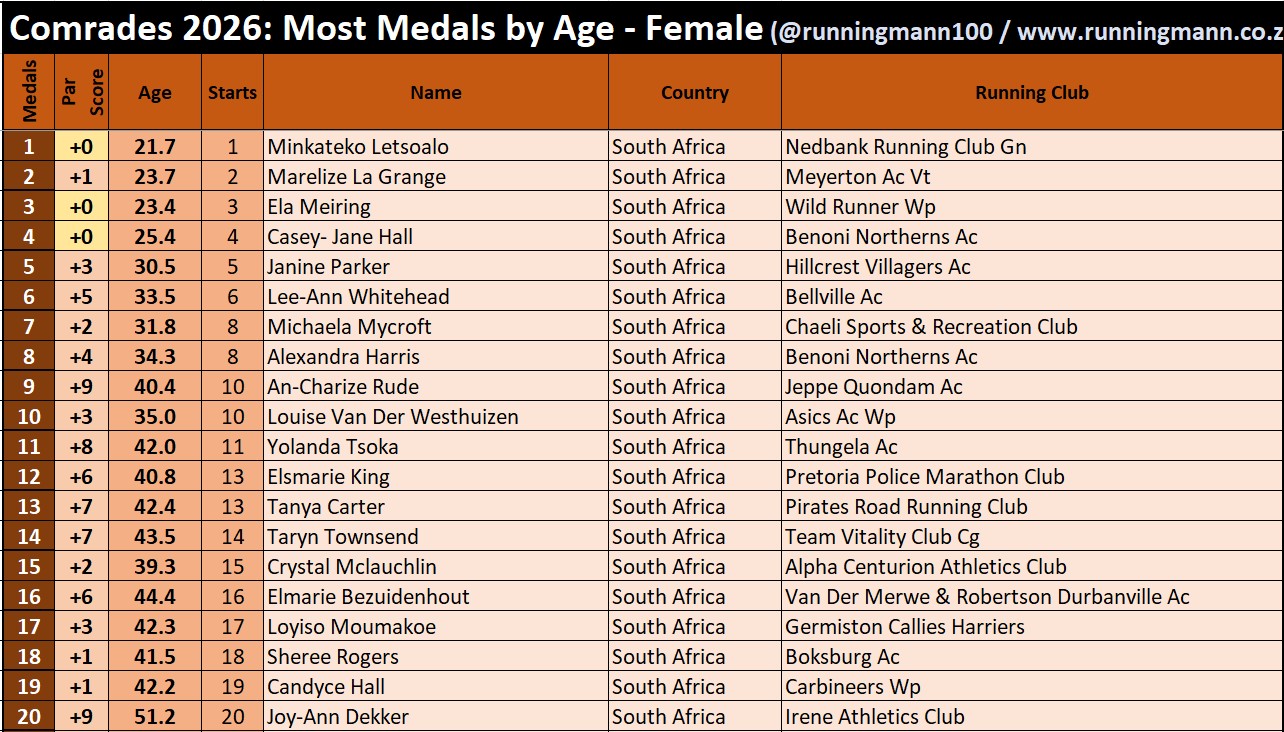
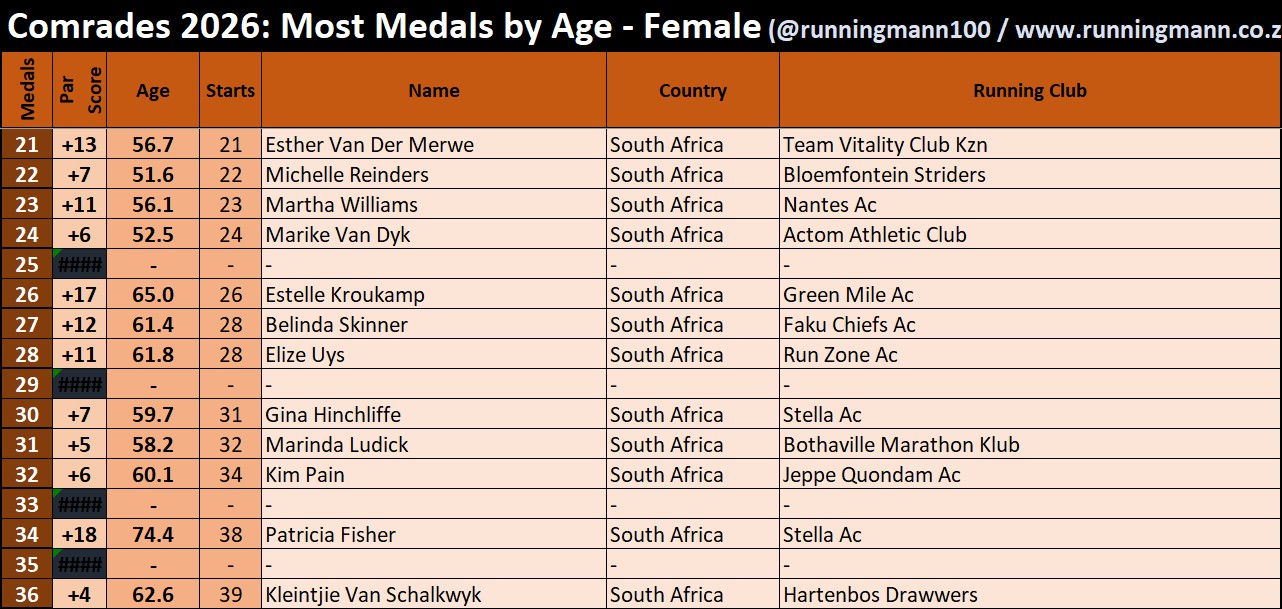
Breaking the stereotype about millennials not being lazy and not sticking to anything are Sheree Rogers (41yo, 18 medals) and Candyce Hall (42yo, 19 medals) – they are both just 1 over par.
Some other notable names on the list are Gerda Steyn (with 8, the most medals for a 36yo), the joint holder of the record for the most Isavel Roche-Kelly medals Maretha Smit (also with 8, most medals for a 37yo) and Michaela ‘Chaeli’ Mycroft (with 7 medals, most for a 31yo) who is a well-known ability activist with cerebral palsy.
Shoe Stats
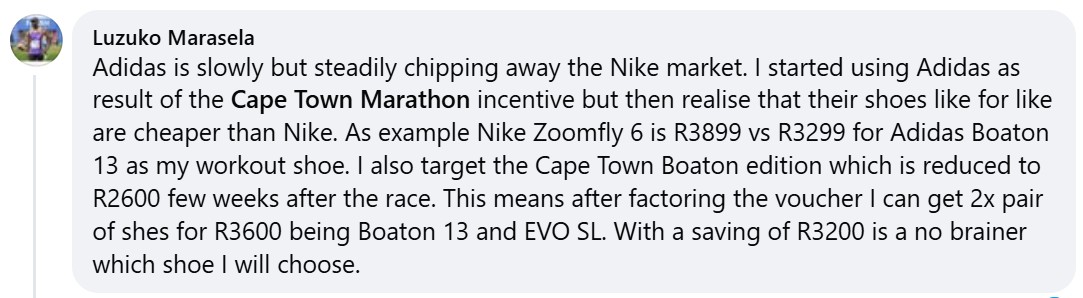
Asics maintains their dominance of the Comrades market increasing a single percentage point from 2025 to 35%. However, the big mover is Adidas who increase from 20 to 25% – that’s a massive jump in one year. I suspect that the CTM vouchers have something to do with it (for those who are able to redeem them anyway). Over the past few years Adidas has eaten into Nike’s market share who get swooshed down from 13 to 10%. All the other brands are largely static but with the drop in Nike’s market share, New Balance grab their podium spot



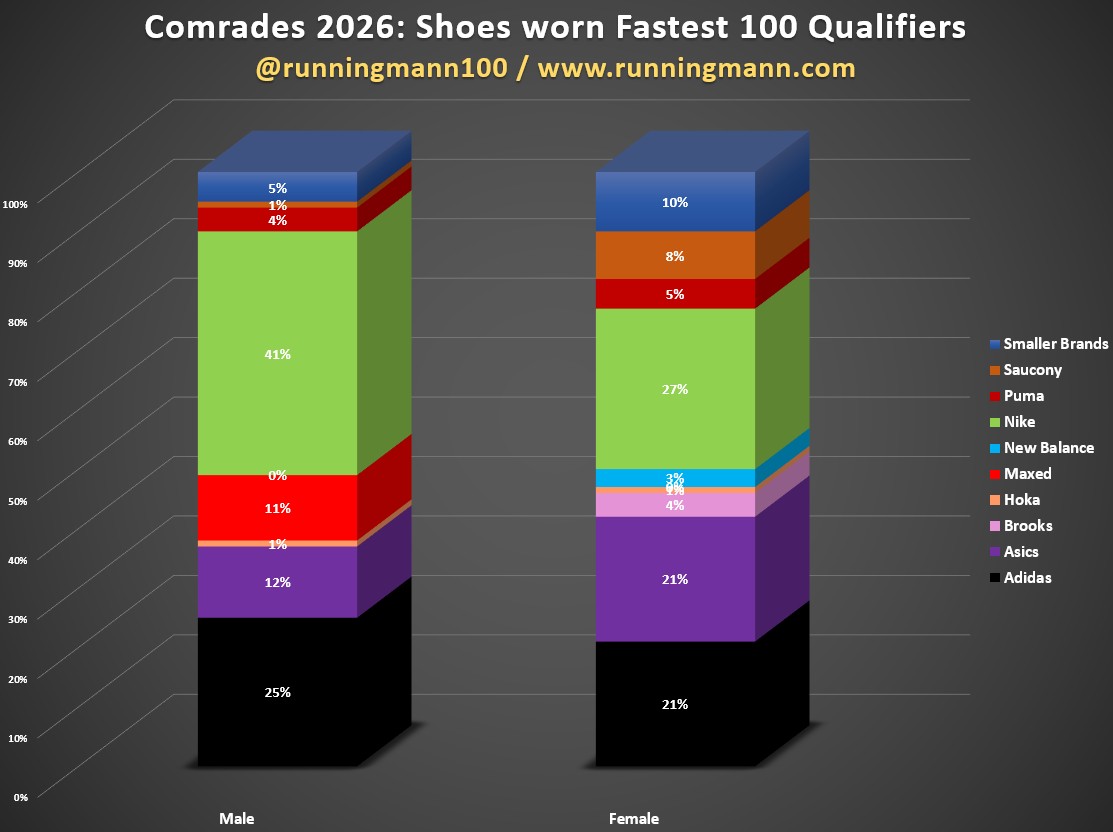
In terms of the fastest 100 qualifiers, Nike dominates the men and also has the highest market share for women. Nike’s sponsorship of the Nedbank Running Club will play a big role here. Adidas are second for the men and joint second with Asics for the women. Maxed is well represented for the men as is Saucony for the women. Much of this is driven by sponsorship (both team and personal for those runners fortunate it have it).
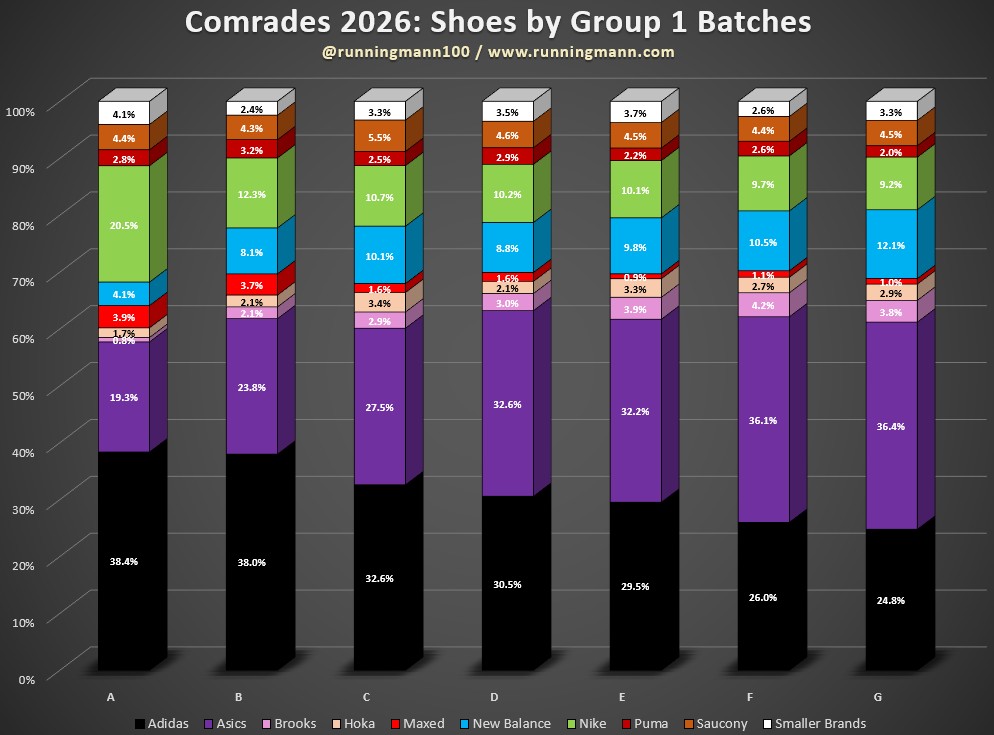
Analysing shoes by qualification time shows that faster runners favour Adidas and Nike but their market share steadily decreases as one moves further back in the field. The opposite is true of Asics, New Balance and Brooks. Other brands are largely constant.

For completeness I’ve also included that shoe by batch which matches the qualification time observations. Maybe, if you know you’re going to be spending a long time on your feet, you are more worried about comfort than coolness!


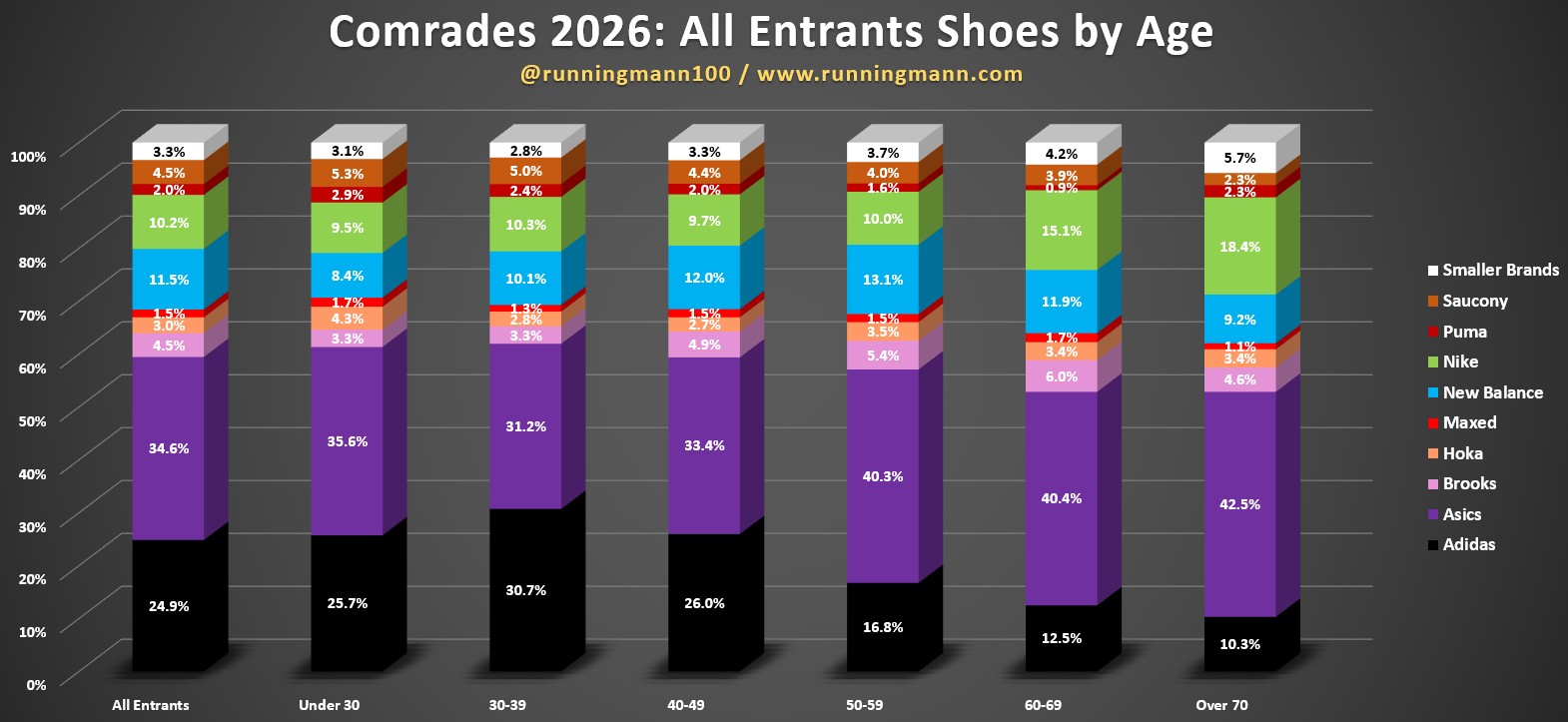
Shoes by age highlights that Asics are #1 in every age bracket but Adidas are a narrow second for the 30somethings. Asics also hit 40%+ from 50 onwards and Nike is also favoured by the boomers.
On the gender front, men have a higher ratio of Asics and Adidas whilst women are more likely to wear Brooks. Women are also more like to choose New Balance and Saucony.

The wise old heads in Green Numbers love running in their Asics – and almost every second Double Green+ will be sporting a pair of Asics on 14 June. It is also interesting that novices largely match the full field percentages.
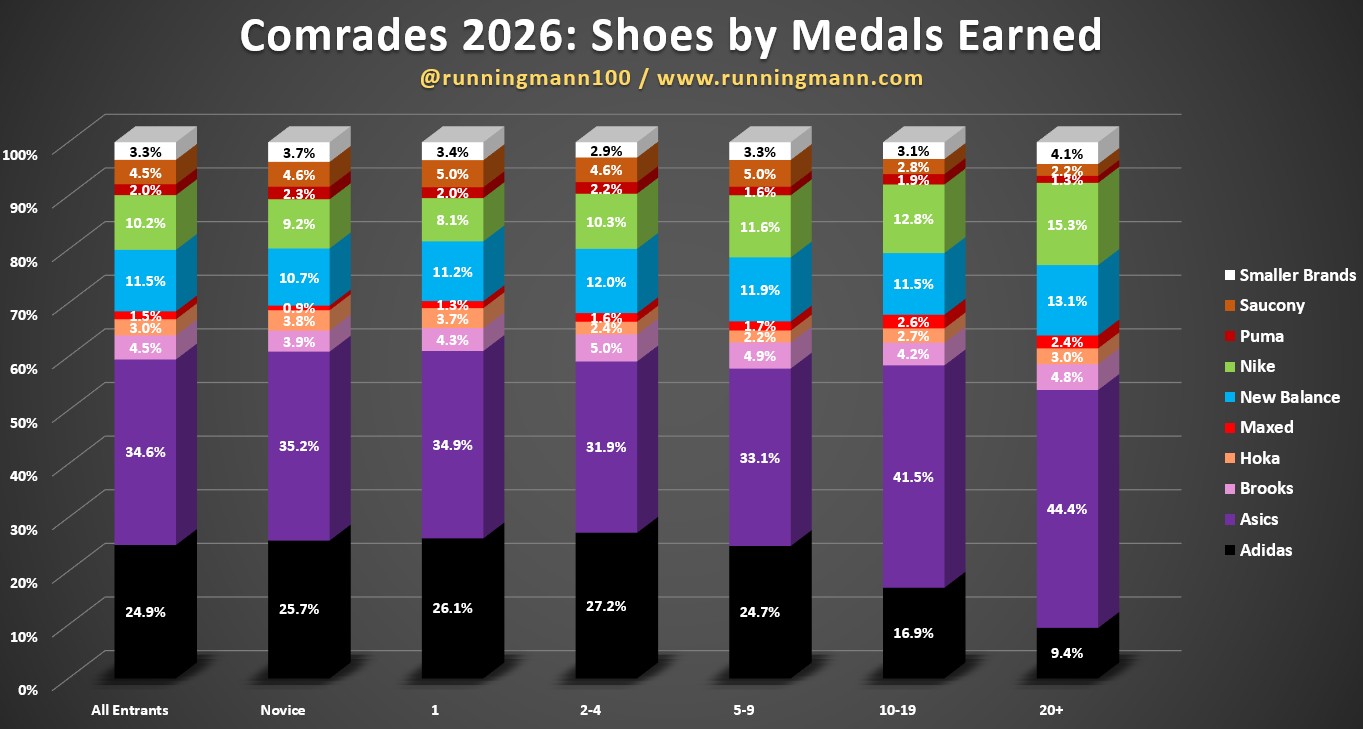
Those wearing Adidas and Puma have the best qualification rate whilst sticking to the well-trodden path appears to be the best option if you want to get to the Comrades start line – collectively the smaller brands have the biggest entry to qualified drop-off rate.


Always really interesting. Thanks Stuart. Any plans to show what the distribution looks like for qualifying times? ie volume of entrants with a QT of 2h30 -2h45, 2h45 – 3h00, 3h00 – 3h15 etc.
Yes, I plan to run that stat.
Hi Stuart.
Re the biggest clubs: qualified runners the table
Hi Stuart
Re Biggest clubs: qualified runners: the table for clubs from 51 to 75 is missing
Thanks Greg, just corrected.