
This is a guest blog on the safeguarding failures from ASA (relating to the Steven Swarts and his rape conviction) by Norman Brook MBE.
Before turning to how the Steven Swarts matter exposes serious weaknesses in Athletics South Africa’s safeguarding framework—and raises uncomfortable questions about ASA’s willingness or capacity to confront those weaknesses—it is necessary to set out the facts clearly.
History
In 2018, Steven Swarts, a well-known Free State coach and athletics administrator, was arrested and charged with the rape of one of the athletes he coached: a 21-year-old woman who alleged that he inserted his fingers into her vagina while giving her a massage. The allegation was not merely a criminal matter; it also raised urgent questions about the safeguards in place to protect athletes from abuse by those in positions of authority.
Swarts pleaded guilty in 2020 and received a five-year suspended sentence. Yet, in November 2023, he was elected President of Athletics Free State (AFS) which also gave him a position of the Board of Athletics South Africa (ASA). It has since been alleged that, when questioned about the 2018 charges, he claimed the matter was an extortion scheme, said it had been settled out of court, and denied that he had been convicted or sentenced.
In 2024, after obtaining the court documentation, representatives of several athletics clubs challenged Swarts’s election, arguing that they had not known at the time that he had been convicted of rape. Instead of treating those concerns as a safeguarding red flag, AFS and ASA suspended the representatives — an action that, on its face, appeared more focused on suppressing uncomfortable facts than confronting them.
The suspensions triggered public outcry in the media, and the matter was subsequently reported to both SASCOC and World Athletics.
Only under pressure did the ASA Board resolve, on 6 March 2025, to suspend Swarts with immediate effect pending a disciplinary enquiry. The suspension and disciplinary notification were delivered to Swarts on the morning of Saturday, 8 March 2025. ASA stated that he was relieved of all duties and functions in athletics while the disciplinary process was pending.
On 6 August 2025, Swarts successfully approached the Bloemfontein High Court under case number 3713/2025 to interdict Athletics South Africa from proceeding with the disciplinary enquiry.
The order states that, pending the finalisation of Part B of the application, ASA is interdicted and restrained from:
- proceeding with the scheduled disciplinary enquiry that was due to recommence from 6 to 8 August 2025;
- proceeding with that disciplinary enquiry at any later stage before Part B is finalised;
- proceeding with or implementing, directly or indirectly, the decision to suspend Swarts as a registered athletics coach; and
- hindering Swarts, directly or indirectly, in the exercise of his rights and responsibilities as a registered athletics coach with ASA and AFS.
The practical result is stark: until Part B is finalised, Swarts remains free to operate in activities conducted by ASA and AFS. For a matter rooted in safeguarding concerns, that is not a procedural footnote — it is the central risk.
DARVO
DARVO is a manipulation tactic used by offenders to deflect accountability. The acronym stands for Deny, Attack, and Reverse Victim and Offender. When a person is called out for bad behaviour, they deny the action, attack the person making the claim, and spin the narrative so that they appear to be the true victim.
This tactic appears relevant to the way Swarts is alleged to have responded when questioned before his election as AFS President. According to the allegations, he characterised the matter as extortion and denied that he had ever been convicted or sentenced by the court.
The decision to seek an interdict against ASA and AFS may also be viewed through that lens. Whatever the legal merits of the application, its immediate effect has been to push the disciplinary enquiry further down the road and delay institutional accountability.
The Interdict
Swarts sought to stop ASA’s disciplinary proceedings by bringing a two-part court application. On 6 August 2025, the court granted him interim relief pending the finalisation of Part B. That distinction matters: the order paused ASA’s disciplinary process; it did not finally decide that ASA had acted unlawfully.
A Part A order does not automatically bring Part B before the court. The litigation still has to be advanced through the ordinary procedural steps, and Swarts, as the applicant, bears the primary responsibility for doing so. Courts have repeatedly recognised the danger of parties obtaining interim interdicts and then failing to prosecute the substantive Part B proceedings with reasonable diligence. In this matter, a year has passed since the interim order, and there appears to have been no meaningful progress in enrolling Part B.
On 18 June 2026, ASA CEO Terrence Magogodela wrote:
ASA also refers to this matter to its two members from the council for an opinion on the way forward since it appears to be an impasse on how best to proceed with this matter, and the committee recommended that ASA should consider how best to resolve this matter internally.
Membership is therefore invited to consider this dilemma that ASA finds itself in and to provide guidance on how best to deal with this matter in order to avoid further legal costs being incurred.
But there is no real impasse. Swarts initiated the court process that stopped ASA’s disciplinary enquiry, and the interim interdict remains in place only because Part B has not been finalised. The next step is not institutional hand-wringing; it is to bring the matter back before the court so that the substantive dispute can be decided.
That delay is precisely the problem. Interim relief should not become a long-term shield by default, particularly where the unresolved issue affects athlete safety, governance, and public confidence in the sport.
A recent 2026 High Court judgment is instructive: the court made an interim order subject to Part B and expressly allowed the respondent to approach the court for reconsideration, variation, or discharge if the applicant failed to prosecute Part B with reasonable diligence.
Given that a year has passed since the court granted the interim interdict, ASA should now consider approaching the court to compel progress or discharge the interim order. The key question is whether Swarts has prosecuted Part B with reasonable diligence, or whether he has obtained temporary relief and then allowed the substantive proceedings to remain dormant.
If Part B proceeds, ASA will have the opportunity to receive and answer Swarts’s papers, raise any preliminary objections, challenge the legal basis for the relief sought, file opposing papers where appropriate, participate in the enrolment process, and prepare for a full hearing. In other words, ASA is not powerless. It has legal options — the question is whether it is willing to use them.
Concurrent Jurisdiction
In the last edition of Safe Sport Storyline, I examined how Swarts’s conduct may have breached ASA’s Integrity Code and how ASA’s Disciplinary Code gives it the power to summarily dismiss someone for serious misconduct. At the time, I did not have access to ASA’s constitution, which was necessary to understand how disciplinary authority is divided between national and provincial structures.
I have since obtained a copy of the constitution, and it contains provisions that appear to undercut any argument that the matter belonged exclusively to an AFS disciplinary process.
Two clauses are particularly important:
29.15 ASA has concurrent jurisdiction over all its members (including athletes, clubs, and officers of all its members).
29.15.1 In terms of this jurisdiction, ASA has the right to take any appropriate disciplinary action against any of its members (including athletes, clubs and officers of its members).
In my view, these provisions are designed to ensure that ASA retains ultimate authority over conduct within athletics, even where a provincial association or club also has disciplinary powers.
Concurrent jurisdiction means that more than one body has legal authority to deal with the same matter.
For example:
- A provincial athletics association may have jurisdiction over a coach because they are registered with the province.
- The athlete’s club may also have disciplinary authority.
- ASA also has jurisdiction over exactly the same individual.
Concurrent jurisdiction is particularly important in safeguarding because a provincial body or club may lack the expertise, independence, or institutional will to investigate properly, manage conflicts of interest, or impose adequate sanctions.
Without national intervention, a person found unsuitable to work with athletes in one context could potentially move to another province or club and continue participating in athletics.
ASA’s concurrent jurisdiction exists to prevent that kind of regulatory gap. It allows ASA to impose sanctions that apply across the national federation and protect athletes throughout the country.
The legal issue behind the interim interdict appears to be whether ASA could proceed with its own disciplinary process after the provincial body had already dealt with the matter.
If ASA’s constitution or disciplinary rules expressly provide for concurrent jurisdiction, then ASA would argue that:
- the provincial disciplinary process did not remove ASA’s jurisdiction;
- ASA retained an independent regulatory responsibility to protect the integrity of athletics nationwide; and
- a national disciplinary process was not an unlawful “second trial,” but the exercise of a separate disciplinary authority pursuing national safeguarding and governance objectives.
Lack of a Safeguarding Policy
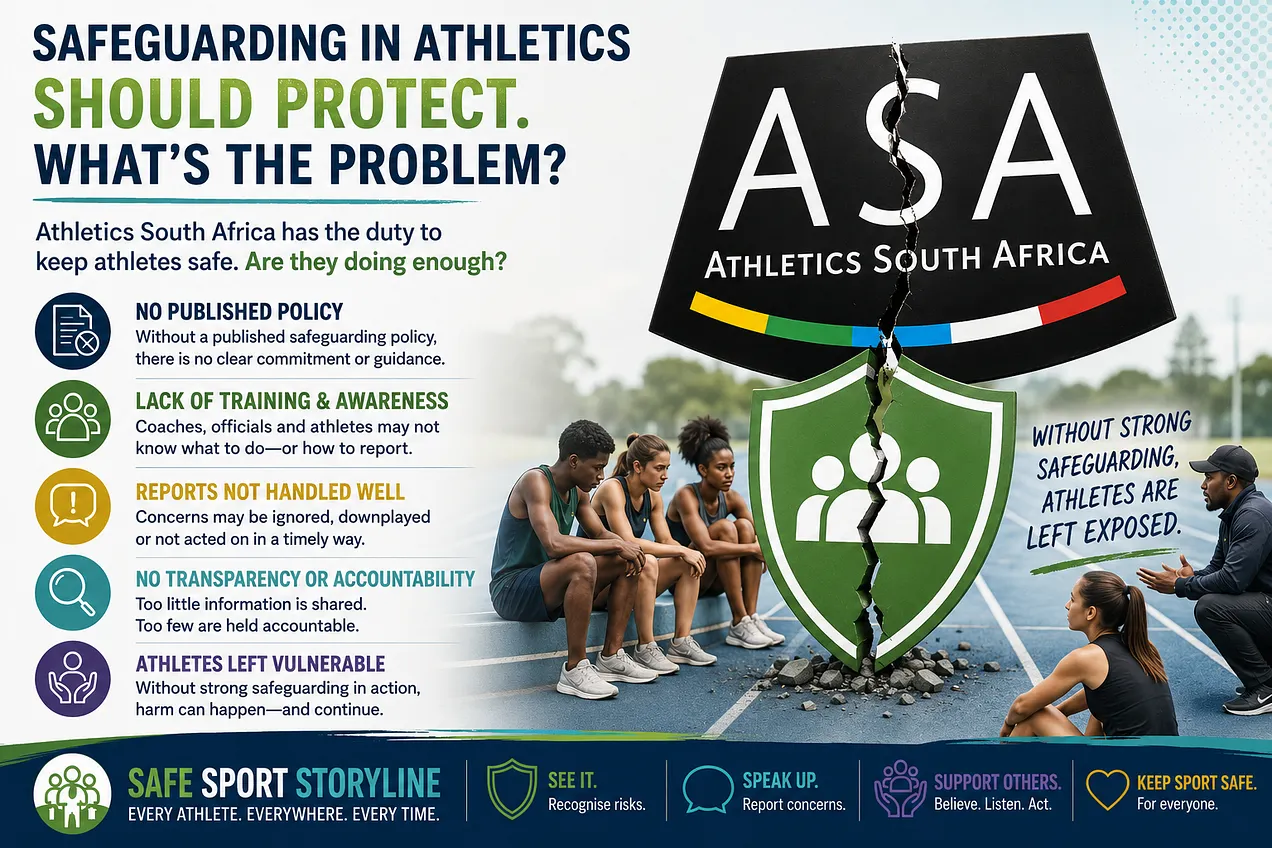
Athletics South Africa (ASA) does not appear to have a standalone safeguarding policy published on its website.
What ASA does have includes:
- an Integrity Code that prohibits harassment, discrimination and other misconduct within the athletics community.
- a Human Rights chapter within its Regulations.
- a Disciplinary Code and Policies.
- references in its regulations to:
- protecting the dignity of participants,
- prohibiting physical, verbal, mental and sexual harassment,
- being conscious of the safety and wellbeing of children, and
- protecting the rights of minors and women.
These provisions are important, but they are not a substitute for a comprehensive safeguarding policy. A code that prohibits misconduct is not the same as a practical safeguarding framework that explains prevention, reporting, investigation, risk assessment, sanctions, and athlete support.
ASA is required to have a safeguarding policy by both the South African Sports Confederation and Olympic Committee (SASCOC) and World Athletics.
The obligation for every National Sports Federation in South Africa to adopt its own safeguarding policy originates in the 2019 SASCOC Safeguarding Policy, which requires member federations to put their own policies in place. In May 2021, a SASCOC General Assembly resolution set a deadline for members to submit those safeguarding policies.
World Athletics also required member federations to adopt and implement safeguarding policies and procedures aligned with local legislation and the World Athletics Safeguarding Policy by December 2023.
Yet halfway through 2026, ASA still does not appear to have adopted or implemented a safeguarding policy and procedures. That failure is difficult to defend. Had ASA put a proper safeguarding framework in place when required, it might not now be facing precisely the kind of institutional uncertainty and athlete-safety risk that this matter has exposed.
To Protect or Punish?
Safeguarding measures such as provisional suspension or permanent exclusion from participation in sport are often misunderstood as forms of punishment. In reality, their primary purpose is protective rather than punitive. They are designed to reduce the risk of harm to athletes and others while ensuring that investigations and disciplinary processes can proceed fairly.

There are several reasons why these measures should be viewed through a safeguarding rather than a disciplinary lens.
First, the primary duty of a sports organisation is to prevent foreseeable harm. If there are reasonable grounds to believe that an individual may pose a risk to children or other protected persons, the organisation has an obligation to act before further abuse occurs. Waiting until criminal or disciplinary proceedings are concluded may expose others to unnecessary danger.
Second, provisional measures are risk management tools, not findings of guilt. A temporary suspension or restriction on contact with athletes is comparable to precautionary measures used in many other professions, such as healthcare, education, or social work. These measures do not determine whether allegations are true; they simply reduce opportunities for further harm while due process is followed.
Third, the purpose of safeguarding differs fundamentally from the purpose of discipline. Disciplinary sanctions are intended to determine responsibility for misconduct and impose appropriate consequences. Safeguarding measures, by contrast, are intended to protect participants, preserve confidence in the sporting environment, and maintain the integrity of investigations. They are preventative rather than retributive.
Fourth, sport owes a heightened duty of care to children and vulnerable adults. Many athletes depend on coaches and other support personnel for selection, progression, financial support, and personal development. This creates significant power imbalances. Where credible safeguarding concerns exist, organisations should err on the side of protecting those who may be vulnerable rather than prioritising the continued participation of the person presenting the potential risk.
Fifth, exclusion can itself be a safeguarding intervention rather than a punishment. Where an investigation establishes that an individual presents an ongoing and unacceptable risk, permanent exclusion from sport serves to protect current and future participants. The objective is not to inflict suffering on the excluded individual but to remove opportunities for abuse or exploitation.
Finally, international safeguarding standards increasingly recognise risk-based decision-making. Effective safeguarding systems distinguish between criminal liability, disciplinary responsibility, and protective action. An individual may not meet the criminal standard of proof, yet the available evidence may still indicate that they pose an unacceptable safeguarding risk. Sports organisations therefore need the ability to make protective decisions based on assessed risk rather than waiting for criminal convictions.
This distinction is particularly important when responding to criticism that exclusions are “punitive”. A safeguarding exclusion should be judged by asking whether it is necessary and proportionate to protect others, not whether it resembles a punishment. Like removing a potentially unsafe bridge from public use or grounding an aircraft with suspected mechanical faults, the action is taken because the consequences of inaction could be catastrophic.
For safeguarding in sport, the guiding principle should be: the welfare and safety of athletes, particularly children and vulnerable adults, must take precedence over an individual’s opportunity to participate where there is a credible and proportionate basis for concluding that continued participation presents an unacceptable risk. This approach aligns safeguarding decisions with the preventive purpose of duty of care, rather than treating them as an extension of the disciplinary process.
Related Articles:
Athletics Free State General Manager bust cheating at Two Oceans (A rapist’s best friend)
Get your coaching accreditation from a convicted rapist (brought to you by Athletics Free State)
Norman Brook is a global safeguarding-in-sport advocate and author of the Safe Sport Storyline Substack newsletter. Based in Cape Town, he first connected with South African sport in the early 1990s. A former UK National Athletics Coach and Technical Director for Endurance Events, he later served as CEO of the British Triathlon Federation. He now advises organisations including FIFA, CAF, Rugby Africa, SASCOC, and the African Union Sports Council on safeguarding in sport. You can Subscribe to his weekly newsletter at SafeSportStoryline.substack.com.


I was a runner at Lemo mangaung marathon on the 2nd May 2026. While running I was knocked down by a car and admitted at Busamed Hospital in Bloemfontein.The owner and organisers were aware but nothing was done up to date.I therefore ask assistance on this matter.All reports from Hospital and police are available.
Only leadership and conviction stops these Stalingrad tactics. Safety of Athletes first, then legalities second. Right now we are allowing the Zuma tactics become the norm as we have no leadership.
Shame ASA
To me, it would seem that the judge’s ruling was incorrect, and another court may well have made a different ruling. In the meantime, the cadres are all protecting each other’s backs, and paying little or no heed to the running community they are supposed to be serving.
How can we as concerned ASA members impose pressure on the leaders of ASA to implement the existing constitution and discipline derilict officers as a result of their concurrent jurisdiction. How can we force the creation and implementation of a safeguarding policy? Most importantly what can ASA members do to force change at ASA leadership?