

[Marathon #293 / Unique Marathon #180 / 22 November 2025]
It had been a while since I’d travelled to Kimberley but the addition of the Diamonds & Dorings Kimberley Big Hole Marathon to the race calendar necessitated a return to the flatlands of the Northern Cape. The Northern Cape is by far the least populated province in South Africa and marathons in the region are similarly sparse. This is perhaps best highlighted with the stat that only 96 people used a Northern Cape marathon as their Comrades qualifier in 2025.

As a rabid collector of different marathons, two factors made my decision even easier: Firstly, I got an invite from the organisers to cover my travel costs which I gratefully accepted and secondly, after a month of rain and thick grey clouds in Joburg, Kimberley promised a bit of warmth and sunshine. In retrospect, I got more than I could possibly ask for both in terms of warm hospitality and sweltering heat.
The marathon is organised under the banner of the “Diamond & Dorings” group to promote tourism and boost the Kimberley economy. The marathon complements four other arts, cultural and entertainment events spread out across the year.
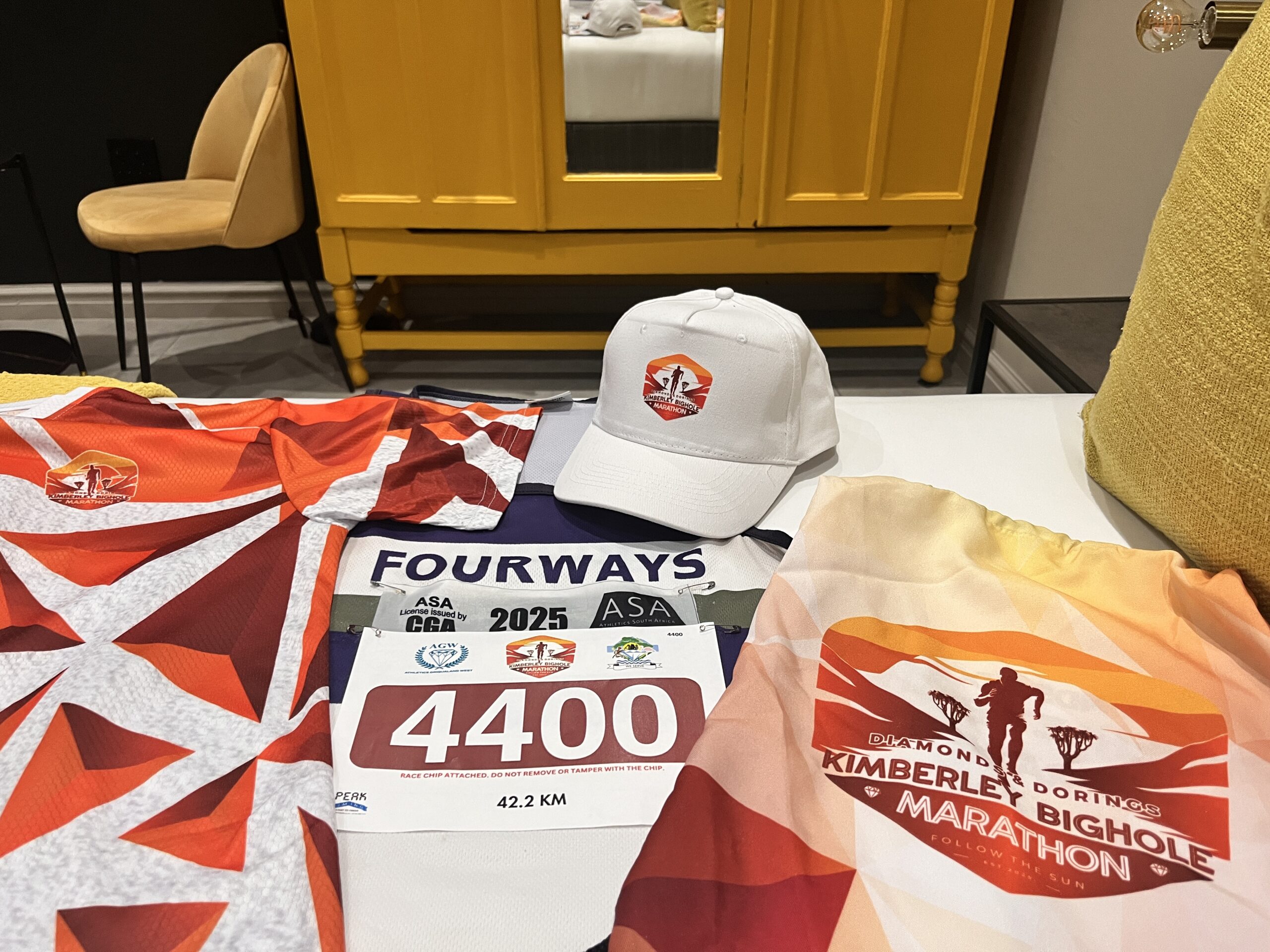
I chatted to Carey Moraladi from the organising team about the objectives of the marathon. She confirmed, “Our aim was to fill up the beds in the guesthouses and hotels, get the petrol stations full and busy, get the malls, food stores and retail shops busy and to also get people visiting our tourism attractions in the city. So basically the marathon was started to increase the economic activity in the city and give Kimberley a much needed boost.”
We started in full sunshine at 5:30am with around 3,000 entrants across all distances (there were also 21k, 10k and 5k options). A very generous marathon first prize of R200,000 and a total purse of R1.2million meant that there was a high quality field and plenty of media interest (SABC covered the race live).
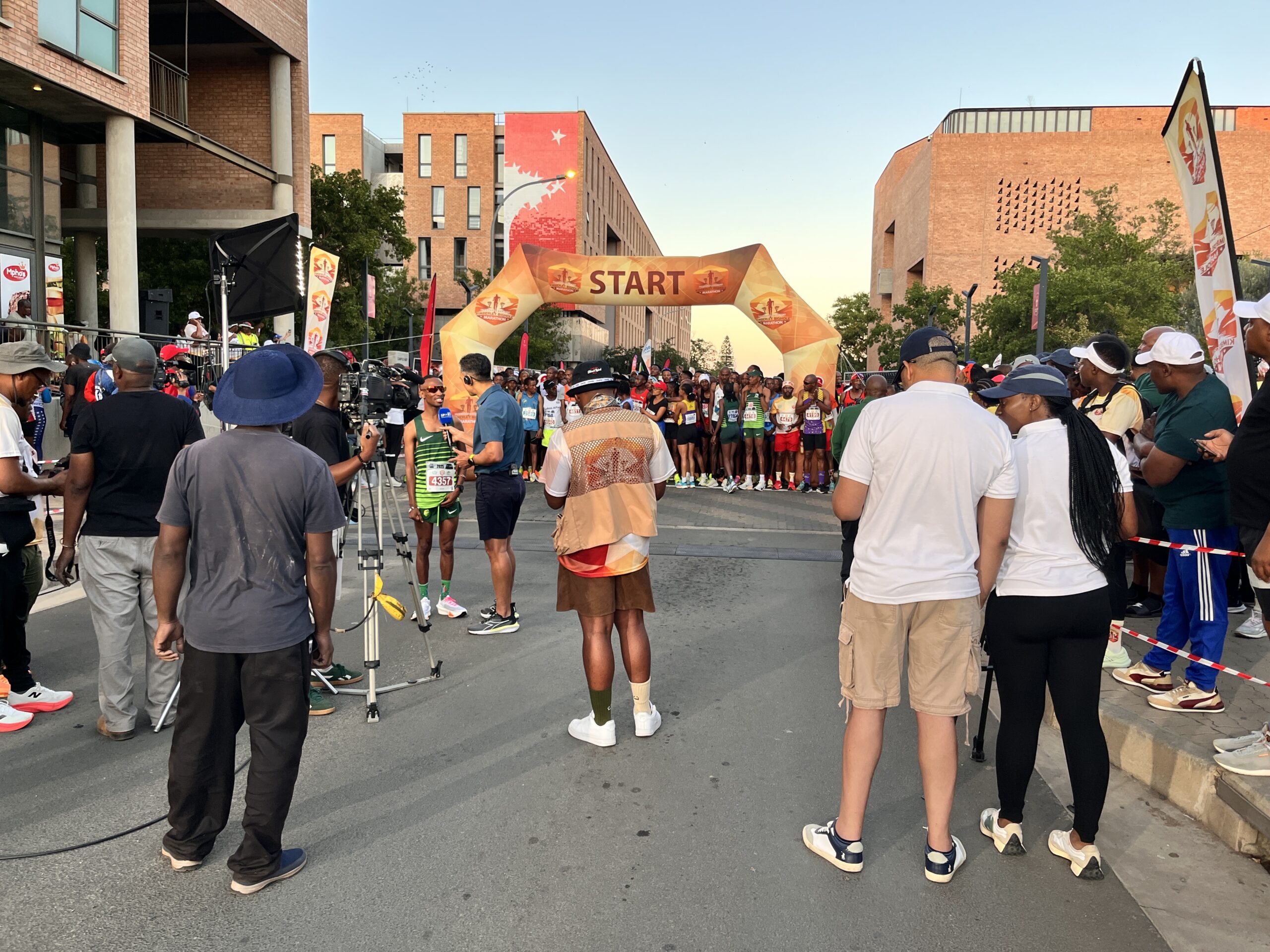
The men’s race was eventually won by the current South African marathon champ Bennet Seloyi in 2:13:22 and the women’s by Kenyan Fridah Ndinda in 2:39:45. Although the single-lap route is very flat (with just 242m of elevation gain), the race is run at an altitude between 1182 and 1243m so Seloyi’s time may well be a world best at altitude*.
* The fastest female marathon time at an altitude higher than 1000m that I know of is Irvette van Zyl’s 2018 Soweto Marathon record of 2:33:43.

However, for most of us this race was just about survival on the scorching hot flattop cooker that Kimberley’s tarmac quickly turns into after sunrise.

I was immediately impressed with the attention to detail. In particular, there was no chance of getting lost in the town, township or Kalahari desert with the excellent marshalling and signage. However, the Kimberley Dungeons & Dragons club (who meet regularly at the public library) may be a little confused if they choose to undertake the “follow the D&D arrows” quest.


Clearly, I was focussed on signage during the early stages of the race. I enjoy a good pun and “Game Over Taxidermy” works on many levels. Kimberley is famous for her gems but if you prefer hunting for gemsbok to digging for diamonds then this is the place to go. On a related note, I can confirm that after getting a good roasting on Kimberley’s tarmac, the race did an excellent taxidermy job on the runners… we were all totally stuffed at the finish!
Kimberley is about as far from the beach as you can get in South Africa and, with this being the site of many historic battles and hunting being a popular pastime, when people here tell you that they “collect shells” you can assume it is of the artillery kind.
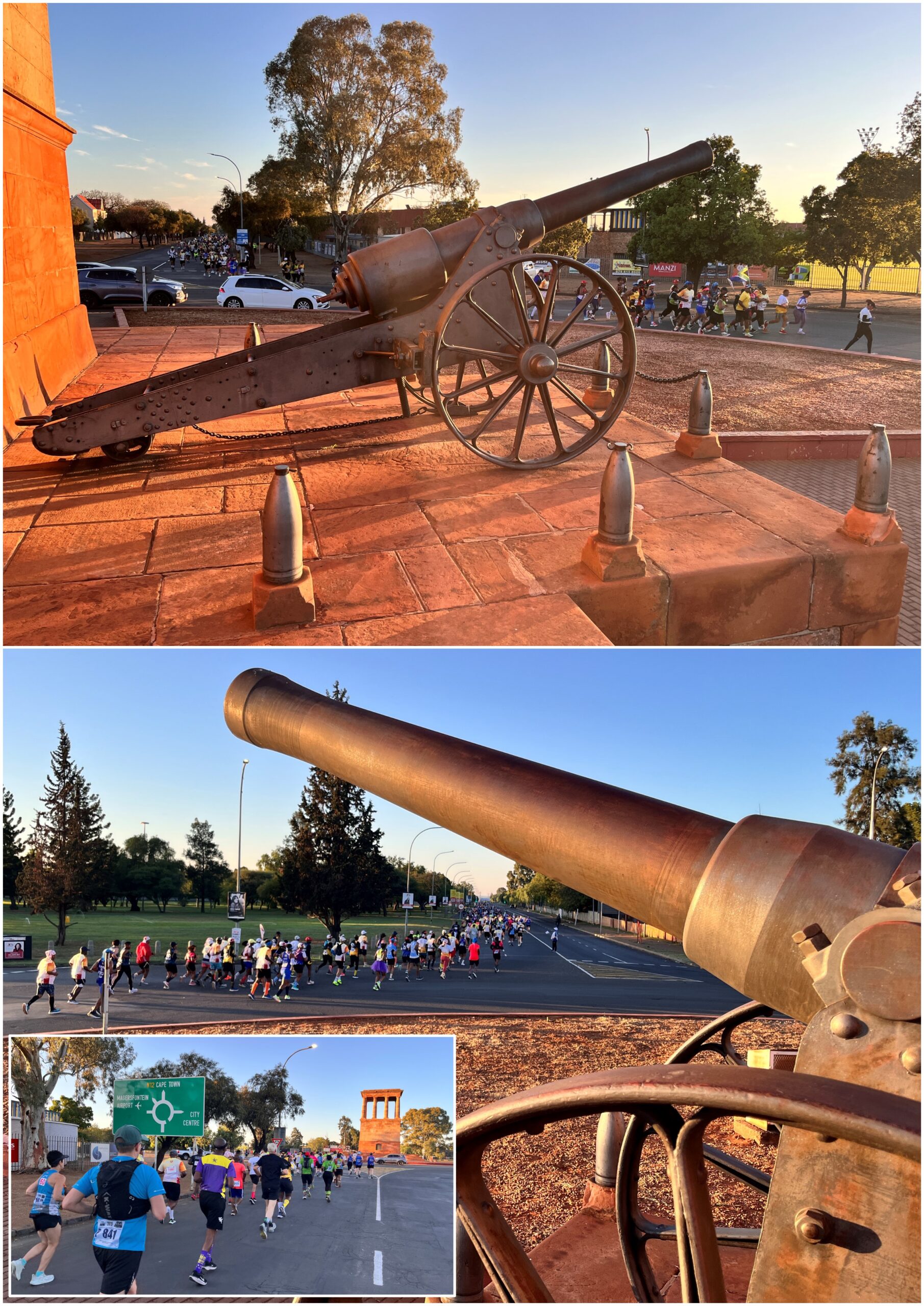
It wasn’t long before we passed the Honoured Dead Memorial whose decorative border consists of the artillery shells from the Boer cannon called Long Tom. The Memorial entombs the 27 soldiers killed during the 124 day Siege of Kimberley (which formed part of the Second Anglo-Boer War 1899-1902). The monument was commissioned by Cecil John Rhodes, designed by Sir Herbert Baker and features an inscription specially written by Rudyard Kipling.
The five roads that intersect with the monument were all built during the siege as a way to keep people occupied and provide employment. The cannon on display is Long Cecil. It was built in Kimberley and is mounted to point directly at the Free State (the border of the old Boer Free State Republic was just over 10km away which is just out of range of the cannon which can fire a distance of 7300m). Ironically, one of the first shots fired by the boer army’s Long Tom cannon killed George Labram, the engineer who built Long Cecil.
Across the road from the monument is the Kimberley Boys’ High School. I am certain that Long Cecil and Long Tom provide rich euphemistic fodder and a rather unimaginative source of schoolboy nicknames. However, it may create some unrealistic expectations for those who get to handle the fuse (and misfires may cause a bigger recoil than expected).

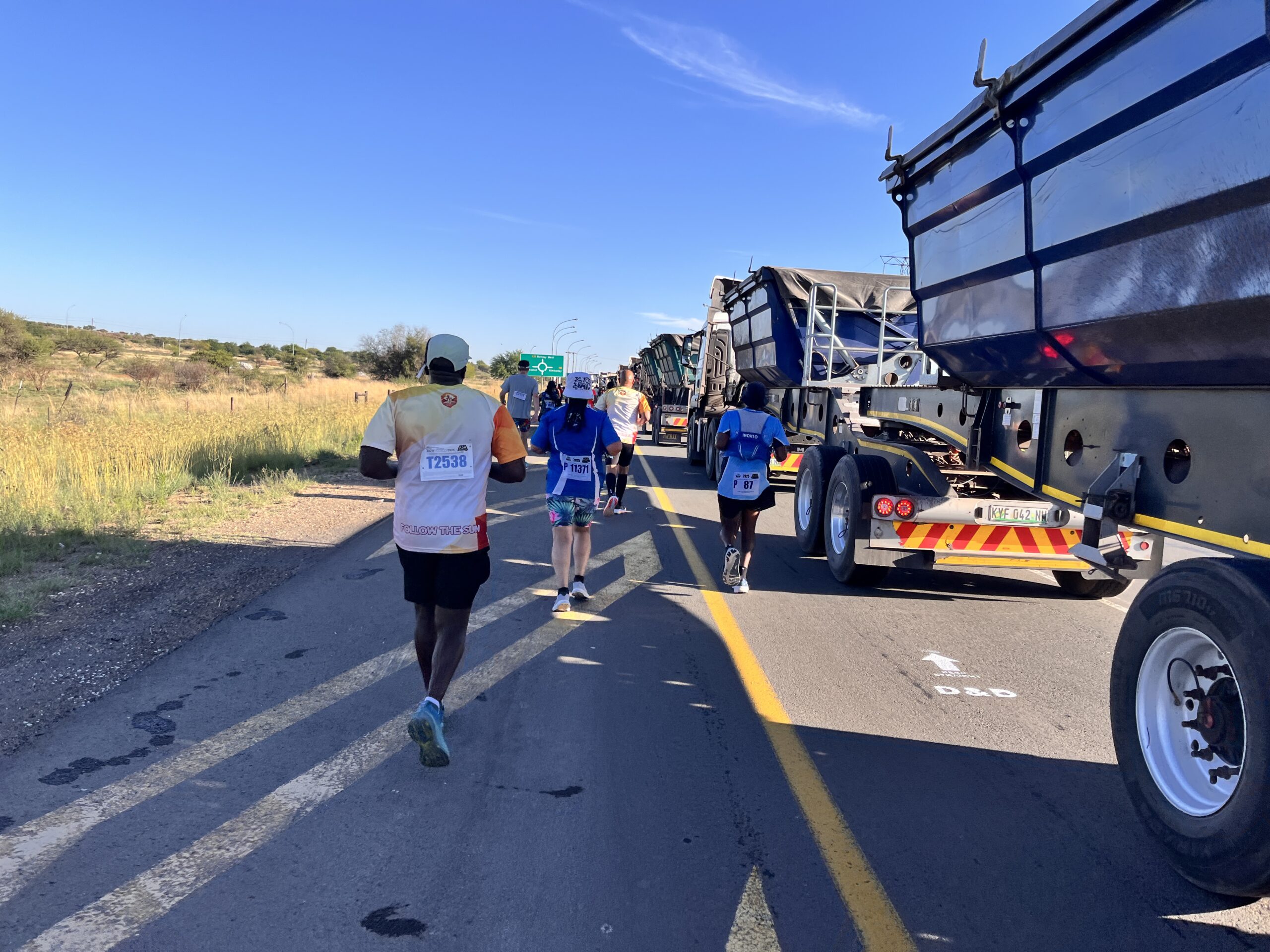
After a short stint through the city, it was out into the Kalahari countryside and the outskirts of the famous desert which is home to meerkats, black-maned lions and heavy-duty mining trucks. We only saw the trucks during the race. The trucks did however provide some shade for the runners (you take whatever you can get in this part of the world).
The route is designed to take in just about everything that Kimberley has to offer. Just after the 14km mark, you veer left to run a detour loop around the impressive Provincial Legislature buildings. This section featured traditional singers and dancers who entertained the runners with a rhythmic, foot-stamping Tswana dance known as Setapa.
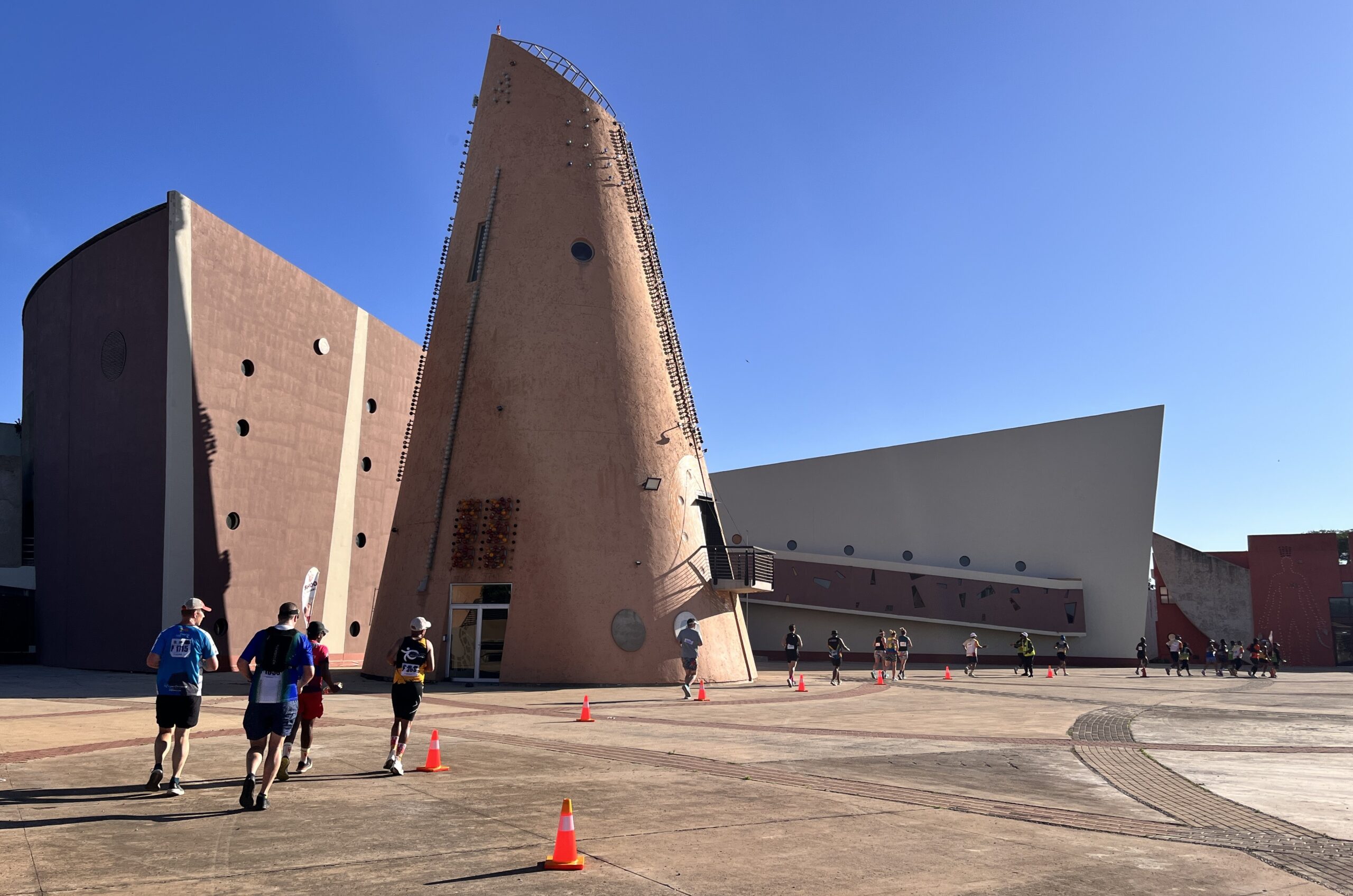
This was a good spot to keep your energy levels high as what follows is a long segment alongside the West End Cemetery to the half marathon split just before 18km. The cemetery hosts the grave of Sol Plaatje, the celebrated South African writer, journalist, founding member of the ANC and a significant figure in the struggle for equal rights. Plaatje was posthumously honoured with various landmarks being named after him including the local municipality and university.
Plaatje was the first black South African to write a novel in English and was an accomplished polyglot, fully fluent in seven languages. Another notable achievement of his was translating the works of William Shakespeare into Setswana.
“Lefatshe lotlhe ke lebala la metshameko” (that’s “All the world’s a stage”) said Shakespeare – and if your city has lots of large traffic circles then you’ve got plenty of readymade theatres to show off talent like the Zulu dance troupe in the video below. I expect that the foot-stamping dancers ended up with a higher step count than most of the marathon runners (I decided not to join in as I wasn’t wearing my dancing shoes)!
Some might have been tempted to cut short at the half marathon split but the marshal on duty owned the split boss role. There was no chance he was letting you go straight if you were wearing a marathon bib. It was a good thing as the best part of the route was to come, which was a vibrant township tour of Galeshewe.

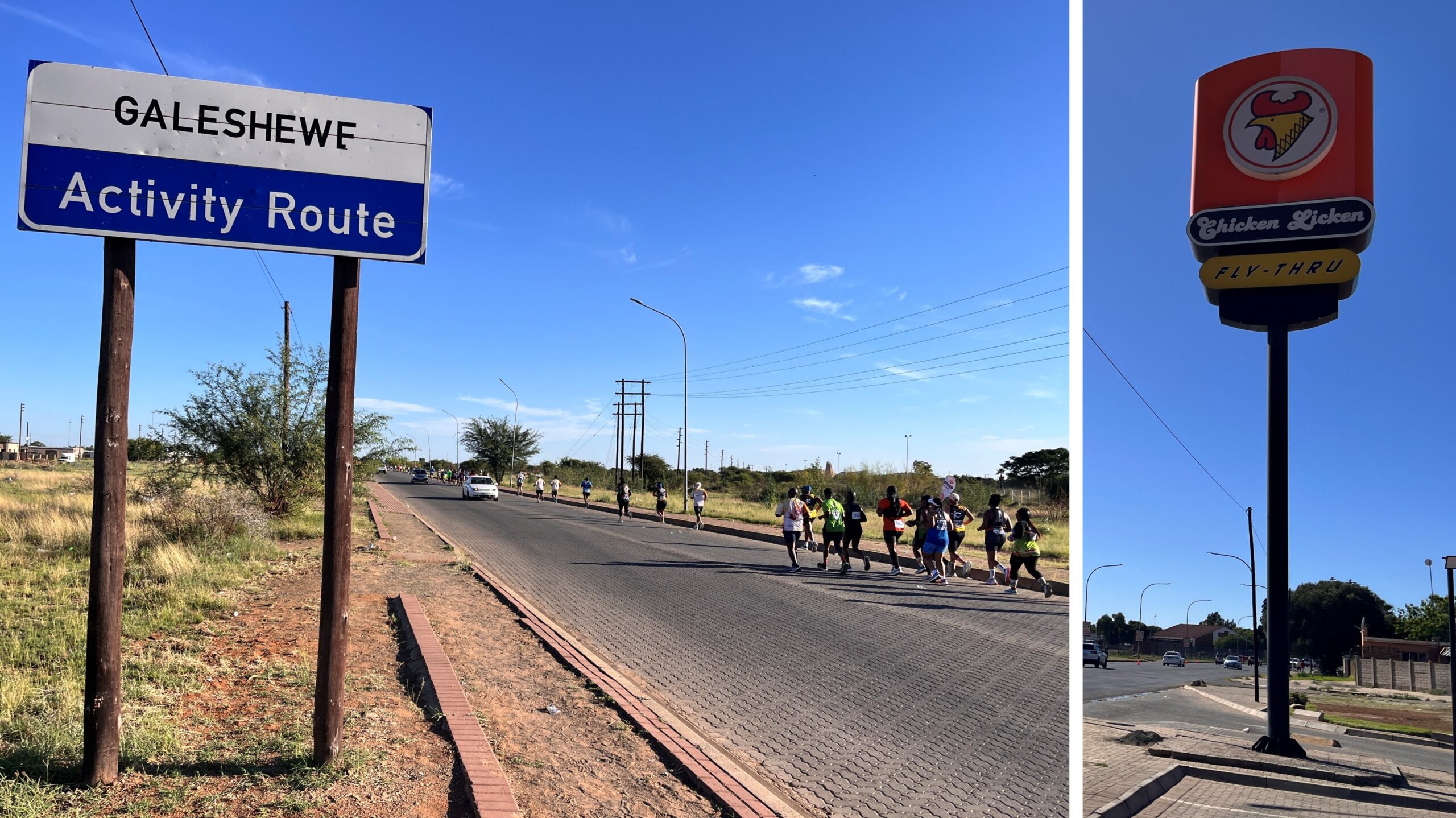
Galeshewe is the oldest and largest township in Kimberley and was named after Kgosi (Chief) Galeshewe (1840 – 1927) of the Batlhaping. After 17 Batlhaping cattle were shot by a British farmer and the courts refused to compensate them, Galeshewe led a sustained anti-colonial rebellion campaign. He was caught but managed to escape several times before eventually being imprisoned on Robben Island for 10 years in 1897.
The 10k loop through Galeshewe was the race highlight for me. It doesn’t get more kasi than free-range dogs and shirtless kids playing happily in the dirt. Lots of high fives and friendly greetings were given to every runner as we ran past the spaza shops, taverns, car washes, shisanyamas and other local businesses. I also noted that here the WiFi is marketed not as uncapped but rather as “unfinishable” (and I was glad that no marathons follow the same promotional technique).

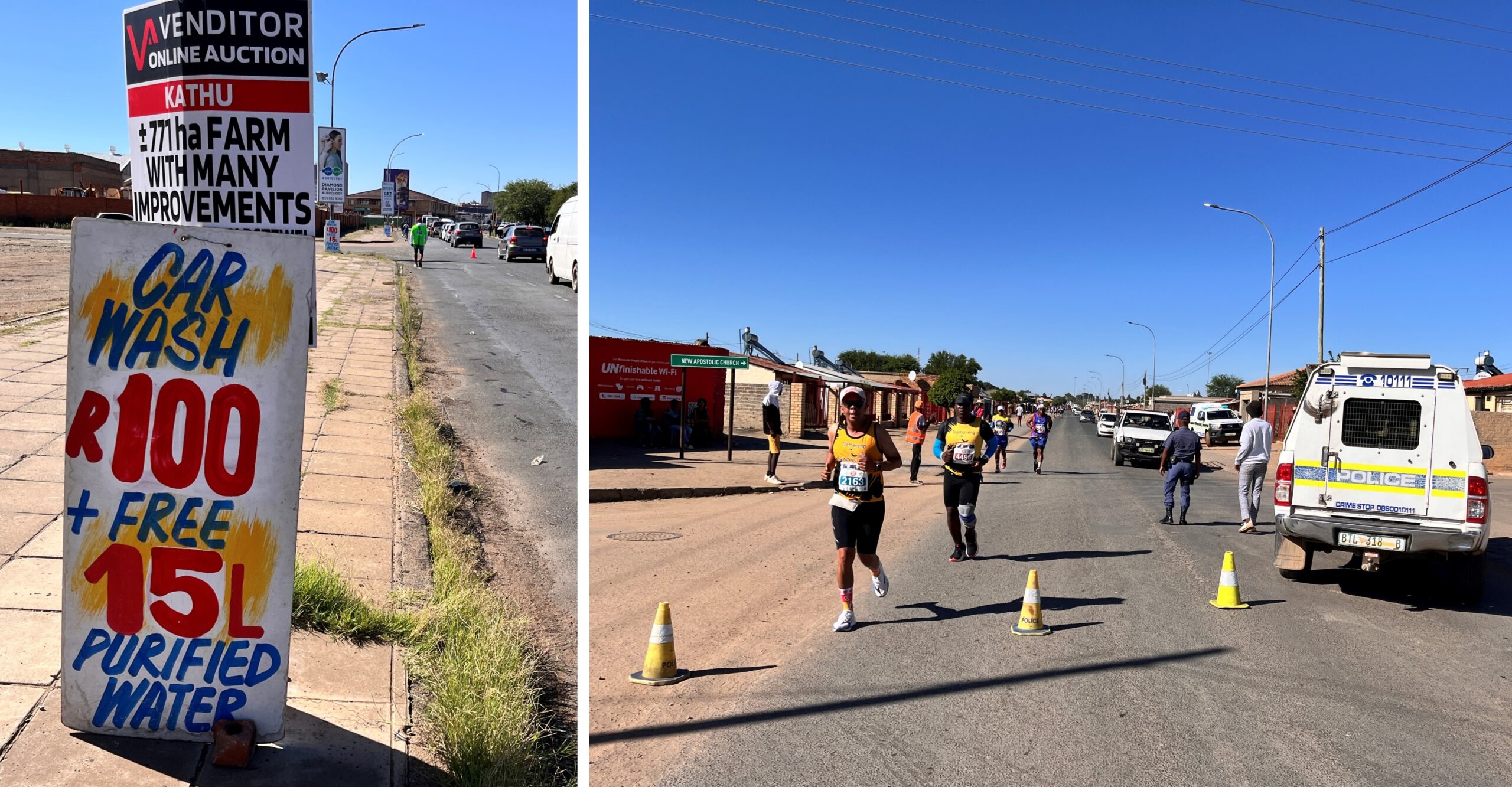

The township was originally called “Number Two location” before being renamed in 1952. On that note, I am indebted to the local Chicken Licken for allowing me to make an emergency landing in their Fly Thru.
Whilst there were plenty of shebeens and day-drinking going on in Galeshewe, I was impressed with the ingenuity of their transport methods: You’ve heard of “cash & carry” – here they prefer the “drag & drop” method. I reckon those beers would have been quite fizzy by the time they got to the shebeen.
The most popular joke about Kimberley is that “We’re only here for De Beers”. Whilst I can confirm that I did enjoy a few rehydrating post-marathon beverages, when people asked me how I was handling the Kimberley heat (it was over 30°C shortly after 8am and hit an in-race high of 37°C), I told everyone that I only was here to get a tan. After the greyest and wettest November Johannesburg’s experienced in living memory, it was indeed a welcome relief to get out of the rain and enjoy some sunshine (thanks to Koena Mokoena for the below video).
There was plenty to eat along the route. In addition to the traditional tables every couple of kilometres, you could bring some cash and try one of the shisanyamas in Galeshewe township.
In particular, a double decker bus that has been converted into a food station called The Ark caught my eye. The establishment has a checkered history. In 2022 an over-officious traffic policeman towed it away because it was deemed “unroadworthy” and lacked a valid vehicle licence. A public outcry followed leading to the mayor intervening and the bus was returned to its rightful spot.

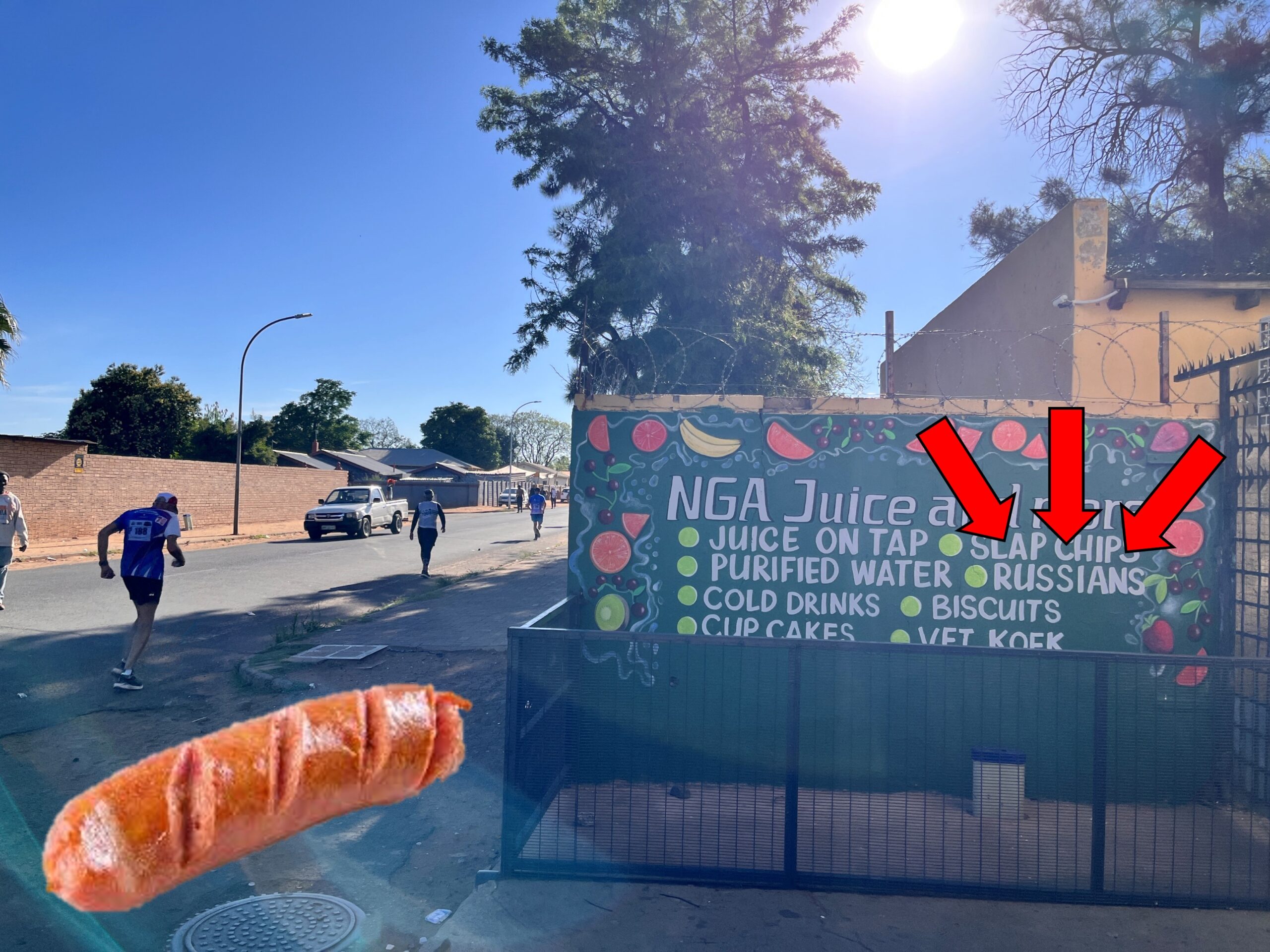
Continuing on the topic of food, for decades we’ve been able to buy Russians in South Africa. During the marathon I realised that Russians can finally buy South Africans too thanks to Duduzile Zuma-Sambudla and the MK Party’s export program.
The official support tables themselves were vibrant. Moraladi told me that this was by design, “The City of Kimberley came together in unison, from government departments, running clubs and the community to man water points and cheer our runners on. It was truly a special moment for the Kimberley community. Government departments basically competed as to who had the best and most lively waterpoint.”
The only race day issue was that a few tables ran out of water. I know that this affected some runners ahead of me but they were restocked by the time I arrived. The organisers have acknowledged the issue and have confirmed that they’ve put in measures to ensure that the problem does not reoccur at next year’s event.
I always expect a few issues at an inaugural event but was impressed with the overall organisation and attention to detail. Having exposed a number of cheats at Comrades and Two Oceans, I was pleased to see that road signage explicitly warns those who might be tempted to ‘pull a Naguriah’ and get a lift to finish as the temperature hit swelter levels and roads got long.

I also noticed that the streetlights were still on mid-morning. I assume this is because Kimberley is proud that they were the second city in the world (after Philadelphia) to get electric street lighting all the way back in 1882. Kimberley also boasted the first flying school and automatic telephone exchange in South Africa.

Of course, you would feel cheated if you came all this way and failed to run past the most popular tourist destination in Kimberley – The Big Hole. With a circumference of 464m and a depth of 215m this is marketed as the biggest handmade hole in the world although there is some debate as to whether the nearby Jagersfontein mine is bigger*.
* However, there is a lot more competition for the biggest manmade hole in the world with pretty much every SOE in South Africa vying for the title.
Some people found themselves in deep trouble long before they got to The Big Hole at the 40km mark and others had to dig deep to cross the finish line but as you can see in the photo below Masego Mokas, Gosetsemang Sebogodi and I were still looking fresh.
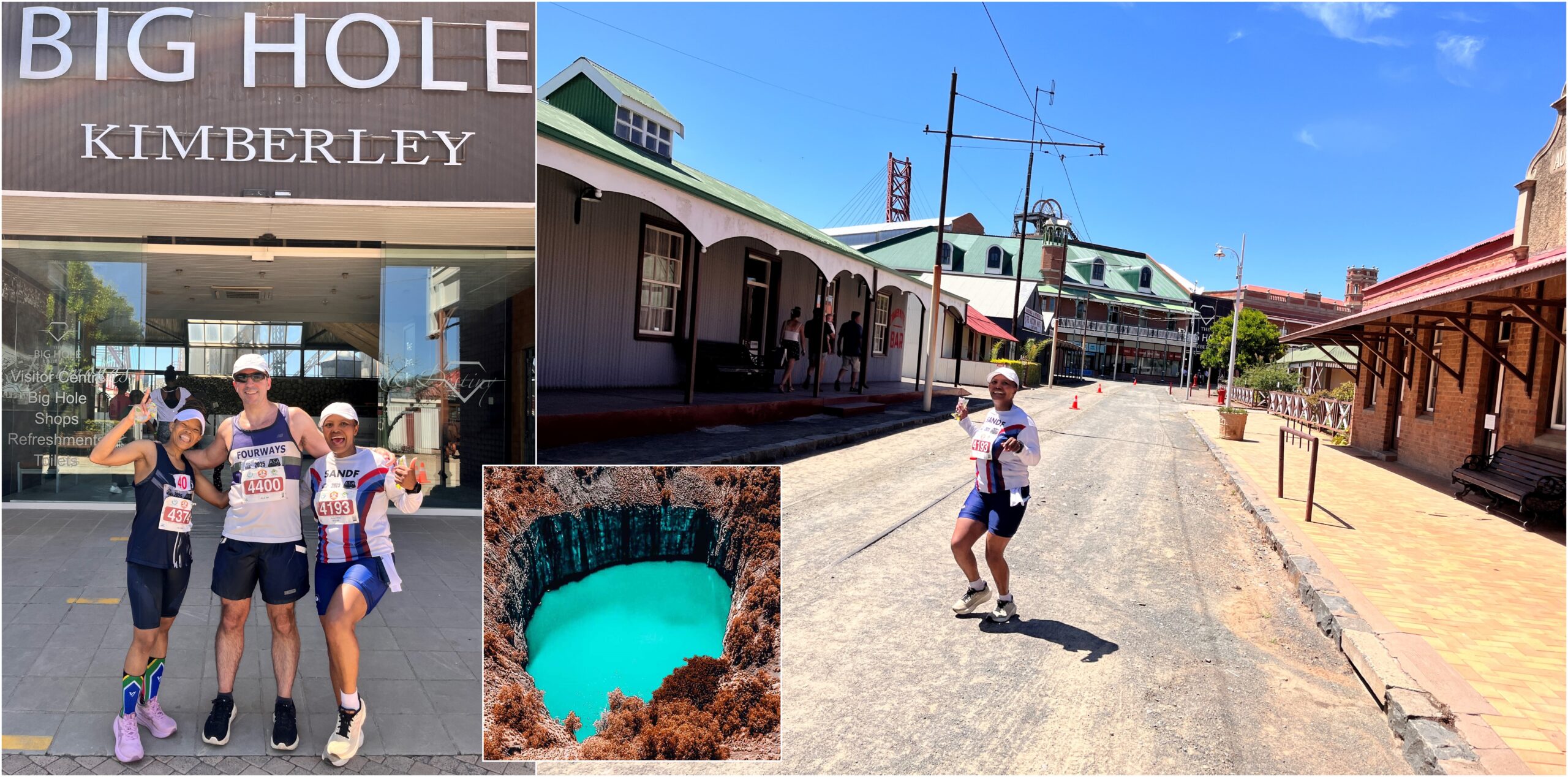
Before the shovels came out, the site was a hill known as the Colesberg Kopje. It’s estimated that 43,000 miners created the whole hole over 43 years by removing bucket by bucket of sand and rock. During this time, 14.5 million carats (about 3,000kg) of diamonds were mined, the largest and most famous being the 83.5 carat Star of Africa.
The landmark is now preserved with an impressive museum but originally a massive fence had to be built around the perimeter as locals started using the derelict site as a rubbish dump and threw their old furniture into the hole.
If you like to combine your history with a bit of mystery, you can come back at night and go on ghost tour. And if you are thinking of tying the knot, it would be highly appropriate to propose on the viewing platform over The Big Hole with a large, locally sourced diamond ring. If you do so, I would recommend playing Led Zeppelin’s ‘Whole Lotta Love’. Posting this on your social media feed would truly result in maximum engagement.
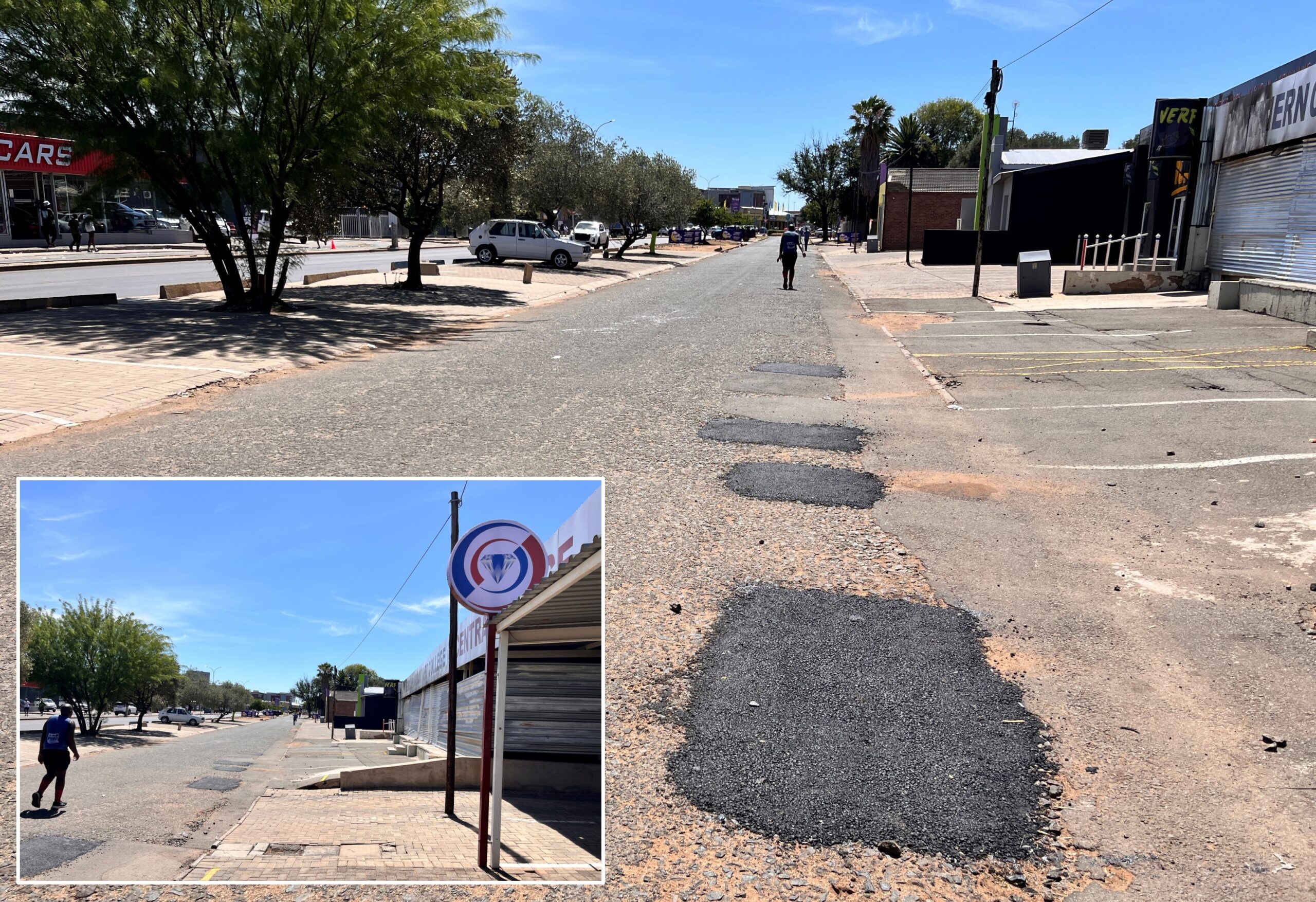
As the finish line approached and the temperature rose towards 37°C, I stopped to take the above photo and caught the distinctive smell of vaporising tar. I thought that the road was literally melting underfoot before realising that they’d recently fixed some klein gats in the road for a smooth run home.
I trudged towards the finish with fellow runners who’d already completed their morning’s work providing encouragement. Some people like to show off their medal after a race but Flippie van der Walt prefers to show off his car. Peugeot dominated rallying in the 1960s and scored a hattrick of victories at the East African Safari Rally from 1966-8.
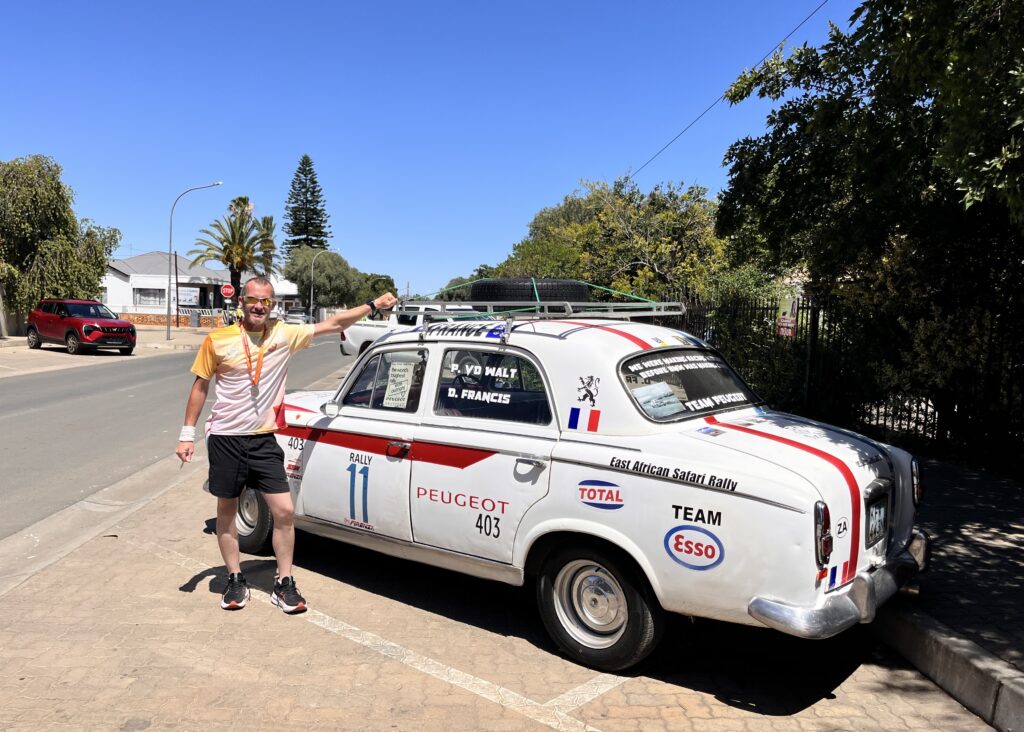
I was in the mood to have a break and had a quick chat with Flippie who told me that he built this replica model himself 15 years ago and still takes it on regular long distance offroad trips. I asked him how many kilometres were on the clock and he said he has no idea as the odometer resets every 90,000km and he’s lost count of how many times it’s clicked through.
The finish itself is inside the campus grounds of the Sol Plaatje University, which opened in 2014. Things have changed a lot since I was a student. Take dating for example. As an awkward teenager it was always a challenge to interact with the opposite sex but now they make things easy with official ‘Pick Up Zones’ (and if your date doesn’t go well the ‘Drop Off Zone’ is just next door).

The finish line itself was a hub of activity and entertainment. Many runners stayed on long after finishing in the “Winners Tent” to enjoy the festivities.
Regular readers of this blog will know that I like my stats and the best way to highlight the success of this race is to draw on one simple figure: In 2024 there were just 431 marathon finishers in the entire Northern Cape. The inaugural Big Hole Marathon single-handedly surpassed that figure with 464 runners crossing their finish line – which also smashes the previous record for a Northern Cape marathon (which I have as 188 at the 2023 Meerkat Marathon).
Moraladi provided this summary of the impact of the race and what future participants can look forward to, “This marathon reminded us how sport can uplift a city. We’re excited to build on that energy and welcome even more runners next year. The inaugural year showed us what is possible for Kimberley when we all pull in the same direction. We are already planning improvements across logistics, entertainment and the athlete experience for 2026, and we want runners to feel that this race becomes a permanent, high-value fixture on the national calendar. Our commitment is simple: every year must be better than the last.”
From my side I can provide the simple motivational mantra to those considering the race in future years: Come to Kimberley and run The Big Hole Marathon, you will dig it!


