

Every year there are a few races that run out of water but at the end of October the taps seem to run totally dry and I was tagged and DMed about three different races with water issues.
Races are getting fuller, the weather is getting hotter and with the World Meteorological Organization declaring a Super El Niño that is projected to last through to early 2027, it looks like we are in for a rough ride if race organisers keep failing their customers and running administrators keep failing their constituents.
The Jetour 10km in Cape Town caused a social media furore on the Cape Town Runners Community Facebook group with a number of different discussions popping up about the complete lack of water – and apparently marshals and medals as well (see Cheryl Louise Jamieson’s post “TOTALLY UNACCEPTABLE! RUNNERS DESERVE BETTER!”https://www.facebook.com/share/p/19i2Mf4tLS/).
On the Highveld I received complaints about the Versus 10k at Kyalami which had a late start and just one water point. And then the normally very well organised Jacaranda City Marathon also ran out of water for the slower runners in temperatures that had risen well into the 30s.
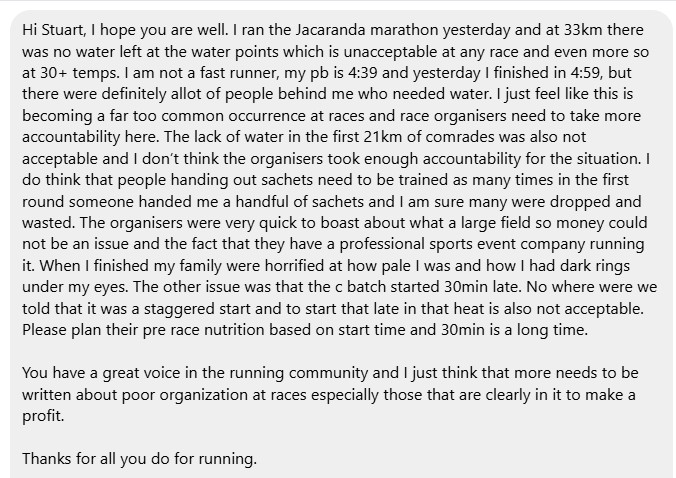
A race should never run out of water but it is going to happen from time to time – occasionally this will be due to factors outside of the organisers’ control but usually it’s human error or negligence. To err is human, and when this happens it’s how the event responds that’s important. Negligence is never OK (which unfortunately was the case at Two Oceans 2025).
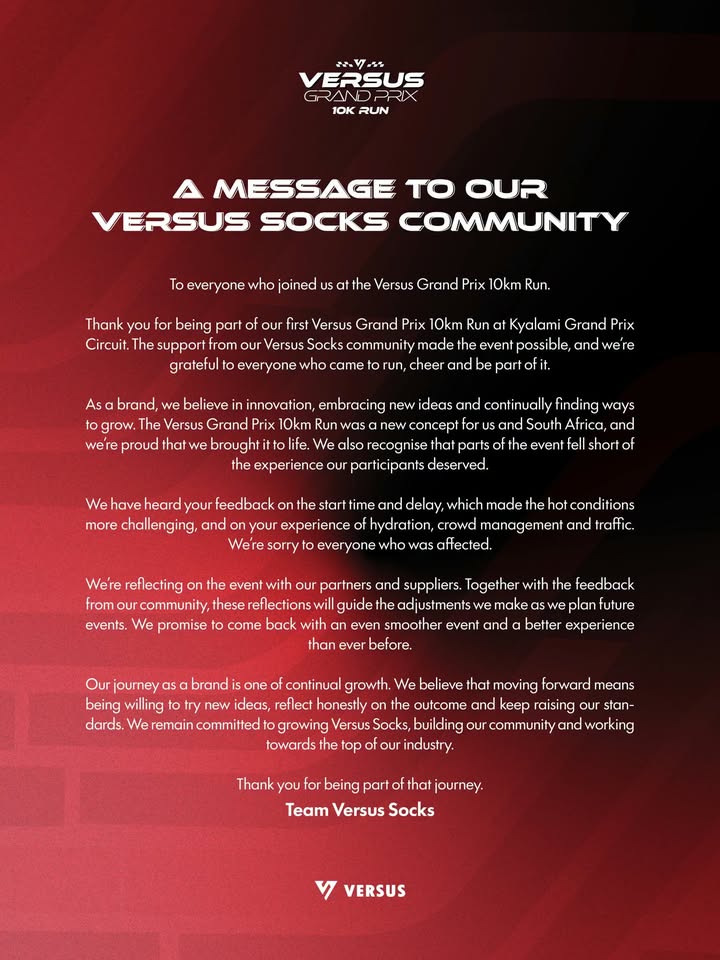
Both the 10k races subsequently issued apologies. The Versus one seemed to be better accepted than the Jetour one although there were some comments about the amount of AI apparently used in both (See: https://www.facebook.com/share/p/1FsnxRX1Xf/).

I’ve seen some people blame the runners. I don’t buy into the “It’s the runners in front taking handfuls of sachets” excuse. I’ve never really seen this in action (although I tend to only run the longer distances where people are generally more well-behaved and better versed in running etiquette). Besides which, the onus is on the organisers to ensure that there is enough water.
Sachet consumption volumes are fairly predictable based on the expected number of runners. These days very few races offer entries on the day which voids the “more people ran than we expected” excuse. Long-term 14- and 7-day weather forecasts are also accurate enough that no one can say, “We didn’t expect it to be so hot”. As an organiser, if the weather forecast is predicting a heatwave, then you have to suck it up and buy more water.
A shortage of medals is not ideal but can be sorted out after the race, a shortage of water during the race cannot – and comes with potentially serious safety and health issues.
Another important factor for organisers is to train the water table helpers properly. If you hold out a handful of sachets then it is far more likely that runners will grab more than they need. If you hold out one or two sachets then that is all that will be taken.
Every table should have a ‘boss’ who is monitoring the stock left versus expected number of runners still to come through (once again this can be calculated using simple maths). If it looks like the stock is running low then the helpers should be instructed to “guard the remaining stock” and only hand one sachet to each runner, telling the runners, “Sorry, the water is running low – it’s only one per runner so the runners behind you also get.” Knowing this, anyone who still insists on taking more water in such a situation is a total prick.
The table boss should also have the race director’s number on speed dial – and the race director should have a contingency plan to restock tables if water is running low. This is especially true for double-lap races where there is plenty of time to assess and address water shortages on the second lap.
In most cases, it appears that the race director is surprised to learn about water issues after the event but they should be aware of what is happening at every point of their race. One of the problems is that as soon as one table runs out of water, runners start stockpiling at the next table which exacerbates the problem.
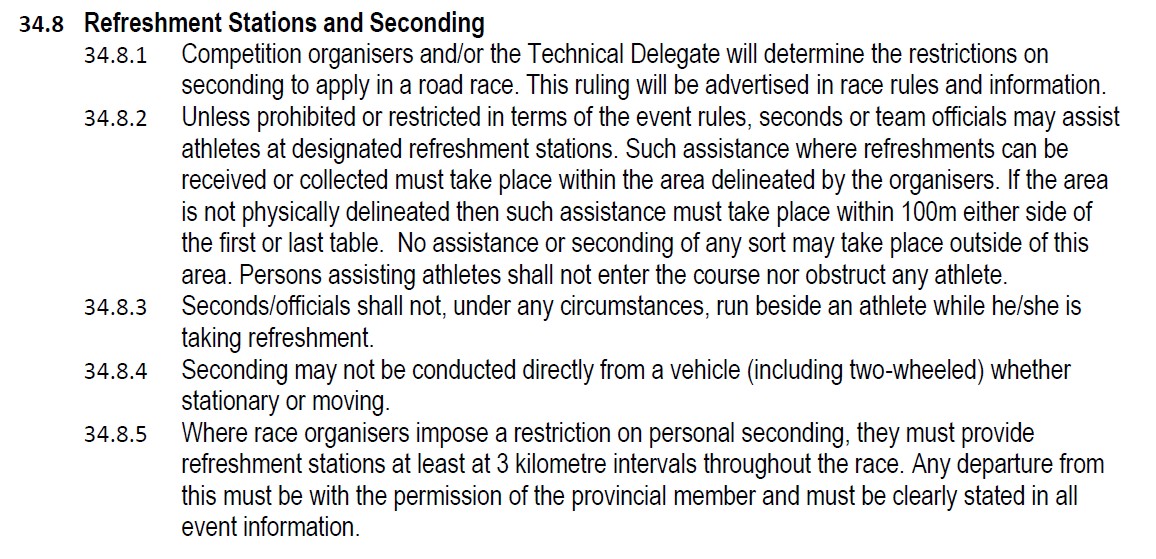
It’s time to look at the rulebook. Under the heading, “Refreshment Stations and Seconding”, rule 34.8.5 states, “Where race organisers impose a restriction on personal seconding [which is every road race in the country], they must provide refreshment stations at least at 3 kilometre intervals throughout the race. Any departure from this must be with the permission of the provincial member and must be clearly stated in all event information.”
Unfortunately, when it comes to the rules, our administrators love to act like schoolteachers and focus on the minutia of their favourite rules, hallucinate new rules and generally treat the runners like naughty school children – but they are terrible at following the rules themselves.
The rules are very clear: A race must have a table every 3 kilometres or get approval from the provincial federation AND advertise the fact on the race flyer. I don’t believe that this is ever done.
With the Comrades disaffiliation, the big question Comrades asked of KwaZulu Natal Athletics (KZNA) was, “Tell us what value you bring?” I’ve been told that several meetings have been held but KZNA have still not been able to establish a value statement.
For the running community, one item of value would be to ensure that the events under a federation’s domain are safe and organised to a prescribed standard. Ideally this should operate a lot like a franchise restaurant. I can go to a Spur anywhere in the country and expect the same standard of food and service. If I have a lousy meal and the manager is rude, I can expect to get recourse (pun intended) via a valid complaint to the head office.
Sadly, I have seen very little evidence of provincial federations proactively addressing issues when events fail to provide enough water. Perhaps the most classic example of this was the 2022 Durban City Marathon where there was no water at all on the double-lap route. The event is organised by Durban City Multi Sport Club which is the home of most of the KZNA technical officials (yes, you read that right – these are the same people who are supposed to correctly apply the rules and will DQ you on a technical whim). At the time, I was still on good terms with former KZNA president Steve Mkasi and he assured me that action would be taken but to the best of my knowledge nothing was done except to issue a press release.
READ MORE: Durban City Marathon (Water, water everywhere but not a drop to drink)
Having said that, I am aware that Western Provinces Athletics (WPA) are one of the few provinces where there are some consequences for events with poor organisation. With respect to the Jetour 10km, WPA domestic rules include a schedule of fines for such breach of basic rules. In the past WPA has also required races who breach rules to work with an experienced technical delegate as part of preparing for any future race.

Even the big-ticket events like Comrades and Two Oceans are not immune from water issues. At the time, I extensively documented the disastrous 2025 Two Oceans weekend. Some personal experiences from runners specifically concerning the lack of water and repercussions thereof are documented here:
TOM 2025 Reader Letters: Water Woes Ignored in 2024, Worse in 2025
TOM 2025 Reader Letters: Lucky’s luck runs out with half marathon water stations
TOM 2025 Reader Letters: The Kindness of Strangers
TOM 2025 Reader Letters: Once Bitten, Twice Shy
Having subsequently joined the Two Oceans board, I can tell you I was very nervous at the start of this year’s event. Renee Jordaan and her team from Stillwater had done a lot of planning to address the previous water issues and I was relieved to arrive at the first table and see that there was plenty of water and no queues (a trend that continued for the rest of the race). Constantia Nek is always a beast but is significantly easier when you don’t have to run it dehydrated.
This year Comrades had their own water issues with most of the runners from Group 3 not getting any water for the first 20 kilometres (although there were Coke and Thirsti Sport drinks available). The 25km table at the top of Field’s Hill also ran out of water.
Comrades did a full investigation and issued an apology ten days after the event. This was encouraging because, in the past, we have seen genuine runner issues being brushed aside. However, I personally found that the apology did not take enough accountability for the issue or the impact that it had on some runners (and that sentiment seemed to be shared by many runners).

There are of course the “carry your own” advocates but runners entering the most prestigious road ultra marathons in the world like Two Oceans and Comrades should not have to worry about sufficient hydration at any stage of the race.
The final topic to cover is “What should one do if you find yourself in a poorly organised race without water”?
The first thing is that no matter how frustrated and irritated you feel, it is poor form to take it out on the water table staff. They are almost always volunteers who have given up their morning to assist you and usually have no control over the water situation themselves. A more effective line of communication is to ask the table volunteers, “Does the event director know about this and is he / she doing anything to address the problem?”
The second thing is to take it easy. Slow down, forget about goal times and don’t overexert yourself risking medical issues. Most routes will go past petrol stations at various stages who should have a tap where you can get some water.
I would also always recommend carrying some money with you for emergencies (as a regular guy the most vital item in my running gear is a bankie of toilet paper which doubles up as an effective waterproof wallet).
Finally, after the event, send a formal complaint to the organising club and the relevant provincial general manager. If you run for a club, I would recommend asking your club secretary to send a formal letter to the provincial body.
Ideally, the only thing running dry at our races should be the excuses. Water sachets are cheap, weather forecasts are free and the maths is simple – there really is no justification for a dry table. But humans are flawed and the more races you run, the higher the probability that you will encounter a water shortage at some stage (and unfortunately there are some races where this is almost a guarantee).
Most events will have a “bad year” every now and again. If they don’t improve their service delivery, then vote with your feet – there are plenty of other events that would love to take your money. And follow these age-old words of wisdom, “Fool me once, shame on you. Fool me twice, shame on me.”
Disclaimer: Due to time constraints and the nature of this article (which is essentially an opinion piece), I have not approached the events mentioned in the article for comment.
Afterword: Disaster Races
Most marathons in South Africa are fantastically organised but here are a couple that were not:
Platinum Belt Marathon: Rustenburg to Marikana (sans water)
Dorothy Nyembe Marathon (Surviving the battlefields)
Follow Running Mann:


