

Foreword
Over the past few editions of Comrades, I’ve had quite a bit to write about after the event. This year it was a pleasant change to be able to focus on the statistics and a few runner stories rather than the controversies. Yes, there were a few issues and several people have asked if I’ll be writing about them. My reply has been “Yes, but it’s not time critical.”
The big difference this year was that the CMA board took accountability of the issues, apologised and (in my opinion) are serious about addressing them in 2026. This makes a stark contrast to previous years when the approach has been to deny, stonewall and wait for things to die down before the carpets are lifted and fervent sweeping occurs.
By far the biggest issue was the finish area. I generally tackle issues that are not getting mainstream press attention and the street finish got plenty of coverage. The other two issues I’ve decided to focus on, based on the number of messages and comments that I’ve seen and received, are the missing elite tables and the allegedly contaminated water sachets.
1. The Tableless Elite Tables
In the build up to Comrades 2025 there was some ‘strenuous debate’ between some of the elite team managers and Comrades officials about what seconding and support would and would not be allowed on the route. Essentially, elite team managers would like to have full route access to provide seconding and support to their runners (which they have had in the past although this had been removed in recent years) whereas Comrades would like to comply with World Athletics rules which means that only official elite tables should be used.
It does bear mentioning that Comrades is an international event and allowing special route access to South African team managers results in an uneven playing field for the international competitors. The Comrades officials won the argument and all elites had to rely on the official elite tables.


Knowing the background tensions on the topic, it was with some consternation to see the picnic blanket style tables appear on the screen with the bottles on the ground and hear the bemused remarks from the television commentators (as well as getting several WTF direct messages from other viewers). What happened to the missing tables and why did the elites have to go from ‘stand to hand’ to ‘crouch and pouch’ if they wanted to get their in-race muti? Let’s find out…
TRM: Please confirm that Star Hiring were responsible for the tables.
Comrades: Star Hire is the service provider that the CMA has been using for many years, and they provide the tables and equipment for all the other refreshment stations and venues of the race, including at the start and finish venues.
TRM: My understanding is that table locations that the Comrades office provided were for the Up run rather than the Down run. When the locations were queried by Star Hiring, a GPS format that Star Hiring could not understand / read was given and Star Hiring did not ask for clarification / another format. Please confirm that this account is correct.
Comrades: There was internal miscommunication between the elite tables coordinating team, the office team and the service providers. The security personnel were deployed and the tables were delivered on the route, but to the incorrect locations. In future we must use various formats of GPS pin locations e.g. Google Maps AND WhatsApp pin locations. The elite tables coordinating team in 2026 will meet with the appointed service providers the week before the race to conduct in-depth route recce site visits, to ensure that there is no misunderstanding or miscommunication between any role-players. The RAC [Race Advisory Committee] will work in conjunction with the Race Director in 2026 to appoint a dedicated elite tables coordinator.
The service providers did try their best in conjunction with race officials to rectify the delivery point issue on the morning of the race, however time constraints and traffic officials restricting access to certain areas of the route proved to be very challenging. An apology was sent to elite athletes and coaches on the 9th of June 2025. Elite team managers and the RAC met to share feedback on the 2025 elite tables stations, as well as their recommendations which will greatly assist the CMA (and new RD specifically) for the 2026 elite tables planning. For 2026 the new race director will oversee the elite tables portfolio and decide who will be coordinating the portfolio.

TRM: Will Star Hiring be used as a contracted supplier in future Comrades?
Comrades: Yes, after many years association with this service provider, and without any hassles or problems being experienced in the past, the CMA sees no reason to exclude them due to the miscommunication that took place in 2025.
TRM: On the day, when it was apparent that the tables had failed to arrive, why was there no contingency plan in place to correct the missing tables as quickly as possible so as not to impact the elite race (and the obvious embarrassment of having the picnic style ‘crouch and pouch’ tables)?
Comrades: We had several elite table stations that were operational, and every effort was made on race day morning to get the tables to the locations where we did not have tables in position.
[NOTE: Based on television evidence the majority, if not all, of the first half elite tables were missing the actual tables as were many on second half.]

The service providers did try their best in conjunction with race officials to rectify the error throughout the night and into the morning of the race, however time constraints and traffic officials restricting access to certain areas were challenging. The traffic officers closed the route once the first leading group of runners were approaching these locations where tables were required, and therefore the delivery trucks could not access these points in time.
The contingency plan that was put in place, despite the lack of tables in the earlier locations, was to allow these runners to get their bottles off the demarcated, numbered tablecloths on the ground whilst simultaneously trying to relocate the tables from one point to another point.
The Elite athletes were not negatively impacted in terms of their overall performance on race day and their times are testament to this fact. An example is Gerda Steyn, who ran the fastest average pace for a Down Run. Informal discussions have taken place with the 2025 elite tables project team and the team managers, and a follow-up formal debrief meeting is scheduled.
[Note: In my opinion, Gerda is not the best example to use, as she has a lot of personal seconding support along the route and got her bottles this way (as seen several times on television with her husband and family members passing on bottles). Full marks to her for having a risk mitigation plan (and she was not the only athlete with personal support along the route, Irvette van Zyl, also had a support crew and I’m sure that there were others as well). However, elite athletes who did not have personal ‘stand and hand’ support would have been negatively impacted. Alexandra Morozova appeared to be cramping and stopped a couple of times to stretch after halfway which may have been as a result of not getting her supplements.]

For 2026, the elite athlete criteria will be reviewed in conjunction with the Race Director, in order to determine the qualification criteria to define an elite athlete.
TRM: Did the elite bottles violate WA anti-doping rules (which are in place to mitigate the risk of contamination and sabotage) as the athletes had to put their names on the bottles and the names / exact table number was distributed to all. Can you comment?
Comrades: The elite athlete bottles did not violate WA anti-doping rules, and the handing over of the bottles at the Elangeni Hotel was overseen by the General Secretary of the IAU and the appointed technical officials. The bottles were all secured and placed into zip lock bags by the athletes themselves, thereby removing any risk of contamination by outsiders.
Those bottles, after being sealed, were delivered on-site by technical officials and security officials, and then removed and placed onto the tablecloth positions, all under the control of the technical officials and table captains.
CMA have no control over the stand-and-hand seconding by running clubs throughout the route.
Opinion: Whilst it was a comedy of errors that resulted in the picnic-blanket style elite tables, I am sure that the elite runners did not find it funny. Whilst I can empathise with the local elite team managers, I do think that World Athletics rules and standards should be applied but basic errors like this make the argument more difficult to win.
I also think that Comrades was missing the meticulous attention to detail and the ‘been there, done that’ elite athlete experience that Ann Ashworth brought to the event in 2024. The CMA advertised the Race Director vacancy on 8 July 2025 with the closing date being 21 July 2025. They received 101 applications for the position and an independent committee led by Renee Jordaan shortlisted nine “exceptional” candidates. The board intends to announce the new RD within the next two weeks.
2. Something in the Water?
After the race I got several queries from people saying that they had suffered from nausea and vomiting during the race, knew of others who had the same issue and wanted to know if this was widespread.
One of the most prominent was elite female athlete Chrizell Roberts who ended up with the biggest positive split of the day. Roberts said, “I started a tad too quick. Was projectile vomiting by 40. Got assistance slept for an hour, felt better and decided to keep running.”
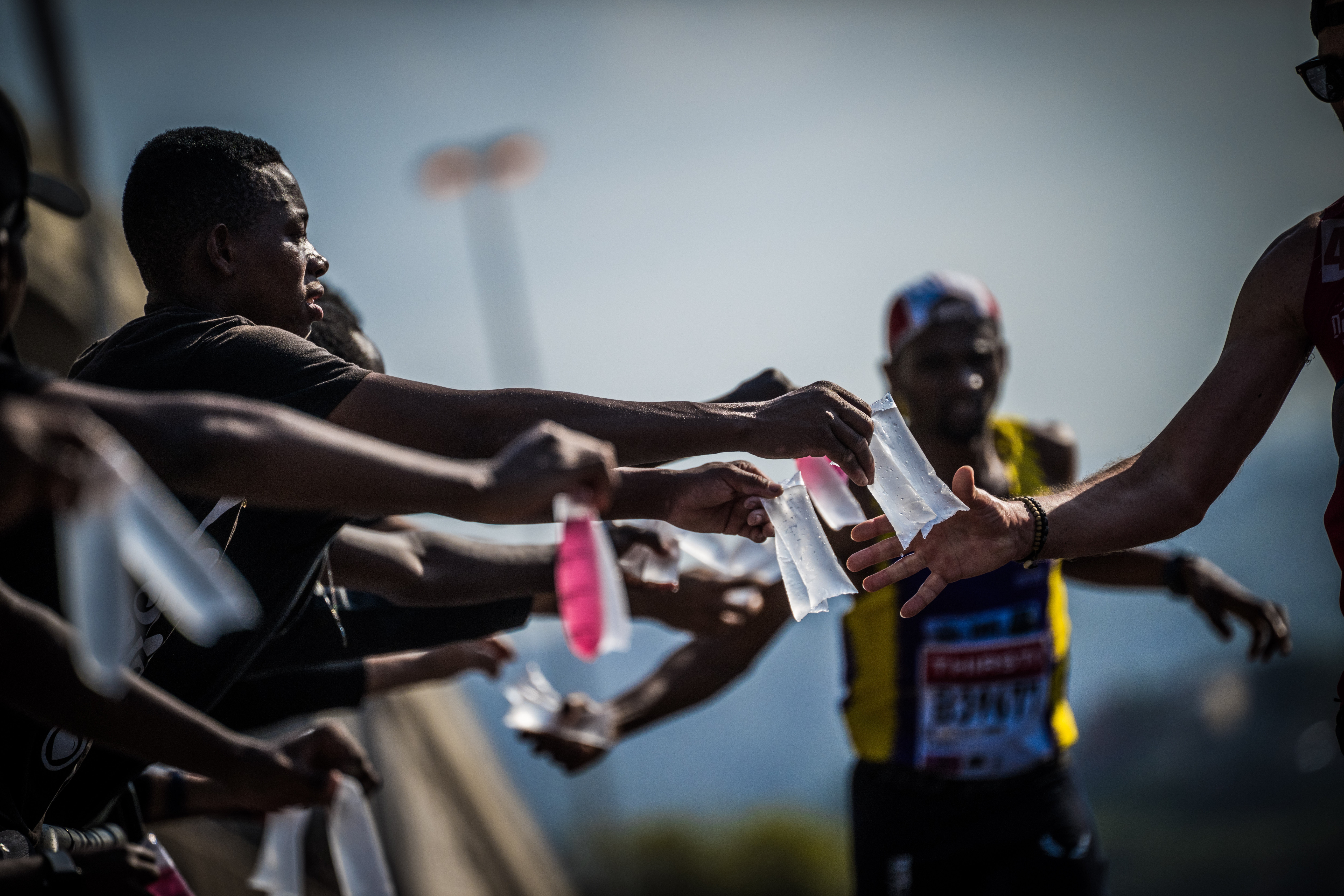
Conjecture from a number of runners was that the water, which tasted ‘funny’ at some points along the route, was the cause of the nausea. Was it the water, a virulent virus or something else? This is something that is incredibly difficult to prove or disprove without taking samples of the water on race day and doing independent testing. As a point of interest, I was asked the same question by vomiting runners after Two Oceans but it was one of the few lines of investigation that I did not pursue as it would have been pure conjecture and impossible to prove.
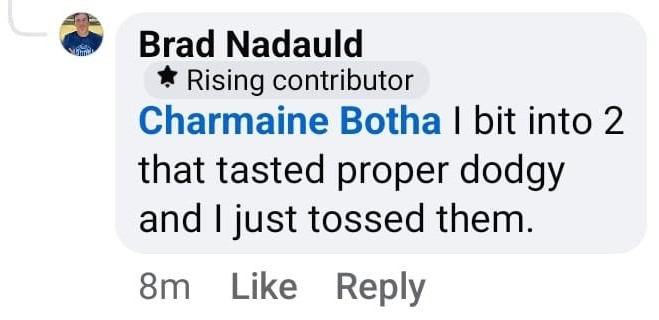
TRM: There has been conjecture that the water was contaminated and caused some runners to vomit. Can I get an official comment from THIRSTI?
THIRSTI: THIRSTI produces 2,000,000 water sachets for the Comrades Marathon with utmost care, applying the same quality standards that they do for every bottle of their extraordinary spring water. In 2025, THIRSTI invested in additional capacity to produce the sachets, further ensuring efficiency and quality. All sachets are stored in their own warehousing until the day before the race where logistically it is a requirement that they deliver to each water point on the Saturday. All our quality tests are done within this specification and THIRSTI is confident that the water complies with the strictest standards.

TRM: Can you / THIRSTI give a summary of the quality control steps that are taken to ensure that no water is contaminated on race day.
Comrades: Every sachet bag was manually inspected for leaks and visible microbial growth. The factory’s quality control team retained and monitored daily samples from production batches to detect any quality deviations.
TRM: I understand that THIRSTI have tested and retested water samples – are you able to confirm and provide the results?
Comrades: Yes, each batch of sachets and bottles underwent quality checks prior to dispatch. This includes microbial testing and packaging integrity, ensuring the water was safe for consumption on race day. We have lab reports confirming this.

TRM: There were reports that water was left out in the sun 24 hours before the race – is this correct and would that have an impact on the quality?
Comrades: Water sachets were distributed from 08:00 on Saturday and placed at aid stations within the same day – less than 24 hours before the race. Afternoon heat exposure was not sufficient to cause harmful plastic migration or microbial development, due to primary and secondary packaging providing protection.
The Comrades Marathon hydration sponsor supplies water bottles and sachets to many large retailers and events around the country, and they undergo very strict testing and quality control processes on a regular basis. This is a legal and regulatory industry requirement.
The sponsored water sachets will have a printed logo on the sachets in 2026 so as to clearly distinguish between the official Comrades Marathon water sachets and those provided by private groups/individuals.
It must be noted that there were several spectators and seconding teams handing out water and refreshments throughout the entire route on race day, and these individuals or groups were not involved in or part of the official 47 Comrades refreshment stations. This is virtually impossible to police or control on the day amongst the thousands of spectators along the route.
[Note: There is also some conjecture that the ‘funny taste’ was residue from anti-cramping and other sprays used in close proximity to the water sachets.]

TRM: I understand that the nurses in the medical tent conduct tests on all admissions as standard protocol and that they found low sodium levels (which would be from de- or overhydration) and not ‘bad water’ (typically caused by E.coli and would result in diarrhoea plus vomiting). Can I get an official statement from the medical team on the results of tests / diagnoses confirming the likelihood of ‘poisoning by bad water’?
Comrades: The official feedback from our medical team is as follows:
“We can confirm that we are unaware of any unusual number of patients treated in the Comrades medical tent for any symptoms that could be attributed to a problem with the water on the 2025 Comrades Marathon route i.e. vomiting and/or diarrhoea. The major problems we encountered in the medical tent were exhaustion and dehydration. The latter confirmed by the fact that, of the patients who had blood tests done, roughly 47% were hypernatremic (a high serum sodium). This is exactly within the normal range that we see every year, i.e. no unusual increase in the number of dehydrated patients.”
“This year was a busy but successful year in the medical tent. We treated 600 patients, 440 in the main medical tent and 156 in the St Johns section. The ICU section was busier than previously, but all patients were managed successfully. We had the usual serious patients, chest pains and possible heart attacks, 3 runners with hyperthermia who were treated in our ice baths, one patient with a low serum sodium who had a seizure, a few in probable early renal failure and a member of the public who is epileptic and had a seizure. [We treated the same person a few years ago for the same problem!] In all 46 patients were transferred to hospital, all of whom made a full recovery.”
“The various referral hospitals received a total of 185 patients, 46 from the finish medical tent and 141 direct from the route. 37 were admitted and all discharged within a couple of days, apart from Moira Harding, and a patient in acute renal failure. They remained in hospital for a longer period but both have made a full recovery”.

Opinion: I think it’s highly unlikely that the water was contaminated and caused vomiting. Having said that, I have no doubt that had I started vomiting during the race I would be convinced that it was contaminated water that caused my symptoms.
There were also comments that Piet Wiersma mentioned he had struggled with nausea and diarrhoea in his postrace interview. However, Wiersma specifically said he had these issues in the days before the race (i.e. they did not present during the race).
3. The ‘Sheet’ Street Finish
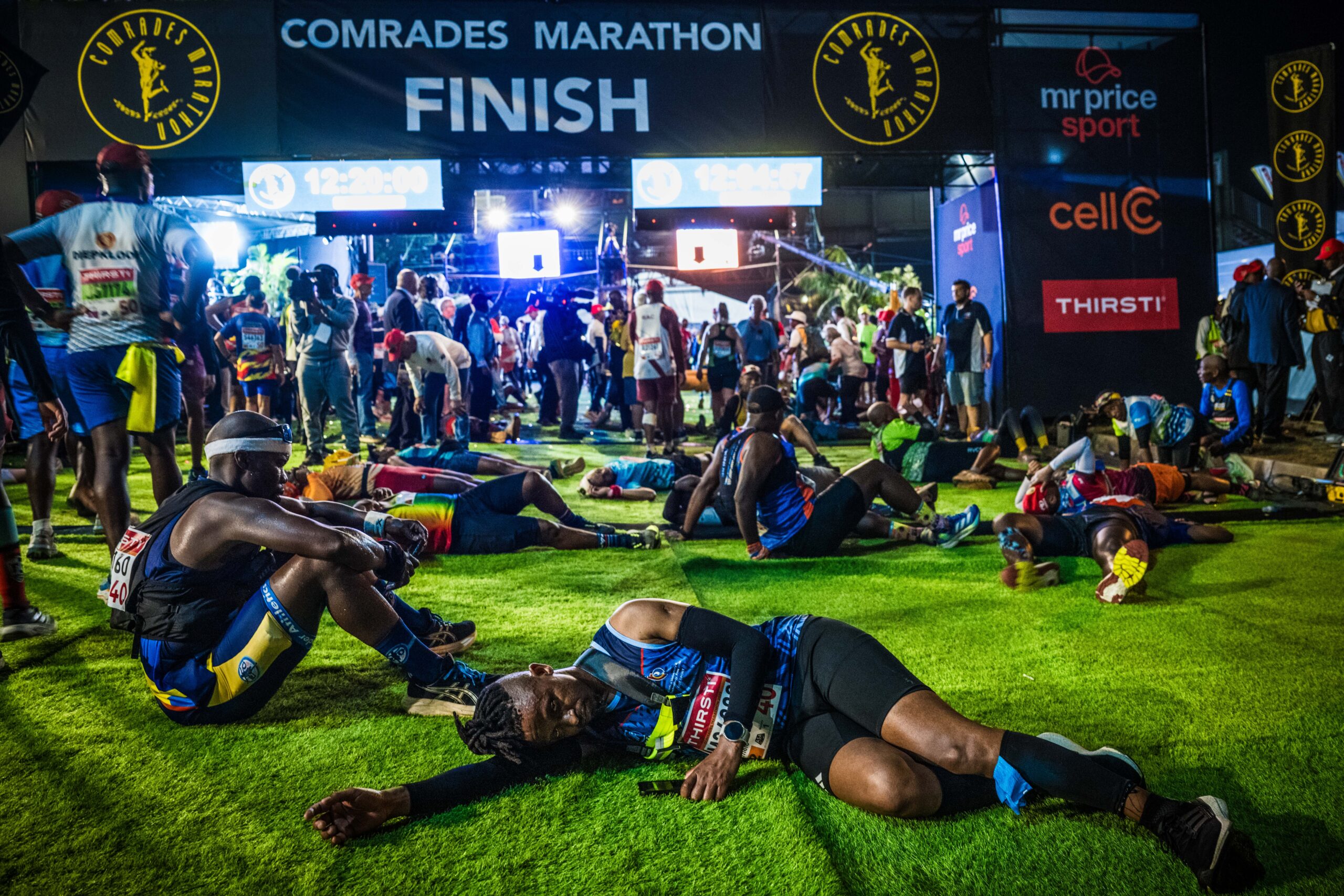
Before the race, the change from a stadium to a first street finish got a lot less attention than the switch to the first ‘two pot’ start in the history of Comrades. The ‘two pot’ start was a success – both statistically and anecdotally from runner reports. However, the finish area was diabolical.

TRM: Does the CMA agree that the finish area was a mess? What does the CMA believe to be the main issues and how will they be addressed in 2026?
Comrades:
- The Finish Venue was very congested in the last two hours, and we have determined that the flow of people must be improved in future.
- Utilisation of both medals chutes throughout the day i.e. use both the Group 1 and Group 2 arch chutes in the Medals tent.
- Layout positioning of the medical tent and tog bags tent to be reviewed and possibly repositioned in future.
- More space must be provided for runners after receiving their medals, and a large, dedicated area for spectators to meet runners must be identified and communicated in advance via all our CMA marketing and media channels.
- Directional signage to be significantly increased, placed on very large boards with large fonts and erected very high above the crowds of people i.e. above the eye line.
- The no-go zone in the finish line area must be improved.
- The RAC met last week to do advance planning and will, with the new RD, ensure that the finish for 2026 has none of the issues experienced this year.
TRM: Is Scottsville the confirmed race finish for 2026? When will the finish venue be confirmed if not?
Comrades: The 2026 finish venue is still to be decided, and the RAC Chair and the GM will present recommendations to the board for the finish Venue. The new RD will then provide their input and recommendation once they are appointed. We anticipate announcing the finish venue by the end of September.
TRM: There were lots of complaints about it taking hours to get out of the finish venue. Was there a formal traffic flow logistics plan in place?
Comrades: There was a formal traffic management Plan that was in place, and this was compiled and approved by the three traffic authorities i.e. RTI-KZN, Durban Metro Police and Msunduzi Traffic Police, and final approval was given by the SAPS Brigadier.
The CMA will share more details via our Marketing & Comms platforms around certain aspects of the traffic management plan in advance of the 2026 race.
TRM: Specifically on the Moira Harding incident, how will the CMA ensure that this never happens again.
Comrades: The CMA remains fully committed to always assist all runners in need and whilst they are within the finish venue. We have no control over runners’ whereabouts or what decisions runners make once they have left the finish venue area. We will have additional marshals in 2026 and additional dedicated medical personnel stationed after the medals tent to assess any runners who appear to be in distress or disorientated, to determine if they require any medical assistance at that point.
We had adequate medical personnel throughout the entire finish area and throughout all areas of the race. A medical debrief meeting took place on 24 June with Netcare and the Comrades medical portfolio convenors for the 2025 race. The following medical personnel were in place on race day:
The on-site, dedicated medical complement consisted of the following:
• 8 x Medical points on the route each staff with 6-10 x RN/medical staff
• 1 x Medical tent at the finish point
• 4 x Medics – Crowd (Level 5/6)
• 3 x Medics – Stadium Entrance (Level 5 & 7/8)
• 2 x Hospital Co- Ordinator’s (St Augustine’s / St Anne’s)
• 16 x Emergency ILS Ambulances & 2 x Medics (level 5/6)
• 7 x Emergency Response units & 16 x Medics (level 5 & 7/8)
• 1 x Quad Bike & 1 x Medic (level 5/6)
• 4 x Emergency Motorcycles & 4 x Paramedic (level 6/7/8)
• VOC support Services – 7 members (level 5/6)
• 4 Support vehicles (logistics)
• 1 x IT Standby support staff
Total Medical complement is 29 x Emergency Vehicles & Approx 165 Medical Staff. In addition, there were 154 medical stretcher bearers at the finish line and medal tent area.
Netcare Manager and Dr Boulter managed all medical personnel on race day. The new RD will meet with the medical team to discuss and finalise the detailed plans for 2026.

Opinion: The street finish itself was not the problem, the way that it was executed was. Most of the largest marathons in the world (with substantially more finishers than Comrades) have a street finish and it allows a lot more people to run and spectate than health and safety would permit inside a stadium. However, having failed at the first attempt, there is now a major risk ahead of the centenary run in 2027.
There were a lot of good suggestions from runners after the event and it looks like most of these have been taken on board by Comrades. The biggest and potentially easiest of these to address would be:
- Making the runners only area much bigger and including tog bag collection in this cordoned off area.
- Having a simple way to meet up with friends and family after the event like tall poles with letters (signifying the surname).
- Training the security staff better so that they can provide quick and correct assistance / directions to those with questions.
- There were very few Group 1 runners finishing in the last hour which meant that all the Group 2 runners were crammed into half the finish straight. It would be much better to use the whole chute at peak medal cutoff periods from 11 hours onwards and sort out the Group 1 runners over the finish line.
Overall, I think that there is a case to be made for having a very large area totally cordoned off from vehicle traffic and only allowing spectator entrance to those who have genuine business being there. The model I would use is that which is followed for the Calabash concerts at Soccer City in Soweto. My teenage daughter wanted to see Green Day and The Offspring earlier this year and, despite being a big fan of both bands myself, I did approach the event with some trepidation worrying about the safety aspect.
I was very impressed with how well it was organised. There is a massive no traffic zone for kilometres around the stadium, there was excellent signage, it was well lit, it was heavily and visibly policed, there were a ton of different transport options to get there and home again and you could not get access to the precinct if you did not have a ticket.

All photos courtesy of the Comrades Marathon Association unless otherwise noted.
Follow Running Mann:


Very informative, thank you Running Mann.
My wife can only ever drink water from bottles, FortunatelyThirsty supplied some water table with bottles. I often taste a miltonish flavour in water saches, if I do I just use that sachet for cooling, washing hands and face. No ways the sprays got to the sachets , medical is always well away from water tables. My sachets on Comrades were all fine from what I can remember…
The open and honest replies, with no hint of defensiveness, are to be commended and are like a breath of fresh air!
A very good and well balanced interview Running Mann. I think that anyone considering entering the 2026 event, can feel confident that it will be a well and professionally organised event.
Hello Stuart,
i have been trying to find out if there will be any special event or recognition to the old Comrade’s runners who want to be part of the 2027 100th celebrations.
It did change our lives ,and we were the runners who helped make the Comrades great .
Have you heard of any developments about this ?
Thanks
Tombstones 606 (18 medals )
Hi Dennis, I am not aware of anything but am not involved in the innner workings and plans for the 100th event. I will pass your comment onto the CMA Board.