

There are two immediate questions to answer:
- “Was the correct call made to cancel the Cape Town Marathon?” I believe that the answer to this question is a “Qualified Yes”.
- “Should winds of 48km/h and gusts of 60km/h have resulted in the cancellation of the Cape Town Marathon?” To that the answer is an “Emphatic No”.
Actually, there is a third question that needs to be asked, “If we have 48km/h winds with 60km/h gusts on the night of 23 May 2026, will the Cape Town Marathon be cancelled again?” If the answer to that question is “Yes”, then we might as well kiss our World Marathon Major aspirations goodbye, pack up and go home. On the other hand, if the answer is “No”, then we should be looking at the root causes to ensure that they are not repeated.
I’ve been asking a lot of questions recently so here’s a fourth, “If the same levels of wind were experienced the night before any of the other marathon majors, would the race have been cancelled?” I believe that answer to that would be “Almost certainly not” and, assuming that is the case, it means that someone messed up.
READ MORE: Major Marathon Cancellations, Windy Marathons and the Peninsula Marathon Argument

In the aftermath of the Hansie Cronje matchfixing scandal when Cronje was quoted as saying, “The devil made me do it”, there was a brilliant fake newspaper headline reading, “Satan – My side of the story: I never spoke to Hansie and I don’t even like cricket.”
On the other side of the spiritual realm, God’s name gets abused and thrown around a great deal. I will happily step in to defend Her – winds of 48km/h are not “an act of God”. This is a strong but not abnormal wind and there was no wind related damage reported between midnight and 4:45am on 19 October 2025 anywhere in Cape Town except to infrastructure at the start, finish and along the Cape Town Marathon route.
So if we can’t blame God for the marathon cancellation, who do we blame? The City of Cape Town’s officials? The Cape Town Marathon organisers? The system in which they operate? The bottom line is that a marathon should never be cancelled because of wind well below gale force level without some level of human error involved. This article takes an in depth look at all aspects of the cancellation and the impacts thereof.
The Investigative Process
I sent Clark Gardner (CTM CEO) and Renata Bossi (Head of Marketing) a set of questions on the afternoon of the race cancellation date. I received what I believe to be open and honest replies less than an hour later.
I sent a set of follow-up questions during the week. These were also answered candidly with the rider that, “These will be the final round of questions we are answering with regards to the cancellation.”
I sent a set of questions to Colonel Christo Engelbrecht from SAPS who was the City official quoted in the cancellation announcement. He declined to answer and referred me to the Western Cape SAPS Media Liaison. They gave me a rather terse reply, “Please be advised that the decision to cancel the Cape Town Marathon was not taken by the South African Police Service (SAPS), but by the Event Safety Committee, of which SAPS is a participating member. Accordingly, this office will not be providing further comment on the matter and refers all related enquiries to the City of Cape Town’s Disaster Management, which is best placed to provide clarity on the decision.” The Western Cape SAPS Media Liaison did not provide any contact details.
Therefore I went to the City’s overall media office (who I have always found to be very professional) and, whilst I did not get replies to my individual questions, did get an overarching response. I have included the full response as an appendix.
I received a large number of tip offs and insights from various sources, several of whom have been involved with athletics administration and race organisation for many years. Where relevant I have followed up on leads to corroborate and refute opinions and statements. Direct interviews were held with a number of key stakeholders and well-informed individuals.
What is a JOC?
A Joint Operations Centre (JOC) is the central command and coordination hub that manages safety, security, and logistics during major public events in South Africa to ensure compliance with the Safety at Sports and Recreational Events Act (SASREA). It typically comprises SAPS, Metro Police, Fire, EMS, Traffic, Disaster Management, the event organisers, route managers and medical coordinators to make real-time decisions before and during high-risk events.
Who Makes the Call to Cancel?
When it comes to race cancellations, the first thing to bear in mind is that the decision is not made by the “race organisers” but by the appointed officials within the JOC. Depending on your perspective, Cape Town is notorious for having the strictest or most pedantic safety and disaster management officials in the country.
Therefore the statement that “The Cape Town Marathon organisers have cancelled the event.” Is incorrect. The correct statement is that “The Joint Operations Council (JOC) cancelled the event.” Press releases confirmed that neither the CTM organisers nor the pending Abbotts World Marathon Major (AWMM) evaluation had any impact or influence on the decision.
In the below article by Adnaan Mohamed, CTM CEO Clark Gardner seems to indicate that if it were solely up to CTM then the race would have gone ahead.
Killing the Conspiracy Theories
Having already eliminated God and Satan, let’s refute some of the conspiracy theories that have flown around.
- Was the real reason that race was cancelled because of a threat of terrorism or civil unrest? No
- Was there any political interference in the decision to cancel the race? No
- Was this just a big “money heist”? Definitely not. All the significant expenses except for the marathon prize money had already been spent before the early morning cancellation call. In fact, the CPT Marathon (Pty) Ltd incurs a significant financial penalty as a result of the race not going ahead.
- If the race started late, it would have meant that CTM would automatically fail the AWMM qualification criteria and would have to start the “pass two years in a row” process again. They therefore deliberately cancelled the race so that they wouldn’t have to start from scratch again in 2026. Other than the AWMM criteria allowing for a late start as a result of challenges out of their control / force majeure reasons, the decision was the JOC’s alone to make. Gardner further clarified, “The AWMM criteria never played a role in any of our thinking. Most of the decision makers are not even aware of the criteria and the complexities of reaching such a status. It was the JOC’s decision to cancel the race and they all unanimously agreed to it.”
CTM’s Track Record
Cape Town Marathon has had an excellent organisational track record over the last decade and more. They have set the standard for large scale distance running events and have avoided the controversies and basic mistakes that have plagued Comrades and Two Oceans in recent years.
Unlike this year’s Two Oceans which was badly afflicted with problems on all fronts before, during and after their race weekend (all the Two Oceans events had serious safety and organisational flaws), CTM’s trail events and 10km run went off without a hitch. The only other organisational issue that I am aware of is that they ran out of goodie bags.
As such, they come into this situation with a high degree of credibility.
Faces, who are the professional events staging partner and true ‘organisers’ of Cape Town Marathon, have a strong pedigree with race organisation. Although they don’t organise any other road events, they have a number of high profile cycling events on their books including 947 Ride Joburg, Race to the Sea, Race to the Sun as well as the Warrior obstacles race series. I recently ran the Otter African Trail race which is also a Faces event and the event organisation and execution were flawless.
A Material Breach
In November 2012, a temporary advertising structure (a brand activation tower for Lucozade) collapsed in high winds as fans were queuing to enter a Linkin Park concert at Cape Town Stadium. One woman died and a further 12 people required hospitalisation. Earlier in the day, the City’s engineer had signed off the structure as being safe. However, the banners were erected after the sign off occurred.
Subsequently no canvas or non-breathable fabric branding has been allowed to be used on any outdoor structures and infrastructure. Only ‘Airtech’ materials (also known as Airmesh and Airtex) are allowed so that the wind will blow through it.
CTM decided to use Polytwil fabric which provides a far higher print resolution quality and photographic detail than Airtech. However, it is not porous and is not recommended for use in any conditions above moderate wind.

I plugged “Are Polytwil fabric banners recommended for use in windy conditions?” into ChatGPT and got predictable results. The short answer was, “Polytwil banners are not ideal for very windy conditions. They can be used outdoors, but only if the wind exposure is moderate or the banners are installed securely and temporarily.” Followed by the conclusion, “So while Polytwil holds vibrant colour and looks great, wind load is its main weakness in outdoor banner applications.”
Asking the more elaborate, “Can you give me a comparison on the pros and cons of Polytwil versus Airtech fabric for use on banner and scaffolding branding in a marathon in a city that is prone to high winds.” produced a detailed response. The “quick verdict” was, “Use mesh (Airtex/Airmesh) for scaffolding & street banners in wind-prone city conditions. Mesh is purpose-built to let air pass through, dramatically reducing sail-force. Polytwil looks nicer up close and prints beautifully, but in strong/constant wind it behaves like a sail and increases risk to fixings and scaffold structures.”
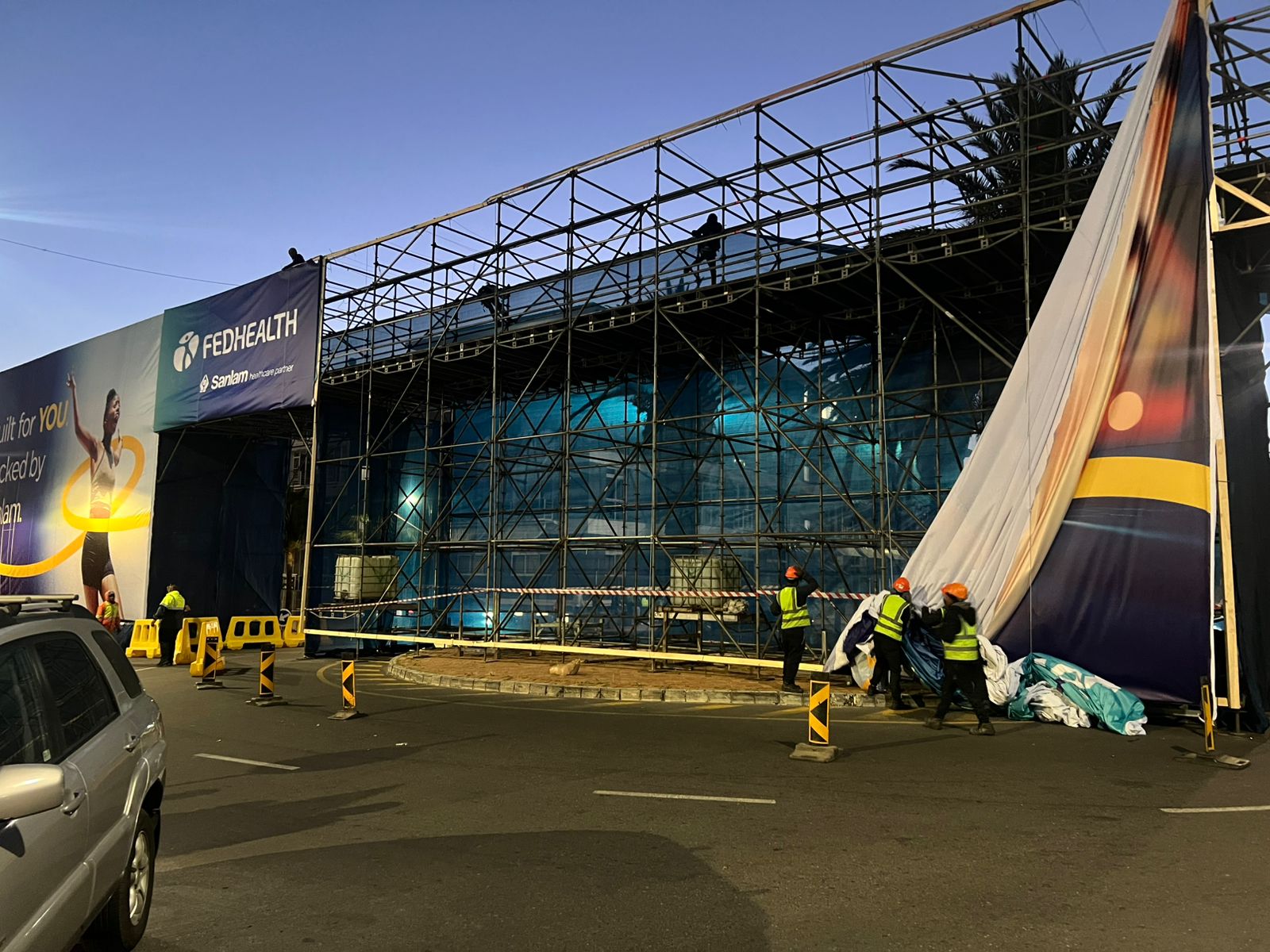
Several parties I spoke to suggested that CTM went for form over function. One told me, “No one [in Cape Town] uses thick canvas. They went for aesthetics over safety. It seems that big egos were at play.” This seems a lot like my teenage daughter who chooses her clothes based on aesthetic appeal rather than the predicted weather conditions and practicality in the environment in which they are to be worn.
I asked Gardner, “The banners, posters and attachments I’ve seen were clearly normal canvas and not Airtech canvas. Would you agree that using the incorrect canvas contributed to the problem and if Airtech canvas was used, railing and other structures would not have been impacted by overnight wind?”
Gardner’s response was, “We do not use canvas. Our fencing uses Polytwil fabric and has a unique zip system that is unzipped overnight to allow wind flow. All these fences were removed off all fence wraps by 3h30. The fences in Woodstock and Salt River had no branding on them. The water tables, elite tables, km markers and other activation on route made use of Airtech or similar. They could all also be removed.”
I did not ask Gardner any specific questions about the medical tent that was shredded in the overnight wind. However, here once again, stakeholders I spoke to suggested that the choice of tent type was questionable and that CTM went for something that looked nice rather than the best option to withstand high winds. An experienced events organiser explained to me that you cannot use gazebos at all when winds exceed 30km/h and that tents have different wind ratings. Many have made a comparison to the tents used every year at the Ironman event in Gqeberha which have a track record of withstanding far windier conditions without incident.
What Infrastructure was Damaged by the Wind?
The initial race cancellation press release stated, “The winds overnight wreaked havoc in the race venue in Green Point, with marquee tents damaged and branding being ripped off fences and scaffolding…” and attributed the following quote to Colonel Christo Engelbrecht of the SAPS, “The route is unsafe, as the wind is constantly gusting in Woodstock, and the infrastructure at the start and finish venue has been compromised. It’s unsafe for runners and pedestrians in that whole area, and that’s why the race has had to be cancelled.”
The subsequent “Cancellation Timeline” press release makes numerous references to both fencing and infrastructure like 02h15 “Safety Walk inspection of Race Village observes damage at Start in Fritz Sonnenberg Road, with some infrastructure blown over. Damage also observed at Finish, with fencing blown over, and in Hospitality Area, where most gazebos and some furniture blown away.”, 03h00 “Sea Point: Fencing and infrastructure at Start in Beach Road blown over or shifted into the road.” and 04h40 “Structural engineer reports that he cannot do final certification that the following structures are safe: Start towers on Fritz Sonnenberg, scaffold bridge on Vlei Road, hospitality marquee and shade stretch tents in Race Village, medical tents on route, pedestrian bridge on Vlei Road, main medical marquee at finish.”
I was left with the impression that the start, finish and pedestrian bridge scaffolding was part of the compromised infrastructure and asked Gardner on the day of the cancellation, “Were you happy with the quality of the start and finish infrastructure? Is there any truth to the rumours that the infrastructure was sub-standard and not signed off?” His response was, “Our infrastructure including start towers, bridges and finish gantry was still standing at 12pm today. See the video footage in our interviews. The bridges were signed off at 60 knots [111km/h] per hour. There was a Bedouin tent that collapsed and another that ripped. The race village was shut down as a result. We had mitigating plans to divert all finishers by keeping them on Vlei Road to collect drinks and medals but the bigger issues were fences, sans branding, still blowing across our roads and start batch loading areas.”
In the follow-on questions I asked, “Can you send me the compliance / structural engineering sign off on the scaffolding?” Whilst I did not get the actual sign off document the following confirmation was received from Gardner, “No scaffolding was compromised or not signed off. Bridges and gantries were all signed off at greater wind speeds and were never compromised.”
There does appear to be a contradiction between this statement and the official reply I received from the City of Cape Town, “On Sunday morning, it became clear that the race village, start area, medical tents, and pedestrian bridge infrastructure had been severely affected by wind damage. These structures could not be certified as safe, and any immediate mitigation measures would not have sufficiently addressed the risks.”
To the question, “There was also a statement that it was not safe along the route, what specifically was unsafe on the route itself?” Gardner answered, “The gusts coming through Woodstock and Salt River and Beach Road were significant at very important set times during the morning. We needed road furniture to protect participants from traffic and to hydrate them accordingly. We needed medical tents and elite tables. We needed signage and cones. None of these were possible at key moments in the morning.”
Having the start, finish or pedestrian bridge scaffolding compromised and at risk of collapsing (which would almost certainly result in deaths in a crowded area) is a very different proposition to fencing and signage being blown around. That adds massive weight to the “why not just delay the start?” argument. If major scaffolding infrastructure was compromised then you cannot have anyone in the immediate vicinity and, unless there is an immediate alternative start / finish, the only choice is to cancel.
The normal protocol is for the JOC and CTM organisers to meet twice a day in the week leading up to the event. Seeing these minutes would be enlightening. Either CTM were told that their banners were non-compliant and would cause problems if the wind picked up and chose to proceed as is or they were not told and should have been.
Why Not Delay the Start?
The ‘timeline’ press release contains the following explanation from Gardner: “We had suggested plans to divert all finishers from the Race Village itself by keeping them on Vlei Road to collect drinks and medals, but the bigger issue was the fences being blown across the road and start batch holding areas, posing a danger to runners, spectators and race staff,” he continues. “Also, starting later would have a number of additional knock-on effects, including many runners then participating during the midday and early afternoon heat, and also shutting down the City for almost the entire day.”
The high on race day was 25°C which is warm but not hot. A race like CTM does attract a large number of novice runners who may not be used to running in warm conditions. However, I would expect that the majority of the field are experienced marathon and ultra marathon runners who are used to running through the heat of the day at Comrades, Two Oceans and other marathons.
The economic costs of keeping the roads closed for an extra hour or two on a Sunday afternoon would easily be outweighed by the economic benefit of the event going ahead with a delayed start. As a comparison, the City recently approved the closure of Philip Kgosana Drive for four days to host the Speed Classic Cape Town event. This is reported to have impacted over 100,000 commuters per day.
The safety argument is a valid one. However, by the time the cancellation is made, there were already several thousand runners at the ‘unsafe’ start holding areas. One would obviously want to limit the numbers as far as possible and prevent others from descending on an unsafe area (measures like holding the park and ride buses seemed to be effective in accomplishing this). A decision to delay the start by at least an hour pending a cancellation decision just seems like the sensible decision from the outside.
The ‘timeline’ announcement has a 4h40 post (which is five minutes before the cancellation decision) stating, “At this stage, nobody is able to predict if or when the wind will subside.” However, the official Cape Town International airport weather report (which I would assume is the most reliable predictor of Cape Town weather) showed the wind dying down at dawn. “Which weather service app / service was used by the JOC to base the decision on?” was one of the questions not directly answered by the City.
Another factor that I doubt was considered in the decision-making process is that a majority of the runners would go and do their own run anyway. This is exactly what happened (many using the official route) which posed its own significant safety and security risk with many thousands of unmarshalled runners traversing through the city streets without any traffic control or official support.
What I do find telling is that, according to the published timeline, only five minutes elapsed between the “Structural engineer reports that he cannot do final certification…” at 4h40 and the 4h45 “Decision taken by Safety Committee to cancel the event, and JOC authorised the decision.” I would have expected a decision of this magnitude to take longer to make. It would indicate that risk mitigation options like delaying the start, having alternate start / finish measures, etc. were not seriously considered.
The Arrogance Factor
I received the below from a credible person involved in the management of elite athletes and event organisation, “More at play here boss. Was no reason at 6am to cancel the race when it was due to start. Was nothing but a power struggle. RD [Race Director] had not wanted WPA [Western Province Athletics] and ASA [Athletics South Africa] involved as well as was not very welcoming to the powers that be at City in the build up to the event. So the city was looking for an excuse to flex their muscle and show RD who is really in charge. A few years ago 2 oceans went ahead in very bad conditions, Peninsula Marathon went ahead with worse conditions.”
I was initially sceptical but this perception was corroborated by a number of other key stakeholders that I spoke to. There is a fine line between confidence and arrogance.
There is a definite rift between CTM and WPA which stems from CTM’s intention to legally challenge ASA’s television rights monopoly (as an affiliated body, WPA are essentially ASA’s ‘agents’ in the matter). Currently ASA claim broadcast rights and resultant revenue for all athletics events and the event itself sees nothing, e.g. Comrades gets no money from the SuperSport broadcast, everything goes directly to ASA’s coffers. This is not petty cash, in the event of CTM becoming a major, the international television rights are likely to exceed R100 million.
With regards interactions with the City’s ‘middle management’ and perceptions of arrogance, this also appears to have some substance. The issue stems from CTM’s tendency to ignore the feedback and instruction from City officials and instead go above their heads “straight to the mayor”. I was given first hand reports of JOC officials being berated and condescended by CTM staff over disagreements. When I showed one senior administrator the above quote he said, “It could definitely be payback.”
It is important to note that, without seeing full transcripts of meeting minutes, the above is conjecture. I did ask but was not provided the minutes from the early morning meetings where the cancellation decision was made. Instead, I was referred to the ‘timeline’ press release but this is something different (at most it is a subset of the decision-making process and excludes all discussions). I am considering whether it’s worthwhile to put in a formal legal PAIAs request to get the document.
If personality clashes and power struggles influenced the cancel decision and / or lack of proper consideration for a delayed start / route adjustments in any way, it would be a very sad indictment of those involved. Other than denying over 20,000 runners their chance to be part of a fantastic event, CTM deferring their AWMM aspirations costs the Western Cape and South African economy hundreds of millions of rands (assuming the same trends apply as experienced by Sydney Marathon when they became a AWMM, CTM will go from having a handful of international entrants to well over 10,000).
A May Day call
When I asked, “In hindsight, what would you have done differently?” the response was, “Can I say changed the date to May last year already? This is our 3rd year in a row of experiencing various degrees of wind. We are now ready to host our event in May and hope for less wind.”
READ MORE: Save the Date (An evaluation of Cape Town Marathon’s date change)
April and May are the least windy months in Cape Town. With the assistance of ChatGPT (which admittedly may not be perfect), the daily probability of sustained winds exceeding 40km/h is 10-30% and gusts 25-60% in October. In May this drops to 2-6% for sustained wind and 5-15% for gusts.
Therefore, the wind cancellation risk is drastically reduced but not completely mitigated with the move to May. If CTM experiences another controversial, and many would say avoidable, wind-related cancellation in the next decade that may be a blow from which the event cannot recover.
Setting a Precedent
A concern that has been raised is whether this cancellation sets a precedent and is likely to now result in ‘nanny state’ cancellation decisions in future. Comparisons have been made to “Bad light stopped play” in cricket, once the reading has been made, then the umpires have to stick to it for the rest of the test match.
I do think that this is a valid concern. As we’ve established, the wind speeds themselves were strong but were well within “normal Cape weather range”. The strongest reported wind was 48km/h at the finish and strongest gusts were 60km/h in the Rondebosch area. This is well below the gale force wind threshold which is sustained winds between 62–88 km/h (34 and 47 knots).
The Implications
Many things look obvious in hindsight. There are also good arguments against the “They should just have…” and “Why didn’t they plan for…” statements. I believe it’s fair to say that CTM is on the whole an extremely well-planned event but, perhaps by their own overconfidence, they were caught out by the wind in 2025 and everyone paid the price.
However, going forward there can be no excuse for the winds well below gale force levels cancelling large running events. Once is a learning opportunity, twice is negligence. Large Cape Town races like CTM and Two Oceans will need comprehensive risk mitigation plans for high wind conditions to ensure that this is a once off and never repeated occurrence.
Appendices
Below are a number of additional headings covering various aspects of this year’s CTM and the cancellation decision.
Questions Asked and Response Received from the City of Cape Town
My email:
I am trying to get some answers / official statement to the below questions about the Cape Town Marathon cancellation. Please could you assist in putting me in contact with the Event Safety Committee (I contacted Colonel Christo Engelbrecht who referred me to the WC SAPS Media Liaison who told me to contact the Event Safety Committee but did not provide contact details)…
I am writing an article about the CTM cancellation and the impacts thereof. I am investigating all possible angles and the plan is to provide a balanced article that hopefully refutes all conjecture and conspiracy theories.
I have received comprehensive answers from Clark Gardner and the Faces team but they referred me to you for some questions / specifics.
1. My understanding is that the primary reason for the cancellation was the damage caused to infrastructure at the start and finish by the overnight wind and not the threat of high winds during the race itself – is this correct?
2. What was the specific damage to infrastructure that caused the safety issues? I have seen video footage showing the collapsed tent, blown over railings and porterloos but is there other documented evidence to support the damage to infrastructure rationale?
3. Other marathons in the Western Cape have gone ahead without incident in higher winds (like the 2025 Peninsula Marathon) – what was different in CTM’s case?
4. Many people have claimed that the cancellation was a “massive overreaction” – how would you counter this argument?
5. Which weather service app / service was used by the JOC to base the decision on?
6. Will the full information that the JOC used to make the cancellation decision be made available? Can I get a copy of the minutes of the decision meeting?
Official response from City of Cape Town:
The Joint Operations Centre (JOC), in consultation with event organisers, made the difficult decision to call off the Sanlam Cape Town Marathon on Sunday, 19 October.
The decision was made with the safety of runners, officials, and spectators as the top priority.
Severe winds caused extensive damage to event infrastructure at the start and finish areas, as well as along several sections of the route. This made conditions unsafe and compromised critical event operations, including medical, logistical, and crowd safety structures.
The responsibility of the Joint Operations Centre is, first and foremost, to ensure that every event under its oversight can be executed safely and that the lives of all within the event footprint are protected.
The Safety at Sports and Recreational Events Act (SASREA), which governs all events in South Africa, requires that events be held in a safe, controlled environment and that all infrastructure is properly certified before use.
On Sunday morning, it became clear that the race village, start area, medical tents, and pedestrian bridge infrastructure had been severely affected by wind damage. These structures could not be certified as safe, and any immediate mitigation measures would not have sufficiently addressed the risks.
Given these conditions and coupled with the fact that some parts of the route (the Nelson Mandela Boulevard, parts of Salt River and Woodstock) were still experiencing severe wind, the Joint Operations Centre could not guarantee the safety of the route for the 24 000 athletes expected to start the race.
It would have been irresponsible for the JOC to allow thousands of runners to proceed under unsafe conditions. This decision was made in the interest of public safety which remains the highest priority.
The Race Organisation is Tough justification
Some commentators have suggested that “race organisation is tough” as an excuse or mitigation for the CTM organisers and JOC. Yes, it’s tough but largely irrelevant in this discussion.
Club events are put on by a largely volunteer base. Comrades and Two Oceans have been organised by a combination of volunteers and paid, full time staff with varying degrees of success. In the aftermath of the disastrous 2025 event, Two Oceans announced that they would be using Stillwater as their professional events staging partner. Both Comrades and Two Oceans are ‘not for profit’ companies and the directorships are unpaid volunteer positions.
CTM has a very different construct, the event is owned and managed by a for profit company, the CPT Marathon (Pty) Ltd whose shareholders (the most prominent of which is Francois Pienaar) directly benefit financially from the success of the race. The CEO of CTM, Clark Gardner, is also the CEO of Faces who manage the event and are a major shareholder of CPT Marathon (Pty) Ltd.
As such they are professionals and it is totally fair and appropriate to judge them on their ability to do their job.
Likewise, the members of the JOC are all paid professionals doing their jobs. They will be involved in dozens of major events over the course of the year. There is no doubt it is both a stressful and difficult job. Being responsible for thousands of people’s lives is a massive responsibility but once again that is their job and what they’ve signed up for.
Mining for Silver Linings
There were a number of marketing and PR wins. As runners were dealing with the disappointment and frustration, Virgin Active scored a massive PR win by offering free smoothies to all disappointed entrants.

Discovery Vitality also scored a win by quickly confirming that all CTM entrants would still get their 3,000 points and 25% entry fee cashback.
One of the standout features of the CTM is the Woolworths table and the grocery store made sure that none of their fresh produce went to waste by distributing it to various charities.
However, I think Sanlam deserves the biggest accolades for responding within hours to the “no refunds” social media clause with the promise that all 2025 entrants would be accommodated in either the 2026 or 2027 events.
The fringe benefit of Sanlam’s generosity is that it mitigates the risk of underselling future events. With AWMM accreditation deferred to the 2027 or 2028 event at the earliest (which is required to see the predicted spike in international entrants) and the race date moving to May in direct competition for local runners with Comrades and Two Oceans, I think that there is a real risk that CTM will struggle to sell out their entries for the next event.
I think the only failure so far is Adidas. Their campaign offering a R2,000 Adidas voucher for all runners finishing the race in Adidas shoes has been very successful (Comrades shoe stats show that Adidas has doubled their market share, largely at the expense of Nike, in a short period which can be largely attributed to this special deal). There were a lot of people banking on this voucher who are eagerly awaiting an announcement from Adidas but it’s been radio silence so far. Indications are that they are considering their options but they’ve missed the ‘faster mover’ opportunity.
Is this like the Heatwave excuse at the Two Oceans Half Marathon?
Earlier this year, the Two Oceans organisers posted social media messages in the early hours of the morning saying that because of the heatwave the course had to be altered (by removing the dog’s leg section of the route near Kirstenbosch) and the batch starting times adjusted. Some have questioned whether ‘weather’ is now being used as a convenient excuse to hide the shortcomings of race organisers.

There are two big differences between the Two Oceans and CTM weather events.
- There was high wind overnight in Cape Town and resultant damage to race infrastructure for CTM whereas there was not a heat wave for the Two Oceans half marathon.
- Communications that the Two Oceans half marathon adjustments were caused by the heatwave were confirmed to be an outright lie from Toni Cavanagh (the chairperson at the time) and her board in the Interim Chairman’s Report at the Two Oceans Marathon NPC AGM in September. The reason for the adjustments was because the 2025 Two Oceans organisers had sold about 4,000 more entries than their permit allowed and was for safety reasons to mitigate for overcrowding.
So no, they are not the same.
Communication
Overall I thought that communication was done well and has been open and transparent. When the call was made to cancel the race, most participants received notifications 15-minutes thereafter. Buses transporting runners to the start also received communication to halt operations. However, there were reports that some runners did not receive a message, notably international runners.

In retrospect, including the “no refunds” terms on a social media post was ill-advised and resulted in a lot of consternation and criticism. However, kudos to Sanlam for quickly stepping in and promising the entries would be honoured at future events.
Gardner made himself available for interviews in the aftermath of the cancellation. He was also present amongst the runners, conversing with them, answering their questions and listening to their disappointment. All indications are the CTM have taken accountability and will apply the lessons of 2025 to future events.
Follow Running Mann:


Around 1999/2001’s the wind was so strong during the Two Oceans Marathon that some runners of smaller / lighter stature were just about blown off their feet on the Chapmans Peak stretch.
(According to Copilot : 70–90 km/h : May knock people off balance or off their feet)
I was under the impression that the event permit requires roads, and most importantly, the outbound N1, to be open by a certain time (10am for N1?) and that prevent any significant delay. For the same reason that the loop of death has to be at the end of the race and not the start. N1 needs to be opened. Am I wrong?
All the road closure times are negotiable with the city but there is always pressure to reopen the roads. So yes, it therefore makes sense to build this into route design and have the loop at the end and not the beginning. I am not sure whether any contingency is built into these plans, e.g. if the race has to start 30 minutes late, what happens to all the in-race cutoffs and road closures? I would be surprised if this is done. At Two Oceans 2024 when they stuff up the marathon cutoff, the error was that someone put the incorrect cutoff time into the system (10:46am instead of 10:56am) and once this was in no one wanted to listen to reason resulting in much angst, negative publicity and people who would have finished under 7h being pulled off the road. One of the thoughts I had was if TOM has to start 10 minutes late for some logistical reason, would they still have stuck to the original cutoff times or added 10 minutes on?
A fact that hasn’t been mentioned — and that could have been quite significant had the race continued — is that it would have been virtually impossible to fill cups with water in such strong wind. I wonder if that might have played a role. Imagine the impact of runners not getting water during the first 15 km! It brings back memories of TOM.
This was something I looked at but did not include (as the article was already very long). There is no indication that the impact on pouring cups was considered at all – it was just the erection of the tables and race furniture. One interesting thing I did find out (confirmed by the city) is that the decision about whether to use sachets, cups, etc. sits with the race itself, the city only provide recommendations.
The most stupid decision to cancel.It was a beautiful day for a marathon.I was just before 7 am in the morning at the stadium.There were not a I little wind.Off cause during the night, there’s always wind and later non. I was every day in town ,for I delivered mail there and across the peninsula for years ,wind,storm , sun. I can tell the weather patterns of Cape Town of my overall experiences over the years.The race could have been held. There were no safety risk.
No one wants to risk their life for a race and if it was a truly exceptionally windy day then I would have a lot of sympathy for the organizers… but the fact that the cableway was open the entire day and that there was no other wind-related damage reported in the city means that this all came down to inadequate infrastructure used. A bitter pill to swallow for the many international runners who spent a lot of money to come to the race.
Well we all went down too the start and found thousands of runners running around and singing in this very so called dangerous area…. We have started many Two Ocean ultras in rain and wind and it’s the advertising banners CT had put up that blew off… Then engineer would not sign off… Proberly looked like the towers were blowing over.. Bad call.. Best weather one would ever want for a race…
I was really hoping someone could show the data used to decide that the wind was going to stay all morning. We know it probably doesn’t exist so a mistake was made here.
The other question I have in answered is the cones. If they were using the WPA cones with the blue base I dispute that they would have been an issue in the wind. Those things are built like Ox Nche.
Good luck if there’s an early cold front on the 2026 race day. It’s less likely than a south Easter in October but this is the time trees get blown down in cape town. You will wish the gusts are only 68km/h. Build the structures properly, or find a way to do it without them.
Confirmed (from both sides) that WPA has zero involvement in the organisation of the race. I asked which weather app / system was used to base decisions on and see wind forecasts but that question was skirted by all.
Using a text bot to see if a material can be used is lazy and poor journalism
au contraire, it’s efficient, effective and (provided sources are checked and validated) much more accurate than relying on a single source or cherry picking quotes.
Well said !
One thing that hasn’t really been discussed in any depth in this and any other analysis is the medical risk assessment that would have played a role in the decision to cancel.
First I want to add a caveat that my reasoning below is based on being an observer in the JOC for some major sporting events in the past and not the actual scenario on the day, but it is something to take into consideration.
The Mediclinic Corporate Events team is the CTM medical partner and is responsible for the medical set-up both at the finish and along the route. The Race Medical Director (aka the head of the Mediclinic team) would have been part of the VOC and usually holds considerable sway in the call to cancel based on the medical risk.
It’s important to remember that the medical tent at the finish isn’t just a first aid station doling out headache pills and applying Band-aids to bleeding knees, it’s a full-on 28-bed hospital with a four-bed ICU geared for everything from dehydration and heat stroke to cardiac events and musculoskeletal soft tissue injuries. Preparation for surge capacity involves meticulous attention to staffing allocations, floorplan layouts, and the efficient management of treatment process flow during busy times, so the facility couldn’t be picked up and moved to another location in a short space of time as some other commentators have suggested.
I’m surmising here because I don’t know the damage to the tent other than it was ripped and whether it would have compromised the quality of care. If it was compromised, this could have played a role in the cancellation. As would damage to any of the medical facilities along the route.
The medical risk plan is likely to also be a key factor for the Abbott Majors criteria.
It might be worth talking to Dr Darren Green from Mediclinic about that aspect.
Thanks for the article and a lot is as I would have suspected
The part I didn’t know about was the potential issues between CTM and ASA which makes sense.
The fact that I read this article just after I read about the ASA president being suspended for abuse of his position does give extra credibility to this !
Fun fact, in 2023 a club member of ours was hit by a flying unused tabletop in the wind in Woodstock. (She would’ve been somewhere between 4-5hrs finish time, so not an elite, but in the masses where most of this risk would be).
She reported it to the organisers and wpa, and I don’t recall any response received. Implying sorry not sorry. But also, there was zero consideration of cancelling that event. And clearly zero intention of learning from a report like that and not having a water table in a high wind-risk spot like Woodstock main road. 🤦♀️
Ultimately, responsibility and accountability sit heavy on the shoulders of those involved.
Race cancellation for whatever reason is always better than putting anyone’s life or health in danger.
For me, who has run through quite a few of the high wind races in Cape Town, including the Peninsula 2025 where the wind howled really aggressively through the night, I feel it’s not pleasant to run in the wind, and sometimes outright dangerous for small statured runners like me. I remember nearly tripping and injuring myself on Chapman’s Peak Drive many times during one Two Oceans where I had to crouch down when the gusts blew. I understand the concern.
I just want to mention that, if the wind had continued through the morning, and for safety reasons they had removed some water points, or if the start was disorganised because the starting chutes were damaged, or the finish area was chaotic, the runners would have complained just as bitterly for the poor organisation. If they had started us later, and the seeding pens were not there, do you think the 24000 runners would have obeyed directions? We South African runners should also take responsibility, because we cannot be trusted to follow instructions and to proceed in an orderly manner, not even self seeding honestly, or simple acts like throwing sachets or paper cups into bins.
The cancelation was a wise decision. The risk of injuries or death to the runners was going to be high had the race proceeded. As they say, one death is one too many, the reputational damage to the event was going to have far reaching consequences if the organizers had ignored the safety concerns. It’s not the end of the world!
Last year driving towards Masters(EL) start, there were two veldfires on route. My friends from CT both agreed if the race was in WCape it would have been canceled.