

No one has written more about cutoffs than I have. I covered the empty finish line at Comrades 2023 (and kept pushing until we finally got an apology and some recompense for the runners seven weeks later), then came Two Oceans’ own cutoff debacle in 2024 (and the resultant post-race digimag update scandal that followed) and in 2024 Comrades were determined to repeat their same mistake until I threatened them with actuaries (and a spread bet) before they finally relented, added 10 minutes to the final cutoff at Mkondeni (which resulted in 117 additional runners earning their medal).
In short in-race cutoffs have come with a lot of drama at South African ultra marathons in recent years but they shouldn’t. In-race cutoffs should be boring. And at Two Oceans 2026 I am hoping that we achieve this goal.
Ironically, given how much I’ve had to say about cutoffs in recent years, this was the first time I have been directly involved with setting them, working with race the Stillwater Sports team. So, if you do have any complaints about the cutoffs this year, you know where to find me!


Why do we need cutoffs?
There is only one reason and that is to open the roads again. The nature of the Two Oceans route and the Cape Town roads (constrained by the ocean on one side of the city and mountains on the other) means that there is significant pressure to open the roads again.
Some residents are also “locked in” for the day until the roads are reopened. From the City’s perspective there is a fine balance between the needs of the runners and the needs of citizens and businesses to get on with their lives.
The only cutoff that matters
There is only one cutoff that matters – and that’s the final cutoff at the finish line. Regardless of what kind of day you are having and whatever predicament you find yourself in, you need to cross that finish line in under 7 hours from your batch start time for the ultra and under 3h30 for the half marathon. If the in-race cutoffs are lenient and sensible (which they are this year) everything else is irrelevant.
If cutoffs are sensible, then no runner should be denied a medal because they were pulled off the course too early.
First half cutoff logic
In the first half of the race, one should consider what is the worst case scenario for a runner. As an extreme example, let’s say my car breaks down and I arrive at the start 5 minutes late. With my morning routine ruined, I have to make three toilet stops in the first 10km. While I’m running through Muizenburg I hear some pitiful mewing and rescue a kitten stuck up a tree but it scratches me badly and I need to stop for medical attention. After that I knock off 5 minute kilometres, run a massive negative split and Good Things Guy are waiting for me at the finish line to write an article.
Second half cutoff logic (and the “add two potatoes” rule)
In the second half of the race, one should consider that is the best case scenario for a runner, even if unlikely. At Comrades we’ve seen people who were running well over 8min/km for 80km being able to run the final 10km well under 6min/km for a last minute finish. Finish line fever is a powerful drug.
One should start by using historic race data to get an objective basis of reality. Subjective ‘expert opinion’ should be completely discounted. Then I would apply what I call the “+2 potatoes” rule. This is derived from whenever my mother is cooking a roast and asks me “How many potatoes should I cook?”. I always answer, “Think of the most amount of potatoes that a human could possibly eat in one sitting, add two potatoes and that is how much you should cook!”
Applying this to cutoffs, one should ask, “What is the fastest someone could possibly run from this cutoff to finish?”, add two minutes to that and you’ve got fiar and sensible cutoff.
Another way to look at this is to ask, “If we added one minute to this cutoff and 100 runners went through the cutoff in that extra minute, how many would earn a medal?” If 50 would earn a medal then the cutoff is too strict, we should add another minute, ask the same question again and wait until we get an answer of zero (personally I would be extra safe and add one additional potato / minute).
Statistical analysis shows that the drop off happens very quickly and, especially at the last in-race cutoff, goes from above a 50% success rate to virtually 0% in a few minutes. At Comrades 2025 (which had very lenient and in my opinion sensible cutoffs) no one who made an in-race cutoff by less than a minute was able to earn a medal. This means that no Comrades runner was denied a medal by an in-race cutoff which is exactly what you want.
Ultra cutoffs
The 2026 in-races cut off are generally the most lenient they’ve been since I’ve been tracking the data. If you make an in-race cutoff with a second to spare you have almost no chance of making it to the finish on time. Here are the 2026 ultra cutoffs.

The Sun Valley cutoff at 24.5km has been moved 4.5km earlier to Fish Hoek and is aimed at allowing the busy Sun Valley intersection to open earlier.
There is also a new cutoff added at the 50km mark. This provides everyone with a fair chance of conquering Constantia Nek but, if once they’ve summited and passed Kirstenbosch top gate, there is no chance of them crossing the finish line before 12:52pm (7 hours after the last batch starts) then we’ll spare their legs further torment and provide a taxi to the finish.
Compared to the 2025 race you have 13 more minutes to make it to the halfway mark and 6 more minutes to cross the marathon mark. All the cutoffs are designed such that you would need to run a substantially faster average pace from that point to the finish than the pace you ran to get to the cutoff.
To reiterate, cutoffs are not for pacing, if you make a cutoff with a second to spare you have almost no chance of earning a medal. If you are narrowly making a cutoff then you need to speed up or you will not earn a medal.

The halfway cutoff is the easiest to illustrate this concept. If you started in the last batch and make it to the foot of Chapman’s Peak at 28km one second before the cutoff at 9:34:59am, you will have run an average pace of 7m39/km. You will need to run over 30 seconds per kilometre (7m02/km) faster from there to finish under 7 hours. When one considers the terrain (flat first half versus Chapman’s Peak and Constantia Nek in the second half) this is very unlikely.
In fact just 81 people, 0.66% of the starters, managed a negative split last year. Here’s an article I wrote about negative splits at Two Oceans: Running Negative Splits at Two Oceans
Normally the most misunderstood and controversial cutoff is the final one. If you started in batch U and find yourself at 50km in a running time of 6:27:59 you will have to run the final 6km at 5m20/km which is almost 2m30/km faster than your average pace to that point. Based on the data I have looked at, no Blue medallist has come close to achieving this in recent years and, if you manage it in 2026, I would hazard a guess that you would be the first to do so.
Importantly, we are not asking 5 hour marathoners to run 5m20/km splits over the last 6km. We are asking them to run 56km under 7 hours and are giving them the fairest possible opportunity to do so to earn a medal.
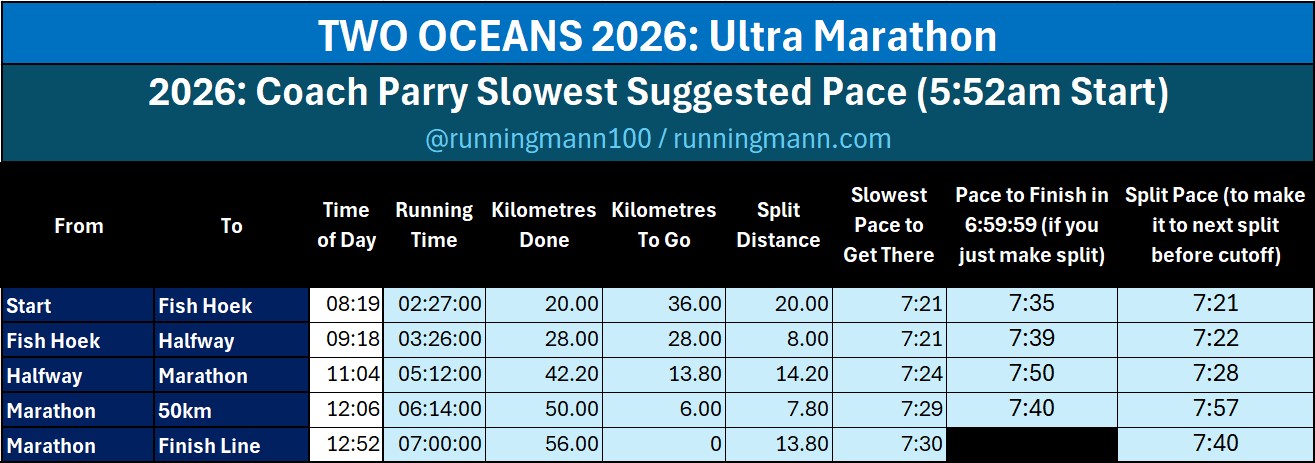
I’ve stressed that cutoffs are not for pacing but to open the roads again. As a point of comparison I asked Lindsey Parry from Coach Parry for his ‘last chance saloon’ slowest pace to sneak in for a Blue medal. From the Coach Parry pacing bands, below is the suggested pacing if you are in the last batch and want to sneak in for a Blue medal. To state the obvious, you will notice that the running time at each split is substantially quicker than the cutoff times above.
Half marathon cutoffs
This year there are two cutoffs along the half marathon route, the first is just before the halfway mark and the second is at 15.5km. As with the ultra cutoffs, their purpose is to reopen the roads to regular traffic and not for pacing.

The half marathon is a very different event to the ultra, allowing a much slower average pace of just under 10 minutes per kilometre to finish under 3h30 and earn a medal. However, the same principle has been applied, where cutoffs have been set such that you would need to run a substantially faster average pace from that point to the finish than the pace you ran to get there if you make a cutoff with a second to spare.
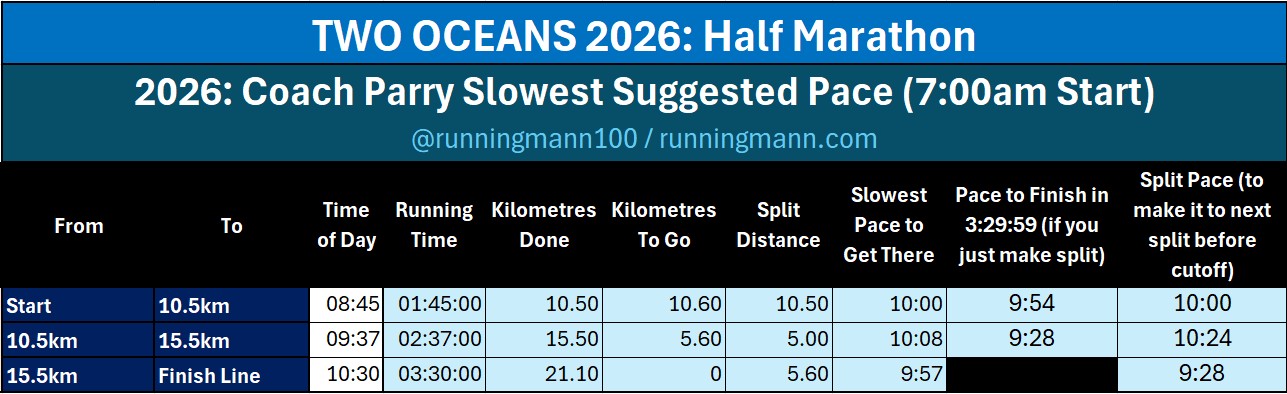
This places everyone’s destiny in their own hands (or should that be legs?). As for what Coach Parry recommends, here his slowest suggested pace to start in the last batch and finish before the final cutoff.
Bailer / Sweep buses
There have been some horror stories from those who’ve had to hop on the bailer buses in the past including being dropped off at the Baxter on main road Rondebosch after riding on a bus with no water and then having to walk several kilometres to upper campus to try and find one’s frantic family at the finish.
A great deal of attention has been paid to ensure that bailer buses are well organised in 2026. This includes:
- There are timing mats at all cut-off points.
- When runners board a sweep bus, their race bibs will be scanned. This data feeds live and links each runner to the bus number. All buses are tracked.
- Two of the four ultra cut-offs are located at waterpoints. The halfway mark and Rhodes Drive cut-offs are nearby but not directly at a waterpoint, due to logistical constraints with Coke trucks, buses, and available space.
- A medic will be present at each cut-off.
- Each bus will have a dedicated manager on board, equipped with water and blankets, and responsible for instructing the driver on a direct route back to UCT.
- The drop-off point at UCT is Upper Campus North Stop (next to P6), a short walk to the main field.
I really hope that no one reading this article winds up on a bailer bus but, if you do so, at least you know you’ll be well taken care of.
Follow Running Mann:


In 2023 I did my first 21km and was doing it as a social runner with my personal reasons to finish within the 3h30min cutoff. However along the route I hear other runners say the cutoff was 3 hours which stressed me out. End result I came in under 3h30 but was denied a finish result. No confirmation was given as to why the cutoff was 3h00 in 2023?
The cutoff time for the half has changed over the years. I think the main reason in recent years has been pressure to open the roads.
Is there a cut off time at the 18K mark for the half marathon? And If I am in X seeding what would be my latest time to be at the said mark?
There’s no 18km cutoff in the half marathon, only those listed in the article.
“No one has written more about cutoffs than I have.”
Love it!
You left out “Everybody says so” and “One Big Beautiful Cutoff”.
Great article Running Mann.
*Firstly*:
How are the people working at the different cut-off points going to know who should be cut and who shouldn’t. They can’t work out everyone’s time based on the time they started?
*Secondly*:
Isn’t it possible that the Two Oceans date could be changed back to the Easter weekend, or at least during the April school holidays? It’s so difficult for the people in the other provinces, who live far from Cape Town to organize everything to run Two Oceans at a normal weekend.
1. The in-race cutoff times are time of day (not running time). However, they have been calculated to be fair to the last batch.
2. Very unlikely unfortunately as the date was changed on request of the City of Cape Town. A lot of emergency staff, etc. are on leave over the Easter weekend which poses a risk to the event.
“…. then we’ll spare their legs further torment and provide a taxi to the finish.”
This is very kind and thoghtful of you.
I did my 1 and only 56 in 2011, made every cutoff by less than 2 minutes finished in 6:58:59 , lost count of the number of times I heard marshalls say “these are the last , we will open the roads very soon”… all cutoffs were at 7:30 pace… too scared to go back ….
I love the evidence-based decision making and planning rather than thumb-sucking. Thanks for pursuing thus issue until management of TOM and Comrades saw the light. Two heads are often better than one.